Nursery Industry Statistics 2026, and How to Cite HortOS
The two kinds of nursery industry number, the official count and the live supply picture, for New Zealand: the Stats NZ enterprise series, the industry body's members, growers listed on HortOS by region and town, the natives listed by the most growers, why no medians exist yet, and how to cite HortOS and the Index.
Updated 25 September 2026. Figures from the live nz.hortosapp.com pages on 24 September 2026 and Stats NZ's business demography as published by Figure.NZ; refreshed with the first New Zealand edition of the HortOS Plant Price Index.

On this page
Anyone who searches for nursery industry statistics in New Zealand finds two kinds of number and rarely knows which is which. The first is the official count: how many businesses Stats NZ records in nursery production, and what the industry body says its members grow. The second is the live supply picture: which growers publish an availability list this month, where they are, and what is on it. The idea that matters most is that the two answer different questions, that both are citable, and that a writer, a student or a library guide should say which one a figure comes from.
This page gives both for New Zealand. The official figures are Stats NZ's business demography count of enterprises in outdoor nursery production, as published by Figure.NZ, and New Zealand Plant Producers Incorporated's description of the industry it represents. The supply figures are what HortOS, a free directory of New Zealand wholesale plant growers with their published availability and trade prices, printed on 24 September 2026: growers listed by region, the towns where they cluster, and the native plants listed by the most growers. It ends with how to cite those figures now and what the first New Zealand edition of the HortOS Plant Price Index will add.
Quick facts
| Businesses | Stats NZ's business demography counted 342 enterprises in the outdoor nursery production industry in February 2024, down from 1,083 in 2003 and 264 in 2021 (Figure.NZ, from Stats NZ). |
|---|---|
| The industry body | New Zealand Plant Producers Incorporated describes its members as the nursery businesses that propagate and grow seedlings and rootstock for revegetation and ecology, food and wine, homes and gardens, and public amenity plantings. |
| Growers listed | More than 1,100 New Zealand growers on HortOS. By region on 24 September 2026: Auckland 190, Canterbury 155, Waikato 129, Bay of Plenty 116, Northland 96, Manawatū-Whanganui 75, Otago 68, Wellington 65, Hawke's Bay 59, Tasman 49. |
| What is grown | The natives listed by the most growers: cabbage tree 38, mountain flax 35, mountain ribbonwood and tōtara 33 each, harakeke 31, kahikatea, kōwhai and Carex secta 26 each. |
| Prices | Each grower's own published price sits beside its line; no New Zealand medians are published yet, because a median needs several growers pricing the same grade on trade lists. |
| How to cite | A live page by its URL and the date it was read; the first New Zealand edition of the HortOS Plant Price Index, when it publishes, by edition and link. |
Two kinds of number
Stats NZ's business demography statistics count enterprises by industry each February, and Figure.NZ publishes the series for outdoor nursery production: 993 enterprises in 2001, a peak of 1,083 in 2003, 690 in 2010, 318 in 2015, a low of 264 in 2021, then 336 in 2023 and 342 in 2024. Figure.NZ notes that the series moved to the Business Register as its source from 2016, so the early and late years are not strictly comparable, and an enterprise count is not a count of nurseries with stock for sale. New Zealand Plant Producers Incorporated, the industry body, describes its members as the nursery businesses that propagate and grow seedlings and rootstock for revegetation and ecology, food and wine, homes and gardens, and public amenity plantings, and runs Plant Pass, the nursery production standard for plant health and biosecurity, with a register of certified producers.
HortOS measures something else: not how many businesses exist but which growers offer what, this month. Its directory lists more than 1,100 New Zealand growers, its regional hubs list them by town, and its plant pages show every grower holding a plant, by region and grade, with the date each list was updated. It is not a census and it is not retail pricing; it is what the wholesale trade could see if it looked at every published list at once.
Growers listed, by region
The regional hubs list the growers in the directory by town. On 24 September 2026 they printed Auckland 190, Canterbury 155, Waikato 129, Bay of Plenty 116, Northland 96, Manawatū-Whanganui 75, Otago 68, Wellington 65, Hawke's Bay 59 and Tasman 49, with the smaller regions behind them. A directory count is not a Stats NZ count: the enterprise series counts businesses in an industry code, and HortOS lists wholesale production nurseries with a page, so the two should never be added or compared as if they measured the same thing.
What is grown
New Zealand's lists are the most native in the four countries HortOS covers. Compiled from growers' current lists in September 2026 and classified by species, 90 of the 100 most listed plants are New Zealand natives. On the live plant pages on 24 September 2026 the natives listed by the most growers were cabbage tree (Cordyline australis) with 38, mountain flax (Phormium cookianum) with 35, mountain ribbonwood (Plagianthus regius) and tōtara (Podocarpus totara) with 33 each, harakeke (Phormium tenax) with 31, kahikatea (Dacrycarpus dacrydioides), kōwhai (Sophora microphylla) and Carex secta with 26 each, Carex virgata and mānuka (Leptospermum scoparium) with 27 each, lancewood (Pseudopanax crassifolius) with 24, and silver tussock (Poa cita) and oioi (Apodasmia similis) with 23 each. Every one of those plant pages lists cells or root trainers, planter bags and a litre pot, which is the revegetation ladder the buying guide explains.
What it costs
HortOS shows each New Zealand grower's own published price beside its line, ex GST, and the plant pages print the lowest price on any list; the cabbage tree page opened at $1.00 ex GST on 24 September 2026. It does not yet publish New Zealand medians, because a median needs several growers pricing the same grade on trade lists and the first New Zealand edition of the HortOS Plant Price Index is still being prepared. When it publishes it will carry, as the Australian edition does, a median at each grade, a range across growers and a regional comparison, and this page will be refreshed with it.
How to cite HortOS now, and the Index when it comes
Until the New Zealand edition publishes, every New Zealand figure on HortOS is a live figure that moves as lists arrive, so it should be cited the way a live database is: the page, its URL and the date it was read. A plant page carries the number of growers listing the plant, by region and grade, and the date each list was updated, and both belong in a careful citation. The Australian Index shows what the New Zealand edition will offer: a monthly page with a fixed edition, a cite line (HortOS Plant Price Index, the edition, the page URL), tables and charts reproducible with attribution and a link, and a JSON data file at a URL that names the edition, with the page's dataset metadata declaring a Creative Commons Attribution 4.0 licence, whose deed allows sharing and adapting the material for any purpose provided appropriate credit is given, a link to the licence is provided and changes are indicated.
What to watch for
- Mixing the two kinds of number. Growers listed on HortOS and enterprises counted by Stats NZ are different populations counted different ways.
- Quoting without the date. A live count moves as lists arrive; a figure from a plant page carries the date it was read.
- Reading a directory count as a census. A regional hub's count is of growers with a page, and it changes as growers are added or removed.
- Reading a grower's price as the market. Until medians exist, a New Zealand price on HortOS is one grower's price on one day.
- Adding up what is not there. HortOS publishes no count of availability lists and no grower's price beside an aggregate; a figure of that kind did not come from it.
Getting it right
- For the number of nursery businesses, cite Stats NZ's business demography series, with the year and its caveat about the change of source.
- For what the industry grows and who its members are, cite New Zealand Plant Producers Incorporated.
- For growers by region and town and the plants listed, cite the HortOS page by URL with the date it was read.
- When the New Zealand edition of the Index publishes, cite it by edition and link, and reproduce its tables with the credit line.
A word of caution
The HortOS figures on this page are what the live pages printed on one date and will differ on another; the first New Zealand edition of the Index will fix them to a month. The enterprise series is Stats NZ's, quoted from Figure.NZ, and Stats NZ is the authority on what it counts. Neither is a count of nurseries with stock for sale in any other sense than its own. A citation that names its source and its date is the only kind that survives the next release.
Sources
- Figure.NZ, businesses in the nursery production industry (outdoors): the Stats NZ enterprise series.
- New Zealand Plant Producers Incorporated: the industry body and its members.
- Plant Pass: the nursery biosecurity standard and register.
- Creative Commons, Attribution 4.0 International deed: what the Index's licence allows.
More guides
Buying From a Wholesale Grower When You Are Not in the Trade
Catchment groups, schools, trusts and landowners can buy from New Zealand wholesale growers when they order like the trade: in quantity, a season ahead, on the grower's terms. This page explains who sells to whom, what an NZBN and GST change, grades from root trainers to PB bags, eco-sourcing and proof of it, lead times and Plant Pass.
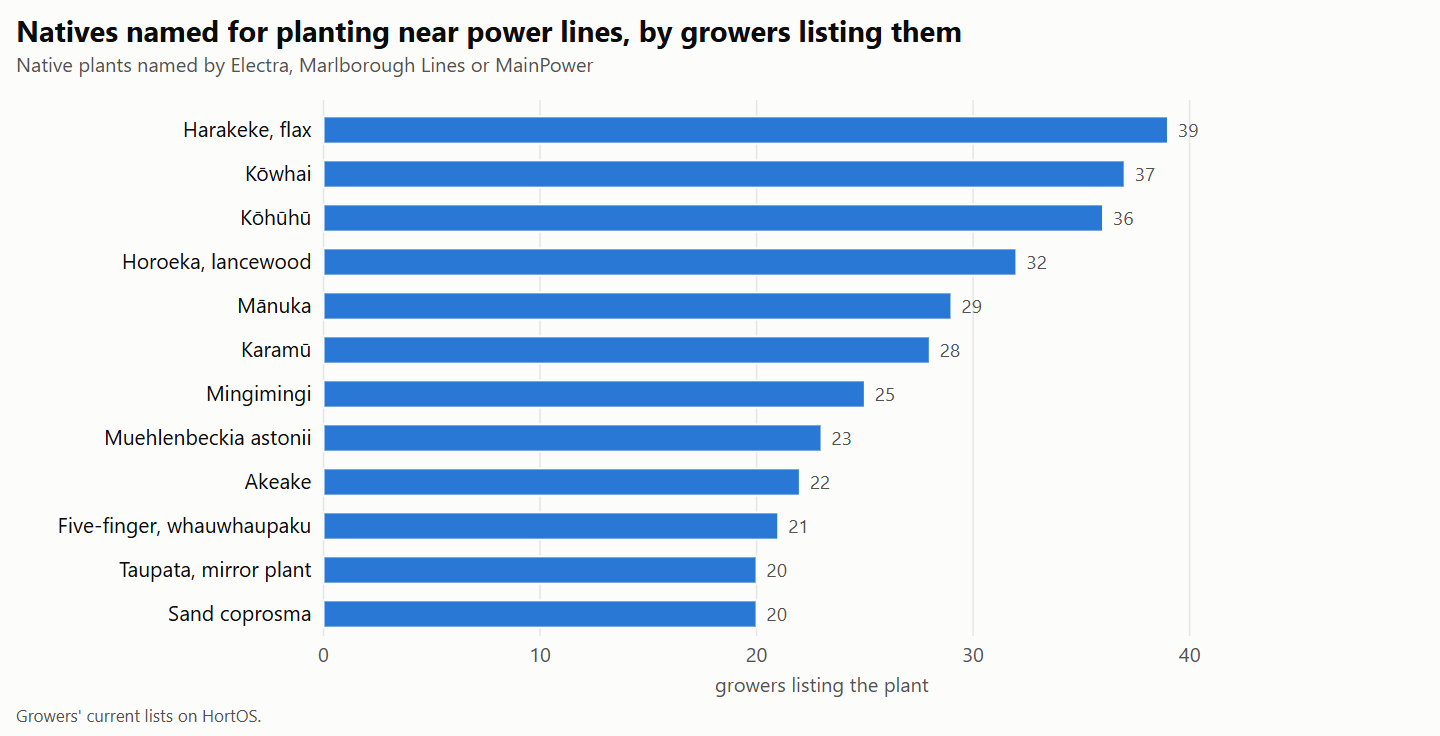
Trees and shrubs for planting near power lines, and who lists them
The zones New Zealand's Electricity (Hazards from Trees) Regulations 2003 set around power lines, and the dates in 2026, 2027 and 2028 on which the latest changes take effect. The page sets beside them what seven lines companies publish about planting height and the native plants three of them name, with the growers listing each plant by region.
Choosing Plants for a Nature Centre or Demonstration Garden
A demonstration garden should show plants visitors can find, buy and grow, at a standard of care a home can manage. This page covers choosing themes, choosing plants growers list in numbers, labels and interpretation, care at the visitor's scale, and the records that keep the garden useful.