Trees and shrubs for planting near power lines, and who lists them
The zones New Zealand's Electricity (Hazards from Trees) Regulations 2003 set around power lines, and the dates in 2026, 2027 and 2028 on which the latest changes take effect. The page sets beside them what seven lines companies publish about planting height and the native plants three of them name, with the growers listing each plant by region.
Updated 17 October 2026. Grower counts are what the live nz.hortosapp.com plant pages printed; medians are not published for most New Zealand plants yet.
On this page
- Quick facts
- The zones the Regulations draw around a line
- Mature height and growth rate inside the Regulations
- What seven lines companies publish about height
- The natives three lines companies name, and the growers listing them
- What a grower count cannot say about a line or a plant
- What to watch for
- Getting it right
- A word of caution
- Sources
A landowner with an 11 kV line on a rural boundary asks what can be planted near it and where growers list those plants. The answer starts with mature height. Regulation 11J of New Zealand's Electricity (Hazards from Trees) Regulations 2003, as at 23 July 2026, tests a new tree's mature height against its distance from a line, within 24 metres of lines on unforested land outside urban areas. Regulation 11J(3) (New Zealand, 2003, as at 23 July 2026) says owners and occupiers need not comply before 23 July 2027.
This page reports the Regulations as at 23 July 2026 and the three dates on which their latest changes take effect. It sets beside them what seven lines companies publish about height, with one statement each from WorkSafe New Zealand and the Department of Conservation. HortOS, a free directory of New Zealand wholesale plant growers with their published availability and trade prices, adds how many growers list the native plants three of those companies name, and in which regions. It is not advice on any work near a line.
Quick facts
| Growth limit zone, urban lines | Schedule 2, clause 1 of the Electricity (Hazards from Trees) Regulations 2003 (New Zealand, as at 23 July 2026) covers a line of 11 kV or less in an urban area, with a span of 150 m or less. Under that clause the zone reaches 0.5 m from a 400/230 volt conductor and 1.6 m from an 11 kV conductor. Those distances are for a conductor that is not aerial bundled or insulated by other means. |
|---|---|
| Growth limit zone, other lines | Schedule 2, clause 2 of the Electricity (Hazards from Trees) Regulations 2003 (New Zealand, as at 23 July 2026) covers an uninsulated line outside an urban area, or above 11 kV, with a span of 150 m or less. It gives 0.5 m at 400/230 V, 1.6 m at 11 kV, 2.5 m at 33 kV, 3.0 m at 50 to 66 kV and 4.0 m at 66 kV or more, and adds the space above the conductor. For a protected tree (regulation 4: one "that is subject to clearance or pruning restrictions under a district plan"), Schedule 2, clause 2 (New Zealand, 2003, as at 23 July 2026) stops the space above at the specified distance. Schedule 2, clause 3 (New Zealand, 2003, as at 23 July 2026) sets its own distances for a span of more than 150 m, from 4.0 m to 50.0 m to the side of the conductor. |
| From 17 October 2026 | Schedule 1, clause 11 of the Electricity (Hazards from Trees) Regulations 2003 (New Zealand, as at 23 July 2026) applies only "until the close of 16 October 2026". Up to that date no cut or trim notice is required for a tree inside the amended growth limit zone of a "specified low voltage conductor", where the tree is outside the former zone. That term takes in only some lines of 11 kV or less. From 17 October 2026 that hold no longer applies. |
| From 23 July 2027 | Regulation 11J of the Electricity (Hazards from Trees) Regulations 2003 (New Zealand, as at 23 July 2026) limits planting in the low-height planting zone, and regulation 11J(3) says owners and occupiers need not comply before 23 July 2027. Regulation 4 (New Zealand, 2003, as at 23 July 2026) sets that zone at no more than 24 metres, measured horizontally, from the line of a conductor on unforested land outside urban areas. Regulation 11J was inserted on 23 July 2026 by the Electricity (Hazards from Trees) Amendment Regulations 2026 (SL 2026/189). |
| From 23 July 2028 | Schedule 1, clause 15 of the Electricity (Hazards from Trees) Regulations 2003 (New Zealand, as at 23 July 2026) bars a treefall hazard notice from being given before 23 July 2028. Regulation 4 (New Zealand, 2003, as at 23 July 2026) sets the treefall hazard zone at no more than 24 metres, measured horizontally, beyond the growth limit zone. |
| Growers listing the named natives | The table of natives on this page has 37 rows, drawn from Electra's native list, the native groups of Marlborough Lines' guidelines and MainPower's native examples. The growers listing them on HortOS, in any size, ran from 37 for kōwhai (Sophora microphylla) to 3 for rangiora (Brachyglottis repanda). |
The zones the Regulations draw around a line
Regulation 4 of the Regulations (New Zealand, 2003, as at 23 July 2026) says a tree "includes any tree, shrub, or plant", so a flax or a toetoe counts. The Regulations (New Zealand, 2003, as at 23 July 2026) call the owner of a line the "works owner"; this page also says lines company.
The growth limit zone is the inner zone, and Quick facts gives its size by voltage. Regulation 8(2) (New Zealand, 2003, as at 23 July 2026) requires a works owner that "becomes aware" of a tree encroaching that zone to give the owner of the tree a cut or trim notice.
The other zones are measured from the growth limit zone or from the line. The table sets out each one as the Regulations (New Zealand, 2003, as at 23 July 2026) define it, with what they attach to it and where it is set.
| Zone | Size in the Regulations | What the Regulations attach to it | Where it is set |
|---|---|---|---|
| Cut-back zone | No more than 1 m beyond the growth limit zone | The tree named in a cut or trim notice has to be cut until it is clear of this zone | Regulations 4 and 10 |
| Hazard warning notice zone | No more than 2 m beyond the growth limit zone | A hazard warning notice may be given for a tree in this zone that is not yet in the growth limit zone | Regulations 4 and 6 |
| Treefall hazard zone | No more than 24 m, measured horizontally, beyond the growth limit zone | A tree assessed as a high or moderate treefall hazard may be the subject of a treefall hazard notice; none may be given before 23 July 2028 | Regulations 4 and 11A; Schedule 1, clause 15 |
| Low-height planting zone | No more than 24 m, measured horizontally, from the line of a conductor, where the land is unforested and outside an urban area | Planting is limited by regulation 11J, which owners and occupiers need not comply with before 23 July 2027 | Regulations 4 and 11J |
Which sizes apply depends partly on zoning. Regulation 4 (New Zealand, 2003, as at 23 July 2026) defines an urban area by the zoning of a district plan, or of a proposed one. That definition takes in land zoned mainly residential, industrial or commercial with the neighbouring special-purpose and open-space zones, and not land zoned mainly rural or rural-residential. Powerco (North Island, read 2026) sends an owner who is unsure to the district plan or the local council.
Three dates follow from the amendments made on 23 July 2026.
- From 17 October 2026. Schedule 1, clause 11 (New Zealand, 2003, as at 23 July 2026) applies only "until the close of 16 October 2026", and Quick facts sets out the notices it holds back up to then. Marlborough Lines (Marlborough, read 2026) calls the space above a line "clear to the sky", a phrase the Regulations do not use, and dates it from 17 October 2026 for lines of 11 kV or less outside urban areas.
- From 23 July 2027. Regulation 11J(3) (New Zealand, 2003, as at 23 July 2026) says an owner or occupier of land "is not required to comply with this regulation before 23 July 2027".
- From 23 July 2028. Schedule 1, clause 15 (New Zealand, 2003, as at 23 July 2026) bars a treefall hazard notice from being given before 23 July 2028.
Mature height and growth rate inside the Regulations
Regulation 11J(1)(a) (New Zealand, 2003, as at 23 July 2026) allows planting in the low-height planting zone where the owner or occupier has "reasonable grounds to believe" the mature tree will be shorter than its fall distance. Regulation 11J(2) (New Zealand, 2003, as at 23 July 2026) defines fall distance as the distance from the foot of the tree, at ground level, to the closest point on a vertical plane through the conductor.
Regulation 11J(1)(b) (New Zealand, 2003, as at 23 July 2026) also allows a tree that belongs to a shelter belt. Regulation 11J(1)(c) (New Zealand, 2003, as at 23 July 2026) allows planting on land managed under the Conservation Act 1987, or under an Act in that Act's Schedule 1 that regulates the use of land. Regulation 4 (New Zealand, 2003, as at 23 July 2026) defines a shelter belt as one or more rows of trees that are planted to shield arable, pastoral or horticultural land from the weather.
The guidance note to regulation 11J (New Zealand, 2003, as at 23 July 2026) reads: "It is not an offence against these regulations for a person to contravene this regulation." The consequences sit elsewhere in the Regulations. Under regulation 11(2A) (New Zealand, 2003, as at 23 July 2026) the works owner need not pay for the first cut or trim of a tree in the zone planted against regulation 11J from 23 July 2027, or self-sown. Regulations 14A and 18A (New Zealand, 2003, as at 23 July 2026) shut out the no-interest tree notice and the dispensation for a tree planted against regulation 11J on or after 23 July 2027.
Growth rate and species have their own places. Regulation 10(2)(a) (New Zealand, 2003, as at 23 July 2026) sets the time to act on a cut or trim notice that arrives within 3 months of a hazard warning notice. Under regulation 10(2)(a) (New Zealand, 2003, as at 23 July 2026) it is 10 working days where the tree can grow a metre or more in a month in the local climate, and 25 working days where it cannot. Under regulation 20(2) (New Zealand, 2003, as at 23 July 2026) a works owner has to give a dispensation once satisfied that a tree's species, age or location makes contact with, serious hazard to, or damage to a conductor unlikely.
What seven lines companies publish about height
The zones are the Regulations'. Plant names and heights come from lines companies, each writing for its own network. The table gives a row to each of seven lines companies whose pages were read for this page: what each says about height, and the plant list or planting programme it publishes.
| Lines company | What it says about height | Its plant list or planting programme | Source |
|---|---|---|---|
| Electra (Horowhenua and Kāpiti) | Prefers shrubs and dwarf forms; names poplars, gums and willows as fast growers over 6 m to avoid | Native plants and smaller exotic trees, nearly all with a height or a height range | Electra, read 2026 |
| MainPower (North Canterbury) | Asks people not to plant trees near lines and, if they do, to choose with care and think how big the tree will get | Native and exotic examples by name, with no heights; a true dwarf variety is asked for cypress and thuja | MainPower, read 2026 |
| Marlborough Lines | Says height is an important consideration and that the right species depends on the area planted | Plants in height groups: 3 m or less, native small trees of 2 to 4 m, and native shrubs of 1 to 2 m | Marlborough Lines, 2012 |
| Wellington Electricity | Notes that a listed plant may still need trimming where growing conditions are especially good | Native and exotic plants, each with a mature height, from 40 cm to 4.5 m | Wellington Electricity, read 2026 |
| Aurora Energy (Otago) | Low-growing species under 4 m; directly under a line, a mature height 2 m lower than the line | Native and exotic plants, each with a mature height, from 0.5 m to 3.5 m | Aurora Energy, read 2026 |
| Powerco | Explains the low-height planting rule from 23 July 2027: no planting of a tree whose expected mature height is more than its distance from the line | Its Replant for Tomorrow programme, begun in 2020, plants native trees with local organisations | Powerco, read 2026 |
| WEL Networks | Asks people to think about where a tree goes and how tall it gets; for vines and creepers, one course it gives is to do without them | Says plants that suit its region can be found for shelter belts and for single trees near lines | WEL Networks, read 2026 |
The companies that publish plant names set conditions beside them. Electra (Horowhenua and Kāpiti, read 2026) says smaller trees and shrubs mean lower safety risk and lower maintenance cost, and adds that a tree can end up taller than the mature height expected of it. MainPower (North Canterbury, read 2026) asks people to avoid planting trees near power lines and, where they do plant, to choose selectively with the tree's eventual size in mind. Wellington Electricity (Wellington, read 2026) says the plants in its guide generally suit sites near power lines, yet some may still need trimming where growing conditions are especially favourable.
The natives three lines companies name, and the growers listing them
The next table holds native plants that Electra (Horowhenua and Kāpiti, read 2026), Marlborough Lines (Marlborough, April 2012) and MainPower (North Canterbury, read 2026) name for planting near power lines. It shows every plant on Electra's native list, in the native small tree and native shrub groups of Marlborough Lines' guidelines, or among MainPower's native examples, that has a plant page on HortOS under the name the company prints. A plant named in more than one of those places is shown once, under the first of Electra, Marlborough Lines and MainPower. From Marlborough Lines' guidelines the table draws on those two native groups alone. That gives 37 rows, in order of growers listing them, and 4 named natives are not shown; the companies' own pages are linked under Sources.
The second and third columns are the company's own. HortOS states no height. Grower counts are the growers listing each plant on HortOS, in any size. Each row's count is for the plant page under the botanical name it prints. A count here is growers listing the plant, not how many plants exist or how well it suits a site. Median trade prices are not published for most New Zealand plants yet.
| Plant | Lines company list naming it | Mature height on that list | Growers listing it | Regions with most growers |
|---|---|---|---|---|
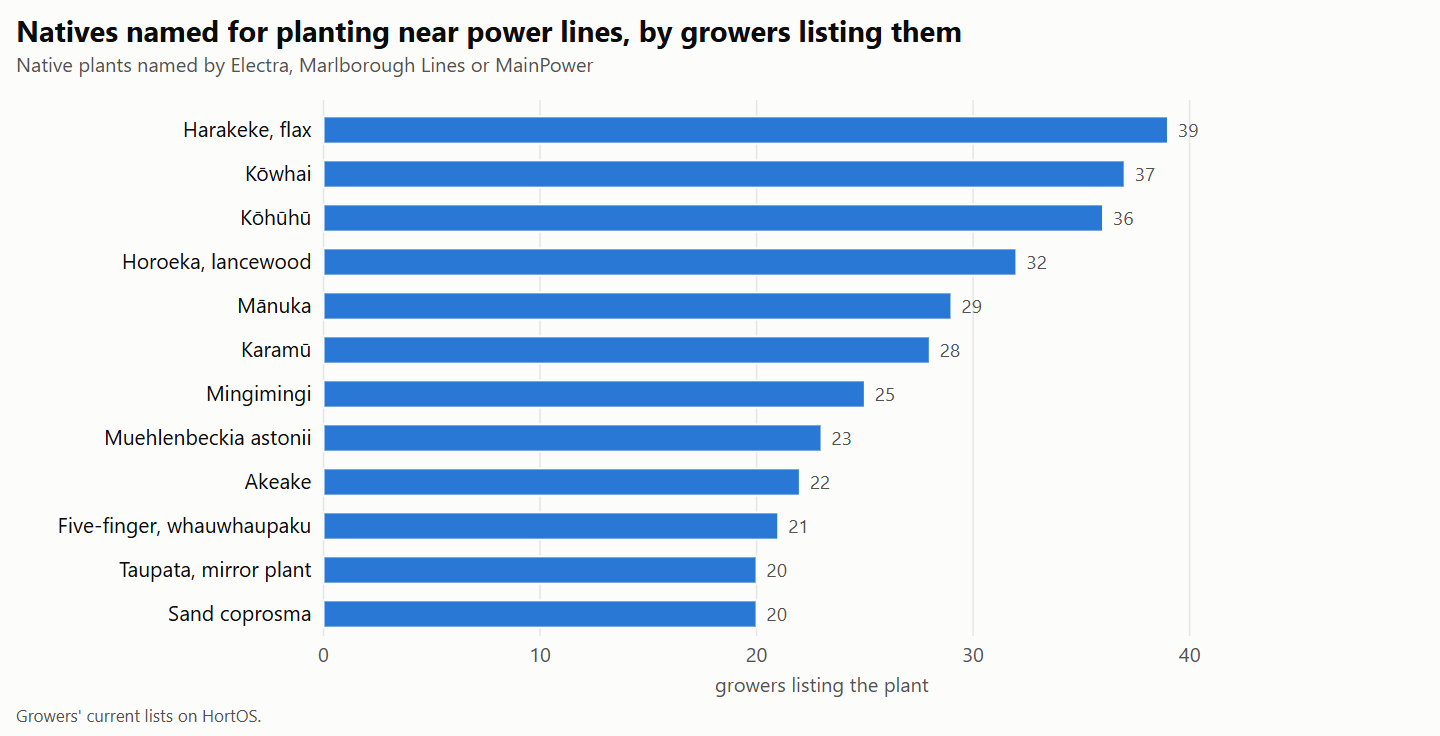
| Harakeke, flax (Phormium tenax) | MainPower (read 2026) | No height given | 39 | Auckland 8, Waikato 7, Northland 5 |
| Kōwhai (Sophora microphylla) | Electra (read 2026) | 6 to 8 m | 37 | Tasman 6, Auckland 5, Waikato 5 |
| Kōhūhū (Pittosporum tenuifolium) | MainPower (read 2026) | No height given | 36 | Auckland 5 |
| Horoeka, lancewood (Pseudopanax crassifolius) | MainPower (read 2026) | No height given | 32 | Auckland 5, Tasman 4, Northland 4 |
| Mānuka (Leptospermum scoparium) | MainPower (read 2026) | No height given | 29 | Auckland 6, Waikato 4 |
| Karamū (Coprosma robusta) | Marlborough Lines (2012) | 2 to 4 m (small trees) | 28 | Waikato 5, Northland 5 |
| Mingimingi (Coprosma propinqua) | Marlborough Lines (2012) | 2 to 4 m (small trees) | 25 | Waikato 4, Auckland 3, Canterbury 3 |
| Muehlenbeckia astonii | Marlborough Lines (2012) | 1 to 2 m (shrubs) | 23 | Northland 6, Auckland 5, Tasman 3 |
| Akeake (Dodonaea viscosa) | Electra (read 2026) | 3 to 7 m | 22 | Northland 4 |
| Five-finger, whauwhaupaku (Pseudopanax arboreus) | MainPower (read 2026) | No height given | 21 | Northland 4, Canterbury 4 |
| Taupata, mirror plant (Coprosma repens) | Electra (read 2026) | About 3 m | 20 | Tasman 4, Auckland 3 |
| Sand coprosma (Coprosma acerosa) | Marlborough Lines (2012) | 1 to 2 m (shrubs) | 20 | Auckland 4, Wellington 3 |
| Red māpou (Myrsine australis) | Electra (read 2026) | 3 to 6 m | 17 | Northland 3, Auckland 3 |
| Korokio (Corokia cotoneaster) | Marlborough Lines (2012) | 1 to 2 m (shrubs) | 13 | 5 regions with 2 each |
| Koromiko (Hebe stricta) | Marlborough Lines (2012) | 1 to 2 m (shrubs) | 13 | Northland 4, Waikato 2, Auckland 2 |
| Kōtukutuku, tree fuchsia (Fuchsia excorticata) | MainPower (read 2026) | No height given | 13 | 5 regions with 2 each |
| Coprosma virescens | Marlborough Lines (2012) | 2 to 4 m (small trees) | 11 | Wellington 3 |
| Marlborough rock daisy (Pachystegia insignis) | Marlborough Lines (2012) | 1 to 2 m (shrubs) | 11 | Wellington 3, Otago 2 |
| Hebe | Electra (read 2026) | Up to 7 m | 10 | Canterbury 3, Northland 2 |
| Coprosma rhamnoides | Marlborough Lines (2012) | 2 to 4 m (small trees) | 10 | Tasman 2, Taranaki 2 |
| Dwarf kōwhai (Sophora prostrata) | Marlborough Lines (2012) | 1 to 2 m (shrubs) | 10 | Canterbury 4 |
| Shining karamū (Coprosma lucida) | Marlborough Lines (2012) | 2 to 4 m (small trees) | 9 | Canterbury 2, Wellington 2 |
| Lophomyrtus obcordata | Marlborough Lines (2012) | 2 to 4 m (small trees) | 8 | Canterbury 3 |
| Weeping matipo (Myrsine divaricata) | Marlborough Lines (2012) | 2 to 4 m (small trees) | 8 | Canterbury 3 |
| Kawakawa (Macropiper excelsum) | Electra (read 2026) | 2 to 3 m | 7 | Auckland 2, Northland 2 |
| Coprosma crassifolia | Marlborough Lines (2012) | 2 to 4 m (small trees) | 7 | Canterbury 2 |
| Brachyglottis monroi | Marlborough Lines (2012) | 1 to 2 m (shrubs) | 6 | Tasman 3, Canterbury 2, West Coast 1 |
| Small-leaved tree daisy (Olearia lineata) | MainPower (read 2026) | No height given | 6 | Canterbury 3, Otago 2, Southland 1 |
| Ralph's karo (Pittosporum ralphii) | Electra (read 2026) | 4 to 6 m | 4 | Hawke's Bay 2, Manawatū-Whanganui 1, Tasman 1 |
| Weeping tree broom (Carmichaelia stevensonii) | Marlborough Lines (2012) | 2 to 4 m (small trees) | 4 | Tasman 2, Otago 1, Canterbury 1 |
| Tree hebe (Hebe parviflora) | Marlborough Lines (2012) | 2 to 4 m (small trees) | 4 | Bay of Plenty 2, Northland 1, Tasman 1 |
| Koromiko (Hebe salicifolia) | Marlborough Lines (2012) | 1 to 2 m (shrubs) | 4 | Canterbury 2, Otago 1, Wellington 1 |
| Rangiora (Brachyglottis repanda) | Marlborough Lines (2012) | 1 to 2 m (shrubs) | 3 | Wellington 1, Hawke's Bay 1, Tasman 1 |
| Toetoe (Cortaderia richardii) | Marlborough Lines (2012) | 1 to 2 m (shrubs) | 3 | Tasman 1, Northland 1, Otago 1 |
| Teucridium parvifolium | Marlborough Lines (2012) | 1 to 2 m (shrubs) | 3 | Otago 1, Hawke's Bay 1, Canterbury 1 |
| Kōwhai (Sophora molloyi 'Dragon's Gold') | Electra (read 2026) | 2 to 3 m | 1 | Canterbury 1 |
| Porcupine shrub (Melicytus 'Waipapa') | Marlborough Lines (2012) | 1 to 2 m (shrubs) | 1 | Tasman 1 |
The last column names the regions with the most growers listing each plant, three at most, and stops where regions tie for the next place.
The height column holds three kinds of entry. Electra (Horowhenua and Kāpiti, read 2026) gives each native a height or a range of its own. Marlborough Lines' guidelines (Marlborough, April 2012) sort natives into small trees of 2 to 4 metres and shrubs of 1 to 2 metres, so a row carries its group's band, not a height for that plant. MainPower's fact sheet (North Canterbury, read 2026) gives no heights, calls its plants examples and recommends asking a plant nursery which species suit the area.
The companies differ on the same plant. Kawakawa is 2 to 3 m on the list of Electra (Horowhenua and Kāpiti, read 2026) and sits among the shrubs of 1 to 2 metres in Marlborough Lines' guidelines (Marlborough, April 2012). Nor is there one ceiling. Aurora Energy (Otago, read 2026) points to low-growing species under 4 metres. Electra's native list (Horowhenua and Kāpiti, read 2026) gives kōwhai 6 to 8 m, hebe up to 7 m and akeake 3 to 7 m.
The Hebe row is the genus, because Electra (Horowhenua and Kāpiti, read 2026) gives hebe as a group. Its count is growers listing a hebe under the genus name alone; three hebe species have rows of their own, and the rows are not to be added together. Toetoe and harakeke are in the table because the companies name them and regulation 4 (New Zealand, 2003, as at 23 July 2026) counts any plant as a tree.
The rows with the most growers were harakeke (39), kōwhai (37), kōhūhū (36) and mānuka (29). At the other end, 2 plants in the table were each listed by a single grower and rangiora by 3, and a count that small shifts as soon as one grower changes a list.
What a grower count cannot say about a line or a plant
A count says who lists a plant. It does not say how tall that plant will grow on a given site, or whether the plant listed is the compact form a lines company has in mind. That question goes to the grower: what mature height to expect of the line listed, and whether it is the straight species or a named form. The grower answers, not HortOS.
The directory shows nothing about the power line. Under Schedule 2 and regulation 4 of the Regulations (New Zealand, 2003, as at 23 July 2026), its voltage, span and insulation, whether the land is urban and whether a tree is protected decide which zone sizes apply. The lines company and the council hold those answers.
Each plant list is one company's, written for its own district: Horowhenua and Kāpiti for Electra, Marlborough for Marlborough Lines, North Canterbury for MainPower. The Department of Conservation (New Zealand, read 2026) says of its own selection of native plants for gardens that "not all will grow in every part of the country". The regions column tells where the growers that list a plant are, not where the plant suits. In most rows those regions are not the district the company's list was written for. The hubs for Canterbury, Tasman and Otago, three regions the column names, lead to the growers of each.
The guide on buying from a wholesale grower explains ordering for a buyer outside the trade. Kōwhai, harakeke and kōhūhū appear for another reason in the guide to native plants for tūī, kererū and korimako. The nursery industry statistics guide ranks natives across the whole directory, on its own date; this table ranks only the plants the three companies name.
What to watch for
- Confusing the planting rule with the offence. Regulation 26(1) (New Zealand, 2003, as at 23 July 2026) makes it an offence to fail, without reasonable excuse, to have a tree cut as a cut or trim notice requires. Regulation 26(2) (New Zealand, 2003, as at 23 July 2026) sets the fine on conviction at up to $10,000, and up to $500 more for every day, or part of one, that a continuing offence goes on. By its guidance note, a planting against regulation 11J (New Zealand, 2003, as at 23 July 2026) is not an offence against the Regulations.
- Treating a rural-residential block as urban. Regulation 4 (New Zealand, 2003, as at 23 July 2026) leaves land zoned mainly rural-residential out of the urban area, so the low-height planting zone can apply there.
- Overlooking fast growth. Electra (Horowhenua and Kāpiti, read 2026) names poplars, gums and willows as fast-growing trees over 6 m to avoid.
- Carrying one company's plants to another district. Aurora Energy (Otago, read 2026) sends readers who want native species suited to a place to a local nursery, an arborist or the Otago Regional Council.
- Assuming a self-sown tree is outside the rules. Regulation 11(2A) (New Zealand, 2003, as at 23 July 2026) relieves the works owner of the cost of a first cut or trim where a tree in the low-height planting zone was naturally sown. Powerco (North Island, read 2026) says trees that seed themselves are outside the planting restriction.
Getting it right
- Ask the lines company that owns the line for its voltage and span and whether the conductor is insulated. Under Schedule 2 of the Regulations (New Zealand, 2003, as at 23 July 2026) those set the size of the growth limit zone.
- Check the district plan, or ask the council, whether the land is in an urban area and whether any tree on it is a protected tree.
- For unforested land outside an urban area, within 24 metres of the line, compare the fall distance from the planting spot with the height the plant is expected to reach. That is the comparison regulation 11J(1)(a) (New Zealand, 2003, as at 23 July 2026) makes.
- Read the lines company's own planting page, and note any height it gives and the date on it.
- Open a plant's page from the table for the growers listing it and their regions. Then ask a grower what mature height to expect and whether the line listed is a compact form.
A word of caution
The zones, dates and duties on this page are those of the Electricity (Hazards from Trees) Regulations 2003 (New Zealand) as at 23 July 2026, and the Regulations themselves are the authority. Heights are each lines company's own, read in 2026 or, for Marlborough Lines, dated April 2012. Under regulations 6, 8, 11A and 20 (New Zealand, 2003, as at 23 July 2026) the works owner gives the notices and decides dispensations. Under regulation 4 (New Zealand, 2003, as at 23 July 2026) a district plan, or a proposed one, fixes what is urban, and a district plan fixes which trees are protected. WorkSafe New Zealand (New Zealand, 2025) says arbitration exists for disputes under the Regulations.
Sources
- Electricity (Hazards from Trees) Regulations 2003 (SR 2003/375), version as at 23 July 2026: tree zones, notices, planting rule.
- WorkSafe New Zealand, Electricity (Hazards from Trees) Regulations 2003: WorkSafe's summary, arbitration.
- Electra, Tree safety and planting around power lines: plant list with heights.
- Electra, Our history and our region: the area Electra serves.
- MainPower, Plan before you plant near power lines: planting guidance, network area.
- MainPower, Look up before you plant fact sheet (PDF): native and exotic examples.
- Marlborough Lines, Powerline friendly approved plant guidelines, April 2012 (PDF): plants in height groups.
- Marlborough Lines, Trees and vegetation: tree rules and dates.
- Wellington Electricity, Suitable trees for planting under or near power lines (PDF): plants with mature heights.
- Aurora Energy, Think before you plant: height guidance, plant heights.
- Powerco, Upcoming tree rules: the planting rule explained.
- Powerco, Replant for Tomorrow: native replanting programme.
- WEL Networks, Planting trees: planting, vines and shelter belts.
- Department of Conservation, Attract birds to your garden: native garden plant selection. Source: Department of Conservation, reused under the Creative Commons Attribution 4.0 International licence.
More guides

Buying From a Wholesale Grower When You Are Not in the Trade
Catchment groups, schools, trusts and landowners can buy from New Zealand wholesale growers when they order like the trade: in quantity, a season ahead, on the grower's terms. This page explains who sells to whom, what an NZBN and GST change, grades from root trainers to PB bags, eco-sourcing and proof of it, lead times and Plant Pass.
Native plants that feed tūī, kererū and korimako all year
The Department of Conservation's month by month calendar of native food plants for birds, read for tūī, kererū and korimako and counted to show its full autumn and thin winter, set beside how many New Zealand wholesale growers list the plants shown and in which regions, with what the Department says about eco-sourced plants and cultivars near bush.
Nursery Industry Statistics 2026, and How to Cite HortOS
The two kinds of nursery industry number, the official count and the live supply picture, for New Zealand: the Stats NZ enterprise series, the industry body's members, growers listed on HortOS by region and town, the natives listed by the most growers, why no medians exist yet, and how to cite HortOS and the Index.