Poisonous plant guidance for New Zealand early childhood services
New Zealand's early childhood regulations set a general duty about hazards and name no plant. The plant lists reported here are Landcare Research handouts of 1999 and 2002. This guide reports both, and sets plants that the later handout names beside the growers listing each one on HortOS, with what the lists do not show.
Updated 7 October 2026. Grower counts are what the live nz.hortosapp.com plant pages printed; medians are not published for most New Zealand plants yet.
On this page
The manager of a New Zealand early childhood centre, planning a new garden bed, asks which plants the rules forbid. The regulation read for this guide names no plant: it sets a general duty about hazards, and the plant lists reported here are guidance written by Landcare Research, not law. Landcare Research's 2002 handout for New Zealand says a plant need not be destroyed only because it has poisonous properties.
This page reports regulation 46 of the Education (Early Childhood Services) Regulations 2008 and two Landcare Research handouts, of 1999 and 2002, in the copies held by the Royal New Zealand Institute of Horticulture. It also draws on Manaaki Whenua's publications page and on Te Ara. Beside the handout's own lists it sets grower counts from HortOS, a free directory of New Zealand wholesale plant growers with their published availability and trade prices. It is not a licensing guide, a way to identify a plant or medical advice.
Quick facts
| The regulation | Regulation 46 of New Zealand's Education (Early Childhood Services) Regulations 2008 requires a licensed service provider to take every reasonable step to promote the health and safety of the children enrolled. |
|---|---|
| Hazards | The same regulation 46, in the Education (Early Childhood Services) Regulations 2008, asks for every reasonable step so that premises and facilities are "used safely and kept free from hazards". No plant is named in it. |
| The national handout | Plants in New Zealand Poisonous to Children, by Landcare Research, was written in 1991 and revised in October 2002. It covers the whole country. |
| The pre-school sheet | Landcare Research's Safety in Pre-school Centres sheet for New Zealand, dated 1999, names plants that, on its reading of the literature, do not belong in a pre-school centre. |
| Removal | Landcare Research's 2002 handout for New Zealand says a plant need not be destroyed only for having poisonous properties, and that deaths are extremely rare. |
| Growers | 13 plants that the handout of 2002 names are set beside the growers listing each one on HortOS. HortOS lists more than 1,100 growers that sell plants to the trade. |
A general duty in the regulation, plant lists in the guidance
Regulation 46 of the Education (Early Childhood Services) Regulations 2008 is a health and safety practices standard written in general terms. It requires a licensed service provider to "take all reasonable steps to promote the good health and safety of children enrolled in the service". It asks for the same effort so that premises and facilities are "used safely and kept free from hazards". The regulation names no plant, and the duty it sets rests on the licensed service provider.
The plant lists come from a research institute. Childcare workers asked for it, Landcare Research says of its 2002 handout for New Zealand: they wanted to know which plants might harm a young child who ate them. The handout says it applies to every part of the country and takes the place of the separate North Island and South Island lists of 1999. Manaaki Whenua, the institute's present name, says on its New Zealand publications page, read in 2026, that this single handout replaces the two island handouts.
The rows below are the documents read for this guide, each with what it says and the body that wrote it. They are the documents the guide relies on for a rule or a plant list. Where a row says the same handout, it means Plants in New Zealand Poisonous to Children, the national handout that Landcare Research revised in 2002.
| Document | What it says | Authority and year |
|---|---|---|
| Early childhood regulations, regulation 46 | All reasonable steps so that premises and facilities are used safely and kept clear of hazards; no plant is named | Education (Early Childhood Services) Regulations 2008 |
| Safety in Pre-school Centres sheet | A list of plants the literature suggests keeping out of pre-school centres | Landcare Research, 1999 |
| The same handout, first list | Internal poisons: plants that harm when eaten | Landcare Research, 2002 |
| The same handout, third list | External poisons: plants that irritate skin | Landcare Research, 2002 |
| The same handout, fourth list | Common berried plants described as non-poisonous | Landcare Research, 2002 |
| Manaaki Whenua publications page | The poster and both handouts in one place, free to print and share | Manaaki Whenua, read 2026 |
Manaaki Whenua's New Zealand publications page, read in 2026, lets the handouts be printed and passed on freely, on two conditions: the copyright statement stays intact and nobody is charged for the information. A service may therefore print a copy and keep it.
How the handouts weigh a plant
Neither handout treats every poisonous plant alike. Landcare Research's 1999 pre-school sheet for New Zealand leaves out poisonous plants that are common but have no part likely to attract a young child. The same 1999 sheet says spines and prickles on their own are not considered enough to keep a plant out of a pre-school centre. That 1999 Landcare Research sheet for New Zealand also names oleander among its internal poisons, and it says of yew that what a child is likely to eat is the female tree's berry, whose seed is poisonous.
The 2002 handout puts the risk in proportion. Landcare Research says in that New Zealand handout that most gardens in the country contain poisonous plants and that deaths are extremely rare. Landcare Research's 2002 handout for New Zealand also asks that children be steered away from eating plant material new to them unless an adult is guiding them. The same 2002 Landcare Research handout adds that its lists are not meant for identifying plants, and are not a guide to weediness.
Te Ara, the Encyclopedia of New Zealand, on an undated page read in 2026, says about 75 people a year need hospital treatment for plant and fungal poisoning. That figure covers all ages and fungi as well as plants, so it says nothing direct about early childhood services.
Plants on the handout's lists that growers list
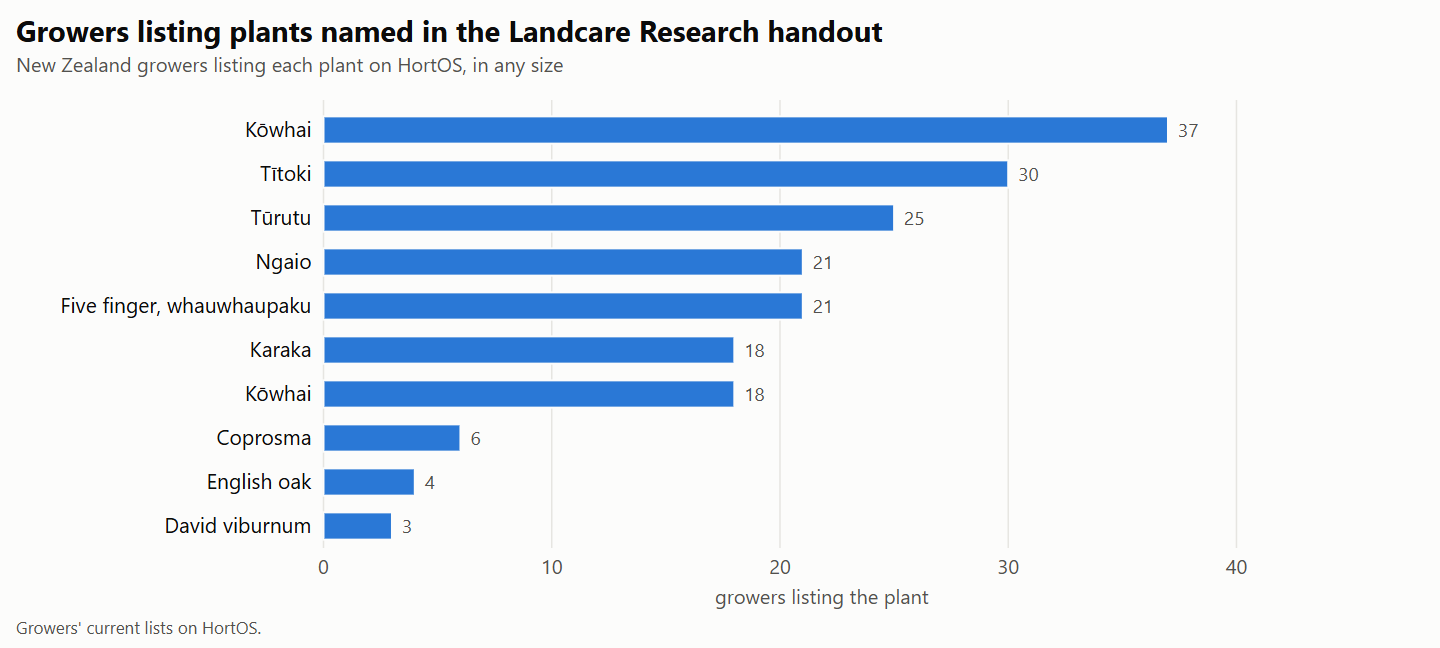
The next table holds plants that the handout of 2002 puts on its internal poisons list or on its list of common berried plants described as non-poisonous. The rows are chosen from the plants on those lists that have a page on this site under the same species or genus name, natives first. That gives 13 rows, 8 from the first list and 5 from the other; plants that met the rule and are not shown: 0. The list names are those of Landcare Research New Zealand Ltd, whose handout this is. Grower counts are the growers listing each plant on HortOS, in any size. Median trade prices are not published for most New Zealand plants yet.
| Plant | Landcare Research handout list (2002) | Growers listing it | Regions with most growers |
|---|---|---|---|
| Karaka (Corynocarpus laevigatus) | Internal poisons list | 18 | Tasman 5, Auckland 5, Northland 3 |
| Kōwhai (Sophora microphylla) | Internal poisons list | 37 | Tasman 6, Auckland 5, Waikato 5 |
| Kōwhai (Sophora tetraptera) | Internal poisons list | 18 | Northland 3 |
| Ngaio (Myoporum laetum) | Internal poisons list | 21 | Northland 5, Tasman 3, Auckland 3 |
| Tītoki (Alectryon excelsus) | Internal poisons list | 30 | Auckland 9, Northland 5, Waikato 4 |
| Five finger, whauwhaupaku (Pseudopanax arboreus) | Internal poisons list | 21 | Northland 4, Canterbury 4 |
| Tūrutu (Dianella nigra) | Internal poisons list | 25 | Auckland 5, Northland 4 |
| Fatsia (Fatsia japonica) | Internal poisons list | 2 | Manawatū-Whanganui 1, Waikato 1 |
| Coprosma | Non-poisonous berried list | 6 | Taranaki 2 |
| Fuchsia | Non-poisonous berried list | 2 | Taranaki 1, Canterbury 1 |
| David viburnum (Viburnum davidii) | Non-poisonous berried list | 3 | Southland 1, Canterbury 1, Tasman 1 |
| Laurustinus (Viburnum tinus) | Non-poisonous berried list | 2 | Southland 1, Otago 1 |
| English oak (Quercus robur) | Non-poisonous berried list | 4 | Tasman 2, Canterbury 1, Manawatū-Whanganui 1 |
The last column names the regions with the most growers listing each plant, three at most, and stops where regions tie for the next place.
A count here is growers listing the plant, not how many plants exist or how well it suits a site. A place on either list is Landcare Research's judgement in 2002, not a finding by HortOS, and the handout qualifies several of its own entries.
- Karaka. Landcare Research's 2002 handout for New Zealand says the orange fruits are poisonous, that the matter is not straightforward, and that the kernel has to be detoxified before it is eaten. 18 growers list it.
- Kōwhai. The same 2002 handout from Landcare Research, New Zealand, says the yellow seeds are very poisonous, but only when they are crushed or ground before being swallowed. 37 growers list Sophora microphylla.
- Tītoki. Landcare Research's New Zealand handout of 2002 includes it because the fruits attract attention and it is uncertain whether they are toxic. 30 growers list it.
- Five finger. The 2002 handout by Landcare Research, New Zealand, says it is probably poisonous in some measure, as a member of the ivy family, though no poisoning is on record. 21 growers list it.
- Fuchsia. Landcare Research's 2002 handout for New Zealand describes the soft berries of native and garden fuchsias as harmless and mostly edible. That description is the handout's own.
The handout reports both things about these native trees: what part it lists as poisonous, and that such a plant need not be destroyed. HortOS discourages none of them, and a service's hazard assessment is its own.
What the lists and the counts do not show
The handout is the 2002 revision of a 1991 text, and the pre-school sheet dates from 1999. Neither says what has been learned since, and a plant missing from both is simply not named there. The page does not call any plant cleared for children, and the berried list is one institute's description from 2002.
A grower count says how many growers list a plant, not what any of them will sell this month, in what size, or at what price. Nor does it show whether a grower's line is the straight species or a cultivar, which matters where the handout rates a species. Regulation 46 of the 2008 Regulations is reported here in its own general wording only. How a licensing body reads it for a particular yard is that body's to say.
A service that buys through a landscaper or direct will find the steps in buying from a wholesale grower. The size of the trade behind these counts is set out in nursery industry statistics, which helps a reader judge whether a handful of growers is few or many.
What to watch for
- Reading the handout as law. Regulation 46 of the Education (Early Childhood Services) Regulations 2008 names no plant. The lists are Landcare Research's guidance.
- Treating a listed plant as one that must come out. Landcare Research's 2002 handout for New Zealand says plants need not be destroyed only for being poisonous.
- Using a list to identify a plant. The 2002 Landcare Research handout for New Zealand says its lists are not intended for identification. A common name such as kōwhai covers more than one species.
- Taking an absence as a clearance. The 1999 Landcare Research sheet for New Zealand left out some common poisonous plants on purpose, because no part of them was likely to attract a young child.
- Reading a grower count as a recommendation. A plant with many growers is widely listed. That says nothing about its place in a children's garden.
Getting it right
- Read regulation 46 in full on the New Zealand Legislation site, and ask the body that licenses the service how it expects plant hazards to be recorded.
- Print both Landcare Research handouts from Manaaki Whenua's publications page and keep the copyright statement on them.
- Have the plants already in the yard named by someone qualified to identify them, since the handouts are not identification guides.
- Let the service's own management decide, plant by plant, what stays, what is fenced or supervised and what goes, and write down the reason.
- For new planting, give the landscaper or grower the botanical names chosen, and ask each grower which species or cultivar its line is. Growers by region are on the hubs, such as Auckland.
A word of caution
The poison lists on this page are those of Landcare Research, now Manaaki Whenua, in texts of 1999 and 2002, and the duty is that of the Education (Early Childhood Services) Regulations 2008. What a service must do in its own yard is for the service and its licensing body to settle. Nothing on this page is medical advice. The grower counts are those of one date, and the live plant pages change.
Sources
- Education (Early Childhood Services) Regulations 2008, regulation 46: the health and safety standard.
- Landcare Research, Plants in New Zealand Poisonous to Children (copy held by the Royal New Zealand Institute of Horticulture): the handout revised in 2002.
- Landcare Research, Safety in Pre-school Centres: poisonous plants information sheet (copy held by the Royal New Zealand Institute of Horticulture): the 1999 pre-school plant list.
- Manaaki Whenua Landcare Research, Poisonous plants (publications page): the poster and both handouts.
- Te Ara, the Encyclopedia of New Zealand, Poisonous plants and fungi: background on plant poisoning.
More guides

Buying From a Wholesale Grower When You Are Not in the Trade
Catchment groups, schools, trusts and landowners can buy from New Zealand wholesale growers when they order like the trade: in quantity, a season ahead, on the grower's terms. This page explains who sells to whom, what an NZBN and GST change, grades from root trainers to PB bags, eco-sourcing and proof of it, lead times and Plant Pass.
Nursery Industry Statistics 2026, and How to Cite HortOS
The two kinds of nursery industry number, the official count and the live supply picture, for New Zealand: the Stats NZ enterprise series, the industry body's members, growers listed on HortOS by region and town, the natives listed by the most growers, why no medians exist yet, and how to cite HortOS and the Index.
Running a Community Plant Sale or Tree Giveaway
A plant sale or a tree giveaway is a wholesale order with a date on it. This page sets out how a club, school, friends group or council plans the stock: what sells and what gives well, ordering for a date, receiving and holding the plants, the rules a sale meets, and the mistakes that send plants home unsold.