Cornus alba sibirica Red Stem Dogwood
Part of Cornus: see them all
No grower lists this plant right now
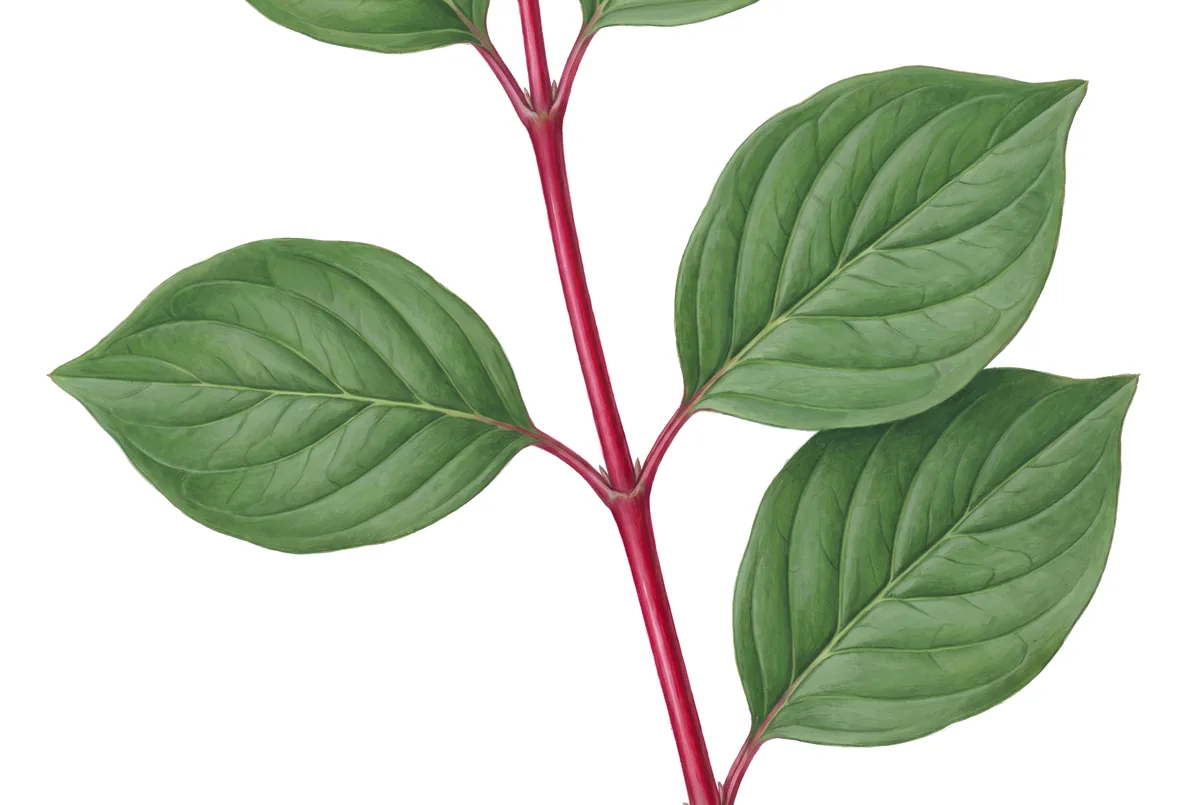
- Type
- Deciduous shrub
- Height
- 1.2 m to 2.5 m
- Spread
- 0.9 m to 2.5 m
- Growth
- Fast
- Flowers
- Cream, late spring, with sparse later flowers sometimes into summer (Missouri Botanical Garden); spring and summer (the RHS)
- Sun
- Full sun or partial shade (the RHS, a British reference); full sun to part shade (Missouri Botanical Garden, an American reference)
- In New Zealand
- Not native
Growing siberian dogwood
No New Zealand reference read describes the cultivar; the references read are the RHS, a British one, and the Missouri Botanical Garden and North Carolina State Extension, American ones. The RHS gives full sun or partial shade and clay, loam or sand, moist but well drained or well drained, acid or neutral, with a hardiness rating of H7. Missouri gives full sun to part shade and an organically rich, consistently moist, fertile soil, and says the stem colour is best on young stems. It says pruning is not required, but that many gardeners remove 20 to 25 per cent of the oldest stems each early spring, or cut every stem to about 20 cm from the ground every two or three years.
Using siberian dogwood
Missouri suggests it in groups or massed, in naturalistic plantings on moist soil where it can spread into a thicket, as a hedge or a screen along a boundary, in shrub borders, and as an accent where its key ornamental feature, the stem colour, can be seen. It adds that pairing it with a contrasting stem colour makes a two-coloured winter display. The red-barked dogwood page gives the species.
What to check before you buy
Trees and Shrubs Online says plants sold as 'Sibirica' often differ markedly from one another and groups them as the Sibirica Group; the RHS still accepts and describes 'Sibirica' itself. New Zealand growers name small stock by the root trainer or the planter bag, PB2, PB3, PB5 and PB8, and larger stock by litres, as the guide to plant grades by market sets out; the table above shows the sizes growers list.
Used forhedging and screeningmass plantingerosion controlpollinators and wildlife
Prices are set by each grower and shown ex GST. Availability is confirmed by the grower at order.
Common questions
- Is this the same plant as the Cornus alba 'Sibirica' page?
- Yes. Both pages are Cornus alba 'Sibirica' under two listed names. The other page carries the New Zealand listings and the fuller account.
- When are the stems most colourful?
- In winter. The RHS says the slender red stems turn bright crimson then, and Missouri says they are brilliant red in winter and grow gradually darker as spring approaches.
- How big does it grow?
- The RHS gives 1.5 to 2.5 m high and wide, and Missouri 1.2 to 2.1 m high. It spreads by suckers into a thicket, by the RHS.
- Is it native to New Zealand?
- No. Missouri gives its species, Cornus alba, as native to eastern and central Asia.
Sources
- GBIF species match API (Cornus alba)
- Royal Horticultural Society (RHS) plant finder: Cornus alba 'Sibirica'
- Missouri Botanical Garden Plant Finder: Cornus alba 'Sibirica'
- Missouri Botanical Garden Plant Finder: Cornus alba (the species' height, for the comparison)
- North Carolina State Extension Gardener Plant Toolbox: Cornus alba (the species, and its list of cultivars)
- Trees and Shrubs Online (International Dendrology Society): Cornus alba
- The HortOS guides for New Zealand (plant grades and container sizes by market)
- HortFlora, the Horticultural Flora of South-eastern Australia (Royal Botanic Gardens Victoria): Cornus alba and its cultivars, 'Sibirica' among them
The growers, sizes and prices above are live and change as lists arrive. Cite this page: HortOS, Siberian dogwood (Cornus alba 'Sibirica'), https://nz.hortosapp.com/plants/cornus-alba-sibirica-red-stem-dogwood.
Found a fact that is wrong? Tell us and it is checked against its source.