Dichondra repens
Kidney Weed
Part of Dichondra: see them all
WGN: 1 grower · 1 size · from $8.73 ex GST
- Type
- Perennial
- Height
- 0.04 m to 0.05 m
- Flowers
- White, throughout the year, mainly spring and summer
- Sun
- Full sun to shade
- In New Zealand
- Native
| Size | Grower | PricePrice ex GST | ||
|---|---|---|---|---|
| 2.5L | Leacroft Nurseries2.5L | $8.73 |
Also grown by 5 nurseries (no sizes or prices listed)
Enquire with them for sizes and prices.
- Goughs NurseriesSwannanoa, Canterbury
- Mangawhai NativesMangawhai, Northland
- Midland Horticulture - Wholesale Tree and Shrub NurseryNapier, Hawke's Bay
- Plantlife PropagatorsAshhurst, Manawatū-Whanganui
- Rural DesignNorthland
Growing mercury Bay weed
Position and soil. NZPCN calls it tolerant of a wide range of conditions and says that in some places it is often present naturally in lawns. The Australian Plants Society, writing for New South Wales, adds that it adapts to various soils but needs ample water to grow at its best, and that it covers the ground in shade. No New Zealand reference read gives a sun or watering need beyond NZPCN's line, or a frost rating.
Problems. NZPCN says it is prone to powdery mildew in summer in humid places. The Australian Plants Society says it can become invasive in garden beds.
Propagation. NZPCN calls it easy from fresh seed and from rooted pieces, gives the seeds as dispersed by wind, and gives it fruiting from November to May.
Using mercury Bay weed
Lawns and groundcover. NZPCN says Mercury Bay weed is not such a good lawn cover as the other native dichondra, Dichondra brevifolia, which it calls an excellent turf plant for bowling greens; the dichondra genus page sets the two side by side. The Australian Plants Society calls it very useful as a dense groundcover, a good hanging-basket plant and a plant that has been used in place of a lawn in full sun.
In the trade. NZPCN says a silvery-grey colour form of uncertain origin is popular at garden centres.
What to check before you buy
Check the botanical name. The Flora of New Zealand gives the common names kidney weed and Mercury Bay weed both to this native and to Dichondra micrantha, a naturalised exotic, so the botanical name on the line is what settles the plant. Silver-leaved lines need the same care: NZPCN calls the silvery-grey form it mentions of uncertain origin, and the Missouri Botanical Garden files Silver Falls under Dichondra argentea, an American species. New Zealand growers name small stock by the root trainer or the planter bag, PB2, PB3, PB5 and PB8, and larger stock by litres, as the guide to plant grades by market sets out; the table above shows the sizes growers list. NZPCN gives Mercury Bay weed as Not Threatened.
Used forgroundcoverpots and courtyards
Prices are set by each grower and shown ex GST. Availability is confirmed by the grower at order.
Common questions
- Who grows Dichondra repens wholesale in New Zealand?
- 4 wholesale growers list Dichondra repens on HortOS right now, each with their own pot sizes and trade prices. They are in Tasman, Auckland, Canterbury and Wellington. The growers are named on this page.
- What pot sizes does Dichondra repens come in?
- Growers on HortOS list Dichondra repens in RX90, 1.5L, PB3 and 2.5L.
- How do I order Dichondra repens from these growers?
- HortOS is for the trade. Add the lines you want to a list and send it: each grower gets their part of the order by email, confirms what they have and quotes freight, and nothing is bought until you approve it. Listing, searching and ordering are free.
- Is Mercury Bay weed native to New Zealand?
- Yes. NZPCN gives it as native, and the Flora of New Zealand as indigenous but not endemic. NZPCN says it is also found throughout the world.
- How big are the leaves?
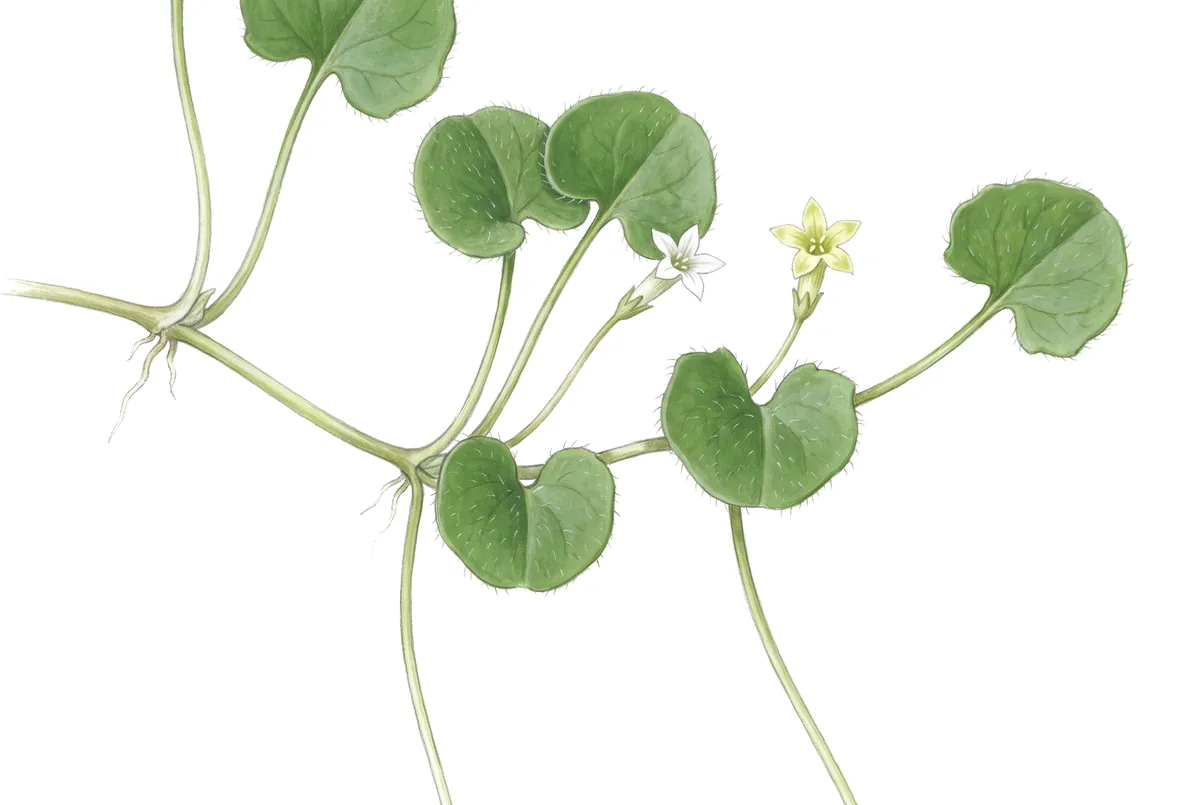
- The Flora of New Zealand calls the leaf very variable: usually 10 to 30 mm across and at most 40 mm, round to kidney-shaped with a heart-shaped base and a usually rounded tip, often equally hairy on both faces. The leaf stalk is occasionally as long as 10 cm.
- What do the flowers look like?
- Tiny and easily missed. The Flora of New Zealand gives a greenish yellow corolla 4 to 6 mm across, about as long as the calyx, with yellowish anthers, on a flower stalk usually much shorter than 5 cm, and a small round hairy capsule after it.
- Can Mercury Bay weed be used as a lawn?
- NZPCN says it is often present naturally in lawns in some places but rates it a poorer lawn cover than Dichondra brevifolia. The Australian Plants Society says it has been used as a lawn substitute in full sun.
Sources
- GBIF species match API
- New Zealand Plant Conservation Network (NZPCN): Dichondra repens
- Flora of New Zealand (Manaaki Whenua Landcare Research): Dichondra repens
- Flora of New Zealand (Manaaki Whenua Landcare Research): Dichondra micrantha
- New Zealand Plant Conservation Network (NZPCN): Dichondra brevifolia
- Missouri Botanical Garden Plant Finder: Dichondra argentea 'Silver Falls'
- Australian Plants Society NSW, plant database: Dichondra repens
- The HortOS guides for New Zealand (plant grades and container sizes by market)
The growers, sizes and prices above are live and change as lists arrive. Cite this page: HortOS, Mercury Bay weed (Dichondra repens), https://nz.hortosapp.com/plants/dichondra-repens.
Found a fact that is wrong? Tell us and it is checked against its source.