Helleborus
Every Helleborus on HortOS in one place: 23 plants, the species and their varieties together. Pick a size to see it across all of them.
15 growers · 9 sizes · from $1.80 ex GST
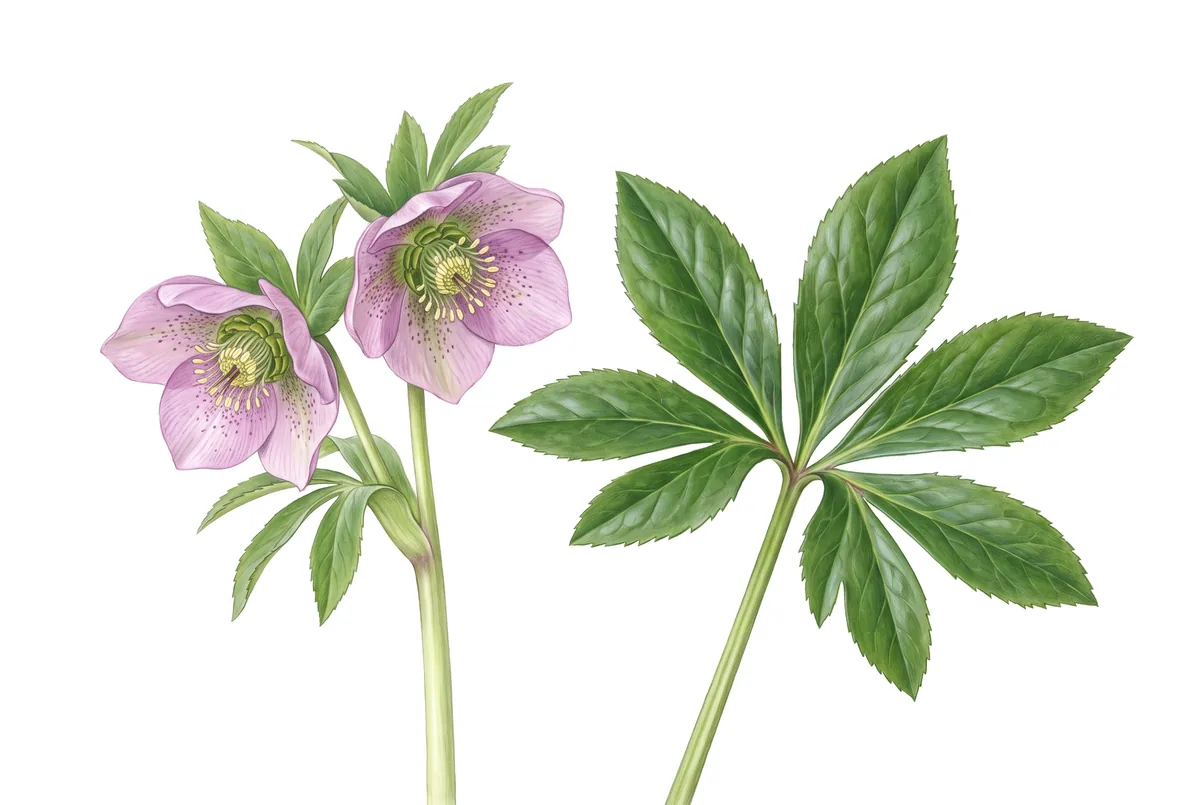
- Type
- Perennial
- Height
- 0.2 m to 0.6 m
- Flowers
- White, winter to spring
- Sun
- Part shade to shade (the American references)
- In New Zealand
- Not native
Also grown by 5 nurseries (no sizes or prices listed)
Enquire with them for sizes and prices.
- A4dibble PlantsHastings, Hawke's Bay
- Beechwood PlantsTe Puna, Bay of Plenty
- Clifton Homestead NurseryClinton (South Otago), Otago
- Kahikatea FarmHastings, Hawke's Bay
- PlantHouseAuckland, Auckland
Growing hellebore
In New Zealand. No New Zealand reference read gives the genus a frost rating. Auckland Botanic Gardens' Plants for Auckland, on its page for the Lenten rose, says hellebores perform best in semi-shade and in fertile, well-drained soil, and gives that species flowers throughout winter to mid-spring. The same page calls it susceptible to aphids, rot and black leaf spot. The rest is the overseas references', with their owners.
Position and soil. The American references give part shade to shade and soil that is organically rich and well drained, and North Carolina State Extension adds neutral to alkaline. They report no serious insect or disease problems, with crown rot and leaf spot occasional.
Care. The American references say the flowering stems can be cut back after flowering to promote new leaves, and that old leaves may be cut to the ground before the plants flower. North Carolina State Extension gives the usual height as about 0.3 to 0.38 m, the hybrids to about 0.6 m.
Using hellebore
HortFlora says the genus is best known through the many cultivars and variants of Helleborus orientalis, and North Carolina State Extension gives the flowers as cup-shaped, about 5 to 7.6 cm across, some forms double. New Zealand growers list the genus under named forms and series, among them 'Ivory Prince', 'Jasper', 'Flash Gordon', 'Conny', Ice N Roses White, the English Thoroughbred series and Winter Rose, and under species rows for Helleborus orientalis, Helleborus x hybridus, Helleborus niger, Helleborus x sternii and Helleborus foetidus.
What to check before you buy
Read the full name on each line: most lines under the bare genus are named forms and series, and North Carolina State Extension gives the genus flowers in a large variety of colours. New Zealand growers name small stock by the root trainer or the planter bag, PB2, PB3, PB5 and PB8, and larger stock by litres, as the guide to plant grades by market sets out; the table above shows the sizes growers list. Hellebores are poisonous: see the cautions.
Cautions
North Carolina State Extension says the leaves, stems and roots of hellebores are poisonous to people if eaten, and HortFlora that the plants contain highly poisonous alkaloids. The ASPCA lists hellebore (Helleborus niger) as toxic to dogs, cats and horses.
Prices are set by each grower and shown ex GST. Availability is confirmed by the grower at order.
Common questions
- Who grows Helleborus wholesale in New Zealand?
- 15 wholesale growers list Helleborus on HortOS right now, each with their own pot sizes and trade prices. They are in Auckland, Hawke's Bay, Wellington, Tasman, Manawatū-Whanganui, Otago, Southland and Waikato. The growers are named on this page.
- What pot sizes does Helleborus come in?
- Growers on HortOS list Helleborus in Tube 5cm, 120mm, 1L, 1.5L, 2L, 2.4L, 2.5L, 4L and 5L.
- How do I order Helleborus from these growers?
- HortOS is for the trade. Add the lines you want to a list and send it: each grower gets their part of the order by email, confirms what they have and quotes freight, and nothing is bought until you approve it. Listing, searching and ordering are free.
- Are hellebores native to New Zealand?
- No. The Flora of New Zealand gives the genus as exotic and counts two species here, both casual; it has pages for Helleborus orientalis and Helleborus foetidus, each given as exotic. HortFlora gives the genus as 21 species from Europe and western Asia.
- Do hellebores need shade?
- The American references give part shade to shade and soil that is organically rich and well drained. On its page for the Lenten rose, Auckland Botanic Gardens says hellebores perform best in semi-shade and in fertile, well-drained soil.
- What is the stinking hellebore?
- Helleborus foetidus, which the Flora of New Zealand gives as exotic here and also calls bear's-foot, setterwort and stinkwort.
- Are hellebores safe around pets?
- No. The ASPCA lists hellebore (Helleborus niger) as toxic to dogs, cats and horses, and North Carolina State Extension says the leaves, stems and roots are poisonous to people if eaten.
Sources
- GBIF species match API (the genus Helleborus)
- ASPCA Animal Poison Control, Toxic and Non-Toxic Plants: Hellebore (Helleborus niger)
- Flora of New Zealand (Manaaki Whenua Landcare Research): the genus Helleborus
- Flora of New Zealand (Manaaki Whenua Landcare Research): Helleborus orientalis
- Flora of New Zealand (Manaaki Whenua Landcare Research): Helleborus foetidus
- North Carolina State Extension Gardener Plant Toolbox: the genus Helleborus
- Missouri Botanical Garden Plant Finder: Helleborus orientalis, Lenten rose
- HortFlora, the Horticultural Flora of South-eastern Australia (Royal Botanic Gardens Victoria): the genus Helleborus, Helleborus orientalis and Helleborus niger
- The HortOS guides for New Zealand (plant grades and container sizes by market)
- The HortOS catalogue for New Zealand (the rows growers list under Helleborus)
- Auckland Botanic Gardens (Auckland Council), Plants for Auckland: Helleborus orientalis (copied from sources/helleborus-orientalis)
The growers, sizes and prices above are live and change as lists arrive. Cite this page: HortOS, Hellebore (Helleborus), https://nz.hortosapp.com/plants/helleborus.
Found a fact that is wrong? Tell us and it is checked against its source.