Malus domestica 'Granny Smith'
Apple
One of 40 Malus domestica varieties: see them all
7 growers · 9 sizes · from $43.43 ex GST
- Type
- Deciduous tree
- Height
- 4 m to 8 m
- Spread
- 4 m to 8 m
- Flowers
- White, spring
- Sun
- Full sun (the SA Plant Selector)
- Hardiness
- Tolerates heat or cold (Christchurch City Council, as Malus pumila)
- In New Zealand
- Not native
| Size | Grower | PricePrice ex GST | ||
|---|---|---|---|---|
| 74.99mm | Harrisons Gardenworld74.99mm | Price on application. Sign in to ask the grower. | ||
| 600mm | Greenspace Plants600mm | $80.00 | ||
| PB18 (1.6-1.8m) | Pioneer NurseryPB18 (1.6-1.8m) | $52.13 | ||
| 17L | Cottle Hill Nursery17L | $70.00 | ||
| 25L | Diack's Nurseries25L | $69.99 | ||
| 35L | Leafland Nursery (Main Site)35L | Price on application. Sign in to ask the grower. | ||
| 45L | Leafland Nursery (Main Site)45L | Price on application. Sign in to ask the grower. | ||
| PB40 | Leacroft NurseriesPB40 | $43.79 | ||
| 1.5m tall | Pioneer Nursery1.5m tall | $43.43 |
Also grown by 8 nurseries (no sizes or prices listed)
Enquire with them for sizes and prices.
- Blueskin Nurseries & CafeWaitati, Otago
- Cooke L E NurserymanHastings, Hawke's Bay
- Edible GardenPalmerston North, Manawatū-Whanganui
- Garden Centre & Nursery at Aston NorwoodUpper Hutt, Wellington
- HabitateWaitati, Otago
- Kiwiflora Nursery – Christchurch Garden Centre & NurseryRd 8, Canterbury
- Mara Whenua Apple TreesKaitaia, Northland
- Midland Horticulture - Wholesale Tree and Shrub NurseryNapier, Hawke's Bay
Growing granny Smith
Climate. The RHS, a British reference, says Granny Smith needs a hot climate to do well and often ripens poorly in Britain, and rates it hardy in all of the United Kingdom and northern Europe. No New Zealand reference read gives a climate or frost rating for this cultivar.
Position and soil. The RHS gives full sun, a sheltered position, and clay, loam or sand that is moist but well drained or simply well drained, and its cultivation note prefers a deep, fertile, moist but well-drained, neutral soil; it says the tree will not thrive on very acid soils, shallow chalk soils or with shade for more than half the day.
Cropping. The RHS calls the tree self-fertile and says it bears heavy crops in mid-autumn that store to mid-spring, seasons it gives for Britain. It adds that the fruit may need thinning to improve its size and quality.
Propagation. The RHS gives chip budding in late summer or grafting in midwinter, and says trees raised from pips are unlikely to resemble the parent.
Using granny Smith
Granny Smith is a dessert apple: the RHS files it in its dessert group, apples it calls sweet and juicy and best eaten fresh. The National Fruit Collection's own description gives firm, rather coarse-textured, juicy flesh with a subacid, refreshing flavour, and the National Apple Register, which it quotes, calls the flavour moderately sweet.
Te Ara says export picking may begin with Cox's Orange Pippin in February and finish with Granny Smith in April. The National Fruit Collection records Granny Smith as a parent of Lady Williams and of Red Granny Smith. Two apples raised in New Zealand have pages of their own: Braeburn and Royal Gala.
What to check before you buy
Growers on HortOS list this apple as Apple - Granny Smith. New Zealand growers name small stock by the bag, PB2 to PB8, and larger stock by litres, as the guide to plant grades and container sizes sets out; the table above shows the sizes growers list. NC State, an American reference, says many apple trees sold are grafted onto dwarfing rootstocks that keep them much smaller than a tree from seed. What to check in the roots, stem and canopy before stock leaves the grower is in the guide to nursery plant quality. The drawback to weigh is the RHS's own: Granny Smith wants a hot climate to ripen well.
Cautions
The ASPCA lists apple, crabapples included, as toxic to dogs, cats and horses: its entry says the stems, leaves and seeds contain cyanide, from cyanogenic glycosides. The listing is for apples in general, not for this cultivar alone.
Used forfruit and orchardediblespecimenpollinators and wildlife
Prices are set by each grower and shown ex GST. Availability is confirmed by the grower at order.
Common questions
- Who grows Malus domestica 'Granny Smith' wholesale in New Zealand?
- 7 wholesale growers list Malus domestica 'Granny Smith' on HortOS right now, each with their own pot sizes and trade prices. They are in Manawatū-Whanganui, Northland, Southland and Wellington. The growers are named on this page.
- What pot sizes does Malus domestica 'Granny Smith' come in?
- Growers on HortOS list Malus domestica 'Granny Smith' in 74.99mm, 600mm, PB18 (1.6-1.8m), 17L, 25L, 35L, 45L, PB40 and 1.5m tall.
- How do I order Malus domestica 'Granny Smith' from these growers?
- HortOS is for the trade. Add the lines you want to a list and send it: each grower gets their part of the order by email, confirms what they have and quotes freight, and nothing is bought until you approve it. Listing, searching and ordering are free.
- Where does the Granny Smith apple come from?
- The National Fruit Collection records it as raised at Ryde, New South Wales, by a Mrs Smith who was born at Peasmarsh in Sussex in 1800 and emigrated to Australia in 1838; trees were known to be fruiting in 1868. It gives the parentage as French Crab crossed with an unknown parent. The RHS says she found the tree as a seedling where she had thrown out some old apples, and that the apple is named after her.
- What does a Granny Smith apple look like?
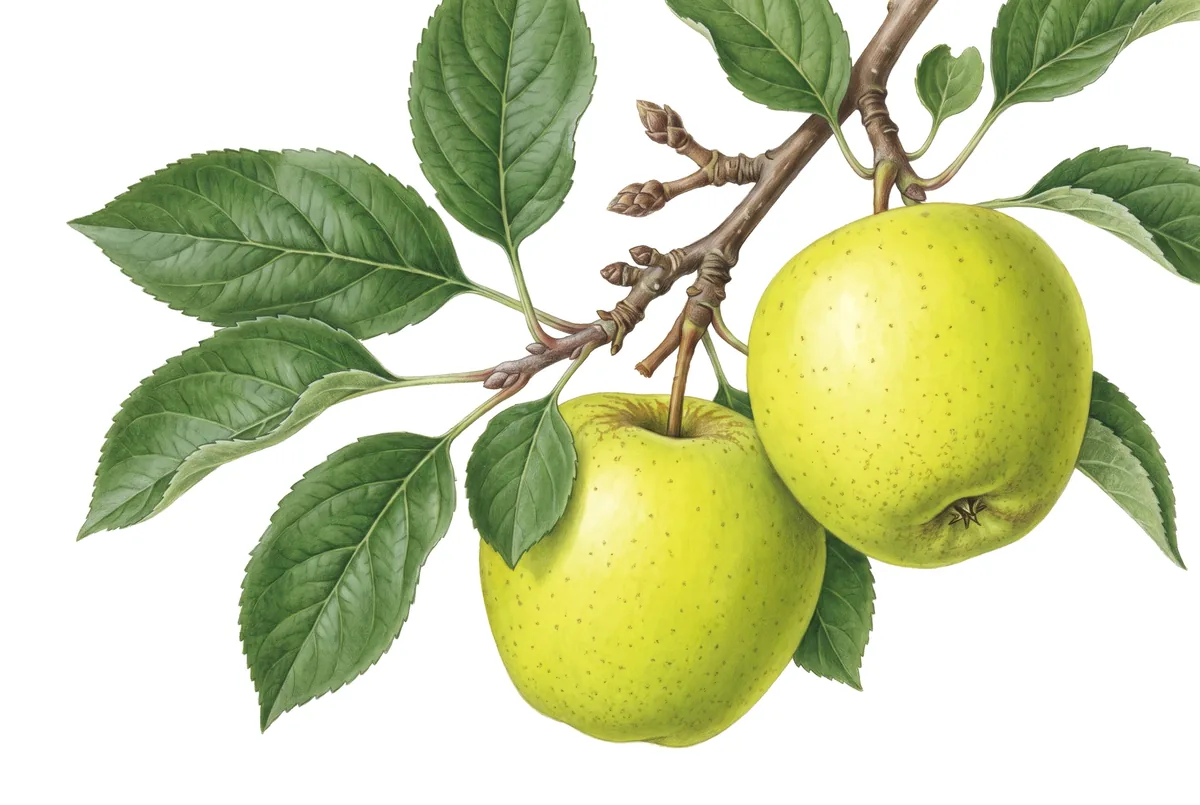
- The National Apple Register, quoted by the National Fruit Collection, gives a medium fruit about 57 mm high and 64 mm wide, ribbed at the eye, green to greenish yellow with some fine netted russet. The Collection's own record of its tree gives a larger fruit, about 70 by 72 mm, whitish green with a very little mottled red. The RHS calls the skin bright yellow-green and the flesh firm and white.
- How big does a Granny Smith tree grow?
- The RHS gives 4 to 8 m high and 4 to 8 m across. A grafted tree's size also depends on its rootstock.
- When is Granny Smith picked in New Zealand?
- Te Ara says export picking may finish with Granny Smith in April. The RHS calls it a late apple that stores well, to mid-spring in Britain.
Sources
- GBIF species match API (Malus domestica, the species name and family)
- New Zealand Plant Conservation Network (NZPCN): Malus x domestica (the apple: biostatus exotic, naturalised 1872)
- North Carolina State Extension Gardener Plant Toolbox: Malus domestica (the species)
- Te Ara, the Encyclopedia of New Zealand: Apples and pears
- ASPCA Animal Poison Control Center, toxic and non-toxic plants: Apple
- The HortOS catalogue for New Zealand (the names growers list this apple under on nz.hortosapp.com)
- The HortOS guides for New Zealand (plant grades and container sizes; nursery plant quality)
- The National Fruit Collection (Brogdale): Granny Smith, accession 1976-145, with the National Apple Register's description
- Royal Horticultural Society plant profile: Malus domestica 'Granny Smith' (D)
The growers, sizes and prices above are live and change as lists arrive. Cite this page: HortOS, Granny Smith (Malus domestica 'Granny Smith'), https://nz.hortosapp.com/plants/malus-domestica-granny-smith.
Found a fact that is wrong? Tell us and it is checked against its source.