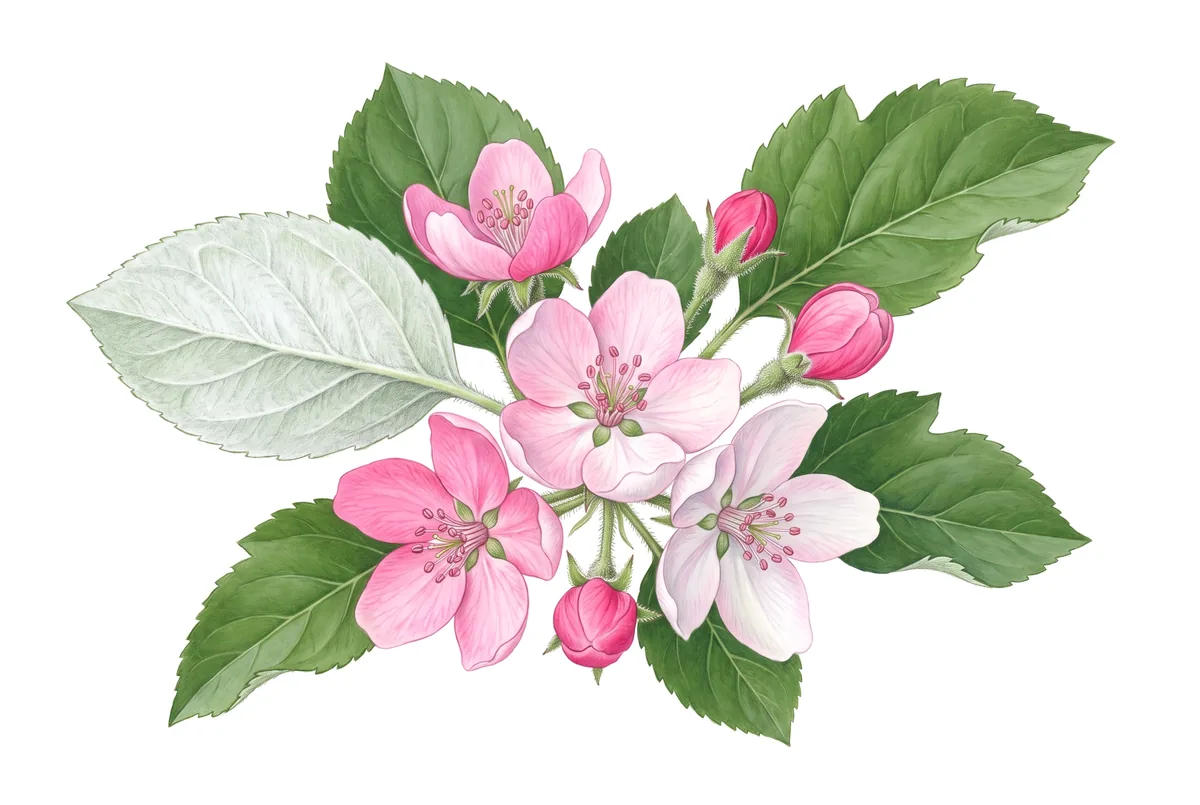
- Type
- Deciduous tree
- Height
- 2 m to 10 m
- Spread
- 4 m to 8 m
- Flowers
- Pink, late spring; summer by HortFlora
- Sun
- Full sun to partial shade, by the RHS
- In New Zealand
- Not native
Growing prairie crab apple
No New Zealand reference read describes how the straight species grows here, so the notes below come from British and American references.
Position and soil. The RHS, a British reference, gives full sun or partial shade and a fertile, deep, moist, loamy soil, and lists chalk, clay, loam or sand, acid, neutral or alkaline. It rates the plant H4; Trees and Shrubs Online rates it H6. Illinois Wildflowers, writing of the plant in its home range, gives loam, clay loam or rocky soil.
Pests and diseases. Trees and Shrubs Online reports it susceptible to rust and very resistant to scab. The RHS says it may be susceptible to aphids, codling moth and fruit tree red spider mite, and to apple canker, brown rot, fireblight and powdery mildews, with some resistance to apple scab. These are British and American findings, not New Zealand ones.
Propagation. The RHS gives seed, chip budding in late summer or grafting in mid-winter. The Missouri Department of Conservation says its deep roots make it hard to transplant but that it grows easily from seed.
Using prairie crab apple
Trees and Shrubs Online says the scented flowers, which open late in the season, are the main reason it is grown, with peeling bark on older trees and good orange-red autumn colour as extras. The RHS suggests it for cottage, informal and wildlife gardens. In its home range Illinois Wildflowers rates its value to wildlife high: birds and mammals eat the fruit, and its dense, sometimes thorny branches give birds cover. The Missouri Department of Conservation says the fruit is too tart to eat raw but serves for baking and preserves.
What to check before you buy
Check which plant the line is. Growers list the straight species, with single flowers of five petals, and its double form, which Trees and Shrubs Online calls still a mainstream cultivar in Australia and New Zealand. New Zealand growers name small stock by the planter bag, PB2, PB3, PB5 and PB8, and larger stock by litres, as the guide to plant grades and container sizes sets out; the table above shows the sizes growers list.
Cautions
The Missouri Department of Conservation lists the plant as thorny, and Trees and Shrubs Online describes thorn-like spurs. The RHS says the fruit is generally edible when cooked but that the seeds contain toxins and should be removed.
Used forpollinators and wildlife
Prices are set by each grower and shown ex GST. Availability is confirmed by the grower at order.
Common questions
- How big does prairie crab apple grow?
- Trees and Shrubs Online gives usually 4 to 6 m, ranging from 2 to 10 m. The RHS gives 4 to 8 m high and wide.
- Is Malus ioensis native to New Zealand?
- No. Trees and Shrubs Online gives its home as the Great Plains of the United States, from South Dakota, Minnesota, Wisconsin and Michigan south to Texas and Louisiana. Queenstown Lakes District Council's tree planting guide lists Malus species, apple and crab apple, as exotic.
- How is the species different from 'Plena'?
- In the flower. The species has single flowers of five petals, 3.5 to 5 cm across by Trees and Shrubs Online. 'Plena', the Bechtel crab, is its double-flowered form and has its own page.
- How do you tell it from other crab apples?
- Trees and Shrubs Online says its leaves stay downy beneath, which separates it from Malus coronaria and Malus angustifolia, and that its branchlets are conspicuously hairy.
Sources
- GBIF species match API
- Trees and Shrubs Online (International Dendrology Society): Malus ioensis
- Royal Horticultural Society (RHS), plant finder: Malus ioensis, prairie crab
- Missouri Department of Conservation, field guide: Prairie crab apple (Malus ioensis)
- Illinois Wildflowers, trees: Prairie crab apple, Malus ioensis
- The HortOS catalogue for New Zealand (the lines growers list under Malus ioensis)
- The HortOS guide for New Zealand: plant grades and container sizes by market
- Queenstown Lakes District Council, planting guide: trees (Malus species)
The growers, sizes and prices above are live and change as lists arrive. Cite this page: HortOS, Prairie crab apple (Malus ioensis), https://nz.hortosapp.com/plants/malus-ioensis.
Found a fact that is wrong? Tell us and it is checked against its source.