Monstera deliciosa
Fruit Salad Plant / Swiss Cheese Plant
Part of Monstera spp.: see them all
AUK: 5 growers · 6 sizes · from $12.00 ex GST
- Type
- Evergreen climber
- Height
- 1.8 m to 2.4 m
- Spread
- 1.8 m to 3 m
- Growth
- Fast
- Flowers
- Creamy white
- Sun
- Part shade or dappled light; indoors bright light with no strong direct sun; variegated forms need more light than green ones
- Frost
- NC State gives a preferred average warmth of about 16 to 29 C; no Australian reference read gives a frost figure
- In New Zealand
- Not native
| Size | Grower | PricePrice ex GST | ||
|---|---|---|---|---|
| 120mm | Rainbow Park Nurseries Limited120mm | $12.00 | ||
| 120mm | Jungle Story120mm | Price on application. Sign in to ask the grower. | ||
| 140mm | The Green Grower140mm | $24.99 | ||
| 170mm | Urban Lush NZ - Indoor Plants Specialists (LynnMall)170mm | Price on application. Sign in to ask the grower. | ||
| 180mm | The Green Grower180mm | $65.00 | ||
| 220mm | The Green Grower220mm | $39.99 | ||
| 250mm | The Palm Garden250mm | $35.00 |
Also grown by 19 nurseries (no sizes or prices listed)
Enquire with them for sizes and prices.
- Beechwood PlantsTe Puna, Bay of Plenty
- Hire Plants LimitedAvondale, Auckland, Auckland
- Love GrowsPapamoa, Bay of Plenty
- Midland Horticulture - Wholesale Tree and Shrub NurseryNapier, Hawke's Bay
- Moffatt's Flower Company (Wholesale Indoor Plants)Canterbury
- Nelson Plant GuyNelson, Nelson
- Palmers AlbanyAuckland, Auckland
- Palmers BethlehemTauranga, Bay of Plenty
- Palmers FranktonHamilton, Waikato
- Palmers MiramarWellington, Wellington
- Palmers New PlymouthNew Plymouth, Taranaki
- Palmers PakurangaAuckland, Auckland
- Palmers PlimmertonPorirua, Wellington
- Palmers RotoruaRotorua, Bay of Plenty
- Palmers St JamesHamilton, Waikato
- Palmers Welcome BayTauranga, Bay of Plenty
- Palmers WhangareiWhangarei, Northland
- Plant CollectiveWānaka, Otago
- Waimea Plant Propagation LtdAuckland, Auckland
Growing fruit salad plant
In New Zealand. The Flora of New Zealand records fruit salad plant as exotic, and the genus Monstera as one species here in the category exotic: casual. NZPCN says it was brought in for horticulture, reproduces by vegetative spread, and is often found as a long-persistent garden relic. The Auckland Botanical Society article describes ten naturalised sites: nine in the Auckland region, Great Barrier Island among them, and one at Pukenui on the Aupouri Peninsula in Northland. Most appear to have come from dumped garden waste, and five were coastal, in full sun to deep shade.
Seed. NZPCN says seed is occasionally produced, with some evidence of seedlings in the wild. The article says it is not known to set seed here, needing cross-pollination and a pollinator, and spreads by stems, which water can carry: it records dumped stems rooting along a stream on Great Barrier Island.
Climate. The article says its tropical origin and cold intolerance are likely to keep it to mild, moist sites in the northern North Island. It gives the vine as climbing to about 20 m, and records one Auckland plant 5 m up a tītoki. No New Zealand reference read gives it a frost rating; the North Carolina toolbox, an American reference, gives a preferred average warmth of about 16 to 29 C.
Light, soil and water. The American references read give it part shade or dappled light, or indoors bright light without strong direct sun, and moist, well-drained soil high in organic matter, letting the top quarter to third of the mix dry between thorough waterings. The Missouri Plant Finder lists aphids, mealybugs, thrips, scale and spider mites.
Using fruit salad plant
Fruit salad plant is grown as a large indoor foliage plant and, the Auckland Botanical Society article says, will also grow well in gardens given warm and moist conditions, and is easily propagated from stem sections with a leaf attached. A survey of the woody plants of the Auckland Domain, in the same journal, describes a colony there with very long cord-like aerial roots. Indoors the American references give it a sturdy pole or trellis to climb, and say variegated forms need more light than green ones.
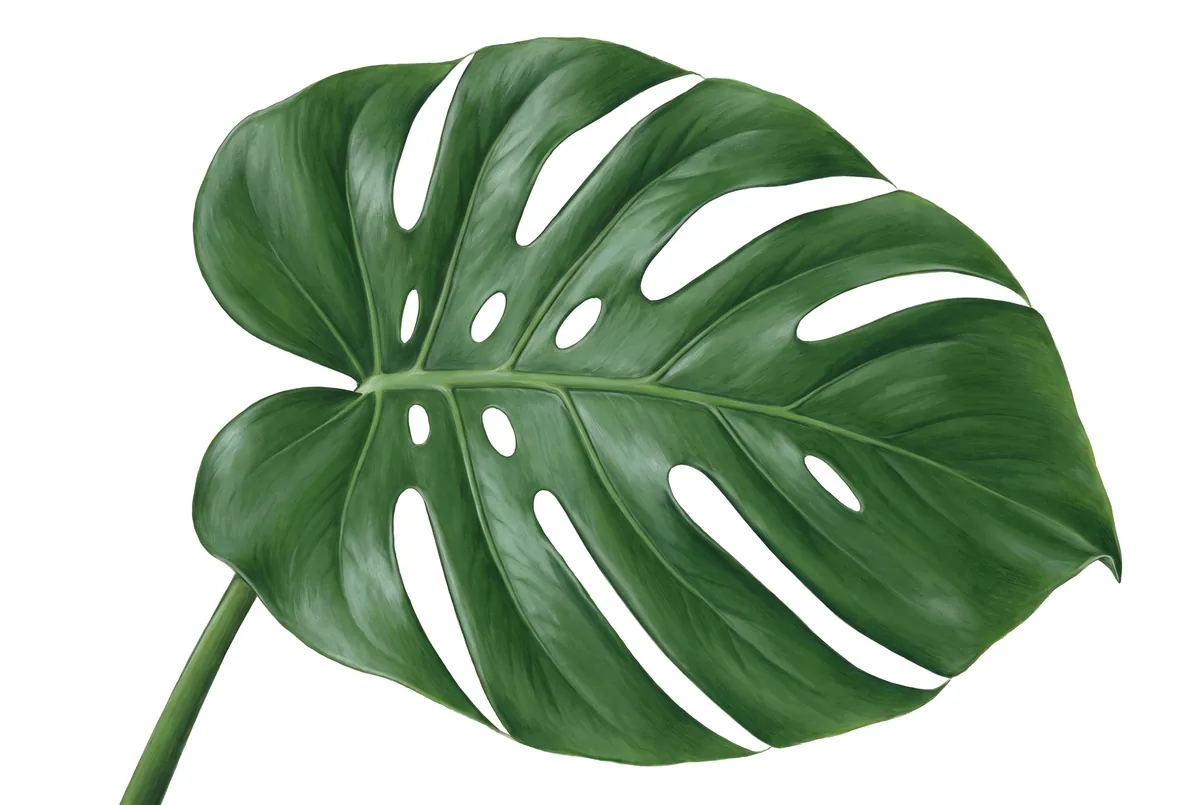
The article reads the botanical name as 'delicious monster', for the banana and pineapple flavoured fruit and the large perforated leaves, and shows a mature fruit shedding its outer layer to reveal the whitish flesh. The American references say it is edible only when fully ripe and is rare on plants kept indoors.
What to check before you buy
Growers list it in New Zealand as Monstera deliciosa. The Auckland Botanical Society article says that, unless it is found producing viable seed here, it is unlikely ever to be a major weed and will only reach new sites through gardeners who dispose of garden waste irresponsibly; most of its naturalised colonies appear to have begun that way. New Zealand growers name small stock by the root trainer or the planter bag (PB2, PB3, PB5 and PB8) and larger stock by litres, as the guide to plant grades by market sets out; the table above shows the sizes growers list. For roots, pests and hardening off, see the guide to nursery plant quality.
Cautions
The ASPCA lists fruit salad plant as toxic to dogs and cats, from insoluble calcium oxalates. The Auckland Botanical Society article says established patches in the Mount Eden rock forest are locally preventing seedlings from establishing and that control there would be warranted.
Prices are set by each grower and shown ex GST. Availability is confirmed by the grower at order.
Common questions
- Who grows Monstera deliciosa wholesale in New Zealand?
- 10 wholesale growers list Monstera deliciosa on HortOS right now, each with their own pot sizes and trade prices. They are in Auckland, Manawatū-Whanganui, Wellington, Waikato, Tasman and Northland. The growers are named on this page.
- What pot sizes does Monstera deliciosa come in?
- Growers on HortOS list Monstera deliciosa in Tube 5cm, 120mm, 140mm, 170mm, 180mm, 220mm, 250mm, 1L, 2.5L, 3.5L and 3 more sizes.
- How do I order Monstera deliciosa from these growers?
- HortOS is for the trade. Add the lines you want to a list and send it: each grower gets their part of the order by email, confirms what they have and quotes freight, and nothing is bought until you approve it. Listing, searching and ordering are free.
- Is fruit salad plant naturalised in New Zealand?
- The Flora of New Zealand gives it the biostatus exotic, in the category casual, and NZPCN calls it often a long-persistent garden relic. An Auckland Botanical Society article describes ten naturalised sites, in the Auckland region and at Pukenui in Northland, most of them apparently from dumped garden waste.
- Will monstera grow outdoors in New Zealand?
- The Auckland Botanical Society article says its cold intolerance is likely to keep it to mild, moist sites in the northern North Island. A survey of the Auckland Domain describes a colony there with very long cord-like aerial roots.
- Does fruit salad plant set seed here?
- The references differ. NZPCN says seed is occasionally produced and that seedlings may occur in the wild; the Auckland Botanical Society article says it is not known to set seed in New Zealand because it needs cross-pollination and a pollinator.
- Can you eat the fruit of Monstera deliciosa?
- The American references read say the fruit is edible only when fully ripe, once the scales fall away of their own accord. The Auckland Botanical Society article describes its banana and pineapple flavour.
- Is monstera poisonous to pets?
- The ASPCA lists it as toxic to dogs and cats, from insoluble calcium oxalates.
Sources
- GBIF species match API
- ASPCA Animal Poison Control: toxic and non-toxic plants, Mexican Breadfruit and Swiss Cheese Plant (Monstera deliciosa)
- Flora of New Zealand (Manaaki Whenua Landcare Research): taxon profile, Monstera deliciosa
- Flora of New Zealand (Manaaki Whenua Landcare Research): taxon profile, the genus Monstera
- New Zealand Plant Conservation Network (NZPCN): Monstera deliciosa
- North Carolina State Extension Gardener Plant Toolbox: Monstera deliciosa
- Missouri Botanical Garden Plant Finder: Monstera deliciosa
- Auckland Botanical Society Journal 57(2): A Mexican migrant: the naturalisation of Monstera deliciosa (fruit salad plant) in New Zealand
- Auckland Botanical Society Journal 59(1): Woody plants of the Auckland Domain
- The HortOS catalogue for New Zealand (the names growers list fruit salad plant under on nz.hortosapp.com)
- The HortOS guides for New Zealand (plant grades by market; nursery plant quality)
The growers, sizes and prices above are live and change as lists arrive. Cite this page: HortOS, Fruit salad plant (Monstera deliciosa), https://nz.hortosapp.com/plants/monstera-deliciosa.
Found a fact that is wrong? Tell us and it is checked against its source.