- Type
- Deciduous tree
- Height
- 4.5 m to 9 m
- Spread
- 4.5 m to 7.5 m
- Flowers
- White, early spring
- Sun
- Full sun to part shade; flowers best in full sun
- Hardiness
- Thrives in cold upland and coastal places (NZPCN)
- In New Zealand
- Naturalised
Growing cherry plum
Climate. NZPCN says cherry plum thrives in cold, upland localities as well as coastal places, and finds it growing wild on forest margins, sand dunes and stream margins.
Soil, light and pests. No New Zealand reference read gives its soil or light needs or its pests here. North Carolina State Extension and the Missouri Botanical Garden, American references, give full sun to part shade, with the best flowering in full sun, and an average, moist, well-drained loam, though the tree adapts to many soils. They list borers, aphids, scale, leafhoppers, caterpillars and spider mites, and black knot, leaf spot, dieback, leaf curl, powdery mildew, root rot and fireblight among its problems.
Using cherry plum
NZPCN gives ornamental planting as the reason cherry plum was brought in, and says a purple-leaved variety with dark crimson fruit is widely cultivated, whose wild progeny keep the purple colouring. The Flora of New Zealand records one cultivar here, 'Pissardii'. The Auckland Botanical Society's account of the woody plants of the Auckland Domain lists Prunus cerasifera 'Atropurpurea' among the trees there, in Auckland. Queenstown Lakes District Council's tree planting guide, writing of Prunus species as a group, accepts them for streets and for parks and reserves, and names debris, suckering and maintenance as its concerns. Growers list the species and the purple-leaved Thundercloud under their own names.
What to check before you buy
Check the form on the line. The Flora of New Zealand gives cherry plum, myrobalan and purple-leaf plum as its names, and says the leaves are usually green, sometimes purple or bronzy purple. Growers name small stock by the planter bag, PB2, PB3, PB5 and PB8, and larger stock by litres, as the guide to plant grades and container sizes sets out; the table above shows the sizes growers list.
Cautions
NZPCN says cherry plum spreads by seed, which it produces very freely, and that people and birds disperse it. Its branches are spiny: the Flora of New Zealand places the spines mainly on the lower shoots.
Prices are set by each grower and shown ex GST. Availability is confirmed by the grower at order.
Common questions
- Does cherry plum grow wild in New Zealand?
- Yes. NZPCN gives 1958 as the year it naturalised here, and Biota of New Zealand records it as exotic and wild.
- When does cherry plum flower and fruit?
- NZPCN gives flowering in August and September, and the Flora of New Zealand fruiting from November to January. The Flora of New Zealand calls the flowers not fragrant; North Carolina State Extension, an American reference, calls them fragrant.
- How big are cherry plum leaves?
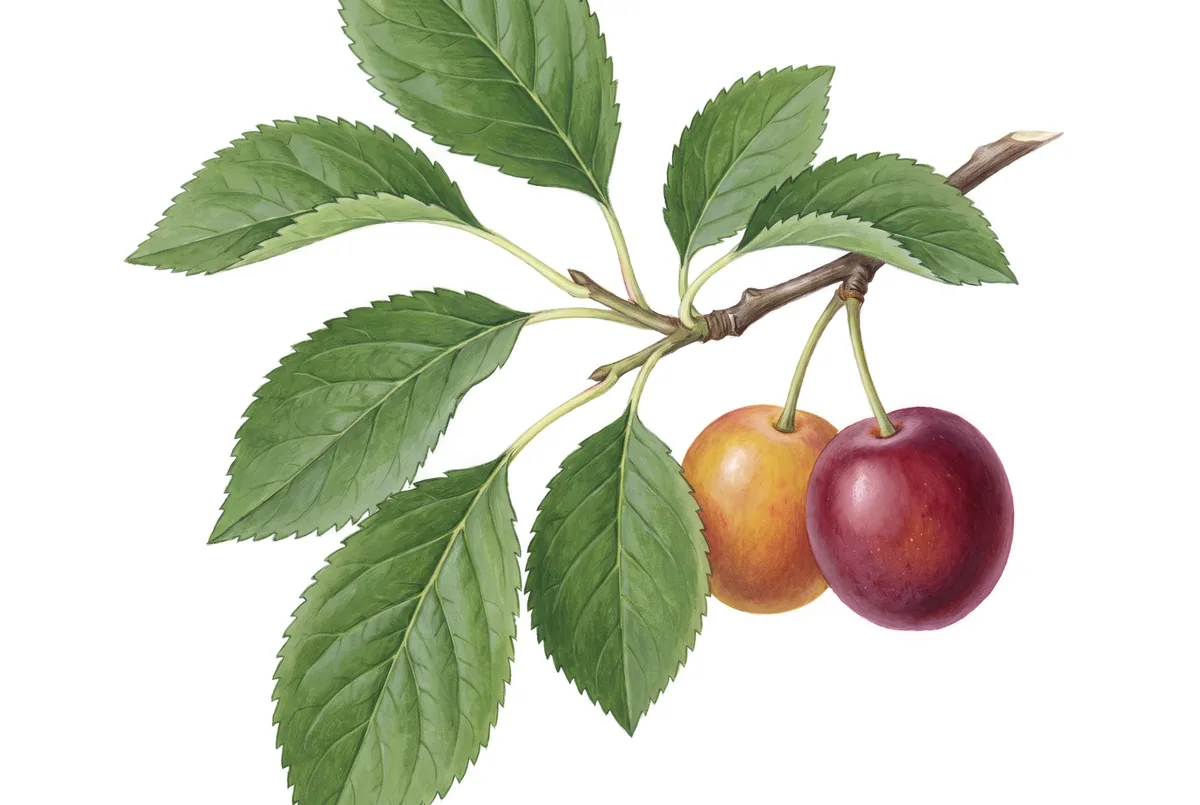
- The Flora of New Zealand gives the blade usually 40 to 80 mm long and 15 to 45 mm wide, sometimes as small as 30 by 13 mm: thin, narrowly obovate to broadly elliptic, more or less shining and finely toothed, on a stalk usually 6 to 12 mm long. NZPCN gives up to 80 by 45 mm.
- How tall does cherry plum grow?
- The Flora of New Zealand gives up to 8 m when mature, and NZPCN to about 8 m. North Carolina State Extension and the Missouri Botanical Garden, American references, give 4.5 to 9 m.
- What are cherry plum flowers like?
- The Flora of New Zealand describes them as single but usually closely spaced, or in clusters of two to four on short shoots, hanging or spreading, on stalks usually 5 to 14 mm long. There are usually five petals, round and wavy-edged, 6 to 11 mm across, white or occasionally pink, with pale stamens about as long as the petals; the sepals become bent back and are mostly green, sometimes purplish.
- How big is cherry plum fruit?
- The Flora of New Zealand gives it usually 15 to 30 mm long, sometimes as small as 10 mm, usually nearly round or broadly egg-shaped and sometimes a true globe, slightly grooved, hairless and with a light bloom. NZPCN describes the fruit as globose and up to 30 mm long.
- How is cherry plum told from other Prunus?
- NZPCN sets it apart from other Prunus species by its hairless fruit, young stems and mature leaves. The Flora of New Zealand adds that the leaves are hairless above and usually beneath, though the lower third of the midrib is sometimes densely hairy underneath, and that the fine teeth of the margin are blunt or end in a short point.
Sources
- GBIF species match API
- ASPCA Animal Poison Control, Toxic and Non-Toxic Plants: Plum (Prunus domestica)
- New Zealand Plant Conservation Network (NZPCN): Prunus cerasifera, cherry plum
- Flora of New Zealand (Manaaki Whenua Landcare Research), taxon profile: Prunus cerasifera, with the species text of the Flora of New Zealand, volume 4
- North Carolina State Extension Gardener Plant Toolbox: Prunus cerasifera
- Missouri Botanical Garden Plant Finder: Prunus cerasifera
- Biota of New Zealand (Manaaki Whenua Landcare Research), plant names: Prunus cerasifera
- Auckland Botanical Society Journal: woody plants of the Auckland Domain
- Queenstown Lakes District Council, planting guide: trees (Prunus species)
- The HortOS catalogue for New Zealand (the lines growers list under Prunus cerasifera)
- The HortOS guides for New Zealand (plant grades and container sizes by market)
The growers, sizes and prices above are live and change as lists arrive. Cite this page: HortOS, Cherry plum (Prunus cerasifera), https://nz.hortosapp.com/plants/prunus-cerasifera.
Found a fact that is wrong? Tell us and it is checked against its source.