Viburnum opulus
Viburnum
Every Viburnum opulus on HortOS in one place: the plain species and 2 varieties. Pick a size to see it across all of them.
Part of Viburnum: see them all
7 growers · 8 sizes · from $2.45 ex GST
- Type
- Deciduous shrub
- Height
- 2.4 m to 5 m
- Spread
- 2.4 m to 4.6 m
- Flowers
- White, late spring and early summer by the RHS; summer by HortFlora
- Sun
- Full sun to part shade
- Hardiness
- Tolerates frost and snow, by Christchurch City Council's tree list
- In New Zealand
- Not native
| Size | Grower | PricePrice ex GST | ||
|---|---|---|---|---|
| Tube 7cm | Butlers Nursery'Sterile'Tube 7cm | $2.45 | ||
| 250mm | Butlers Nursery'Sterile'250mm | $25.00 | ||
| 2.5L | Leacroft Nurseries'Sterile'2.5L | $10.95 | ||
| 2.5L | Green Leaf Nurseries'Nanum'2.5L | $39.95 | ||
| PB6.5 | Vibrant Earth Limited'Sterile'PB6.5 | Price on application. Sign in to ask the grower. | ||
| 5L | Ardmore Nurseries'Sterile'5L | Price on application. Sign in to ask the grower. | ||
| 25L | Leafland Nursery (Main Site)'Sterile'25L | Price on application. Sign in to ask the grower. | ||
| 35L | Leafland Nursery (Main Site)'Sterile'35L | Price on application. Sign in to ask the grower. | ||
| 50cm tall | Pioneer Nursery'Sterile'50cm tall | $33.00 |
Also grown by 1 nursery (no sizes or prices listed)
Enquire with them for sizes and prices.
- Plantlife PropagatorsAshhurst, Manawatū-Whanganui
Growing guelder rose
Climate. Christchurch City Council's tree list gives guelder rose as tolerant of frost, snow and drought, and of full sun through to shade. The RHS rates it H6, its rating for plants hardy in all of the United Kingdom and northern Europe.
Soil. The RHS grows it in a moderately fertile, humus-rich soil that is moist but well drained, on chalk, clay, loam or sand, acid to alkaline. The Missouri Botanical Garden says it prefers loams with consistent moisture but takes a wide range of soils, and that in its native habitat it sometimes grows in wet or boggy ground.
Pruning. The RHS prunes it after flowering unless the fruit is wanted. North Carolina State Extension renews the shrub by taking out the oldest stems.
Pests. No New Zealand reference read lists pests or diseases for it. For British gardens the RHS says it may be susceptible to aphids and viburnum beetle, and to Phytophthora, honey fungus, grey moulds and leaf spot.
Using guelder rose
Christchurch City Council's tree list puts guelder rose in its small size class, with a broad, spreading canopy, for border planting and hedging, and calls its flowers showy. The RHS lists it for hedging and screens, flower borders and beds, and cottage, wildlife and coastal gardens; the Missouri Botanical Garden for a hedge or screen, shrub borders, foundations and woodland margins. For a screen, the references give a spread of 2.4 to 4.6 m. North Carolina State Extension, writing for American gardens, says that although it is often used as a hedge it is weedy there and other plants should be considered. Growers on HortOS list the species beside its forms: the sterile snowball tree, listed as Sterile and as Sterile Snowball Tree, and Nanum.
What to check before you buy
Read the form on the line before comparing quotes: the plain species carries fertile flowers and fruit, and the sterile snowball tree and Nanum are listed on lines of their own. New Zealand growers name small stock by the root trainer or the planter bag (PB2, PB3, PB5 and PB8) and larger stock by litres, as the guide to plant grades by market sets out; the table above shows the sizes growers list. For roots, pests and hardening off, see the guide to nursery plant quality.
Cautions
The RHS says the fruit is ornamental and not to be eaten, by people or pets, and advises gloves and other protective equipment when handling the plant. Landcare Research's pamphlet on plants poisonous to children puts viburnums among its non-poisonous plants: it says their fruits do not seem to be poisonous, though many eaten can cause a stomach upset.
Used forhedging and screening
Prices are set by each grower and shown ex GST. Availability is confirmed by the grower at order.
Common questions
- Who grows Viburnum opulus wholesale in New Zealand?
- 7 wholesale growers list Viburnum opulus on HortOS right now, each with their own pot sizes and trade prices. They are in Manawatū-Whanganui, Marlborough, Wellington, Hawke's Bay, Tasman and Auckland. The growers are named on this page.
- What pot sizes does Viburnum opulus come in?
- Growers on HortOS list Viburnum opulus in Tube 7cm, 250mm, 2.5L, PB6.5, 5L, 25L, 35L and 50cm tall.
- How do I order Viburnum opulus from these growers?
- HortOS is for the trade. Add the lines you want to a list and send it: each grower gets their part of the order by email, confirms what they have and quotes freight, and nothing is bought until you approve it. Listing, searching and ordering are free.
- Is guelder rose the same plant as the snowball tree?
- The name is used loosely. The Flora of New Zealand and the New Zealand Plant Conservation Network both give snowball tree as a name of Viburnum opulus itself, and the Flora gives it to Viburnum plicatum, the Japanese snowball, as well. Growers list the sterile form of guelder rose as the snowball tree.
- What do the flowers of guelder rose look like?
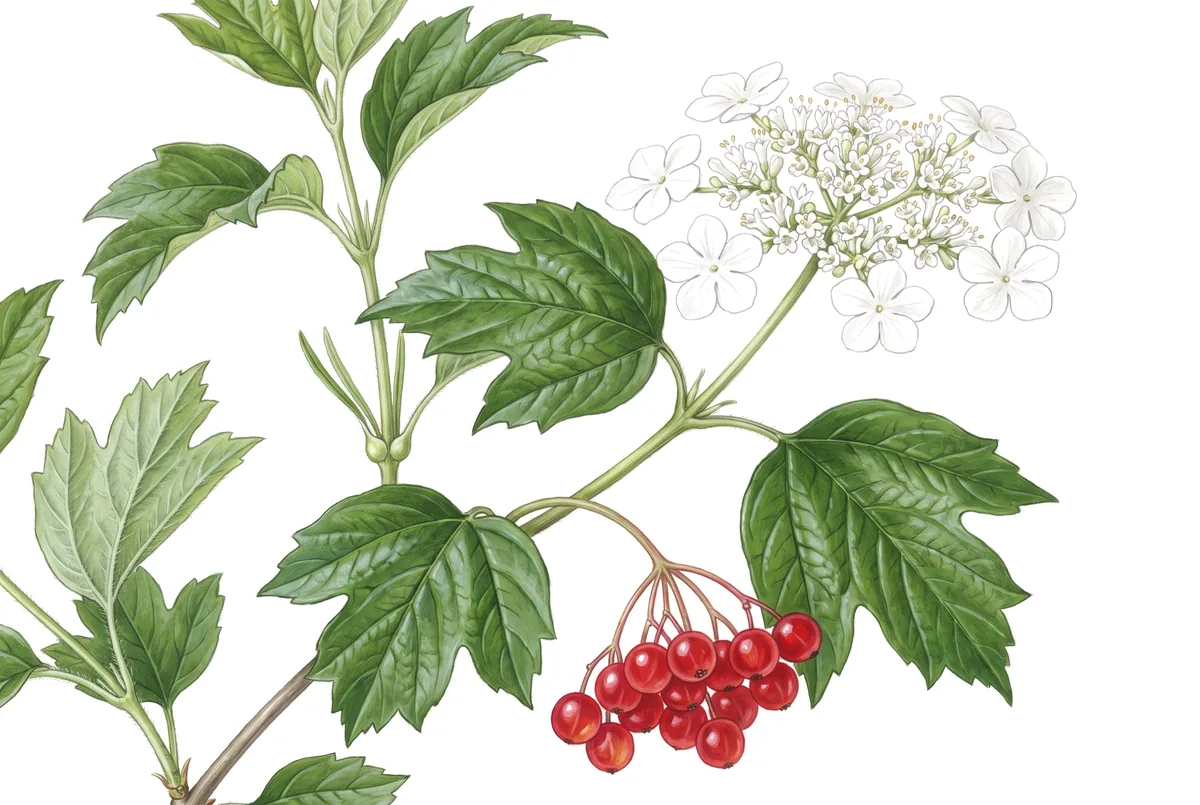
- Flat-topped heads of small tubular fertile flowers ringed by larger, showy sterile flowers, white by the RHS, 5 to 10 cm across by North Carolina State Extension. The RHS gives late spring and early summer for them.
- What are the berries of guelder rose like?
- Bright red and translucent by the RHS, often lasting into winter, and about 8 mm wide by HortFlora. Landcare Research calls them red-orange. North Carolina State Extension says they shrivel after frost to look like red raisins.
- Does guelder rose colour in autumn?
- Yes. The RHS gives leaves tinted red in autumn and the Missouri Botanical Garden a sometimes attractive purplish red, and Christchurch City Council's tree list names its autumn leaves among its features, with the red fruit and white flowers.
- Does guelder rose grow wild in New Zealand?
- The Flora of New Zealand and the New Zealand Plant Conservation Network give its biostatus as exotic. The Flora's profile of the genus lists four viburnums recorded in New Zealand, guelder rose among them, and counts two as fully naturalised and two as casual, so each is recorded wild here; it does not say which grade is guelder rose's. The American references describe it as weedy in North America: the Missouri Botanical Garden says it has naturalised in parts of the northeastern and Midwestern United States.
Sources
- GBIF species match API
- Flora of New Zealand (Manaaki Whenua Landcare Research): taxon profile, Viburnum opulus
- New Zealand Plant Conservation Network (NZPCN): Viburnum opulus
- Flora of New Zealand (Manaaki Whenua Landcare Research): taxon profile, Viburnum plicatum
- Flora of New Zealand (Manaaki Whenua Landcare Research): taxon profile, the genus Viburnum
- Royal Horticultural Society plant profile: Viburnum opulus
- Missouri Botanical Garden Plant Finder: Viburnum opulus
- North Carolina State Extension Gardener Plant Toolbox: Viburnum opulus
- Christchurch City Council, tree species list (September 2024)
- Manaaki Whenua Landcare Research, Plants in New Zealand Poisonous to Children (pamphlet, revised 2002)
- HortFlora, the Horticultural Flora of South-eastern Australia (Royal Botanic Gardens Victoria): Viburnum opulus
- The HortOS catalogue for New Zealand (the names growers list guelder rose and its forms under)
- The HortOS guides for New Zealand (plant grades by market; nursery plant quality)
The growers, sizes and prices above are live and change as lists arrive. Cite this page: HortOS, Guelder rose (Viburnum opulus), https://nz.hortosapp.com/plants/viburnum-opulus.
Found a fact that is wrong? Tell us and it is checked against its source.