Eco-sourcing native plants by ecological district in New Zealand
Sets out the Department of Conservation's eco-sourcing guidelines of September 2025, how an ecological district differs from a council region, and what six documents say about how close seed should be. A table counts the growers listing common restoration natives and names the regions with most growers for each, and the page says no listing shows a seed source.
Updated 11 October 2026. Grower counts are what the live nz.hortosapp.com plant pages printed; medians are not published for most New Zealand plants yet.
On this page
A restoration trust ordering plants for a gully asks how it can be sure the natives it buys were raised from seed of its own ecological district. The Department of Conservation's eco-sourcing guidelines (New Zealand, September 2025) put the seed source as near the restoration site as possible, and no further away than the neighbouring ecological district. HortOS shows which growers list a species, not where their seed was collected, so that part of the answer comes from each grower.
This page reports the Department's guidelines and web pages, Auckland Council's Unitary Plan appendix and restoration guide, Marlborough District Council's eco-sourcing page, a Greater Wellington Regional Council officer report of 2004 and two Tāne's Tree Trust factsheets. HortOS, a free directory of New Zealand wholesale plant growers with their published availability and trade prices, adds how many growers list the commonly planted restoration species, and in which regions. It shows no grower's seed source, and it is not ecological advice or a planting plan for any site.
Quick facts
| The distance rule | The Department of Conservation's eco-sourcing guidelines (New Zealand, September 2025) say the seed source is as near the restoration site as possible, and in the neighbouring ecological district at the furthest. |
|---|---|
| The districts | The Department's guidelines (New Zealand, 2025) count 268 ecological districts in 85 regions, each set apart by its climate, geology, soils and living communities. |
| The buyer's guideline | The Department's seventh guideline (New Zealand, 2025) is for a buyer: the nursery to support is one that grows eco-sourced plants and specialises in them. |
| Region and district | Auckland Council's restoration guide (Auckland, March 2024) groups the region into 12 ecological districts. A Greater Wellington Regional Council officer report of February 2004 counted five in the Wellington Region. |
| Lead time | Tāne's Tree Trust's Factsheet 15 (New Zealand, 2024) says a planting programme needs to allow one to three years for nurseries to get seed from suitable places and raise the seedlings. |
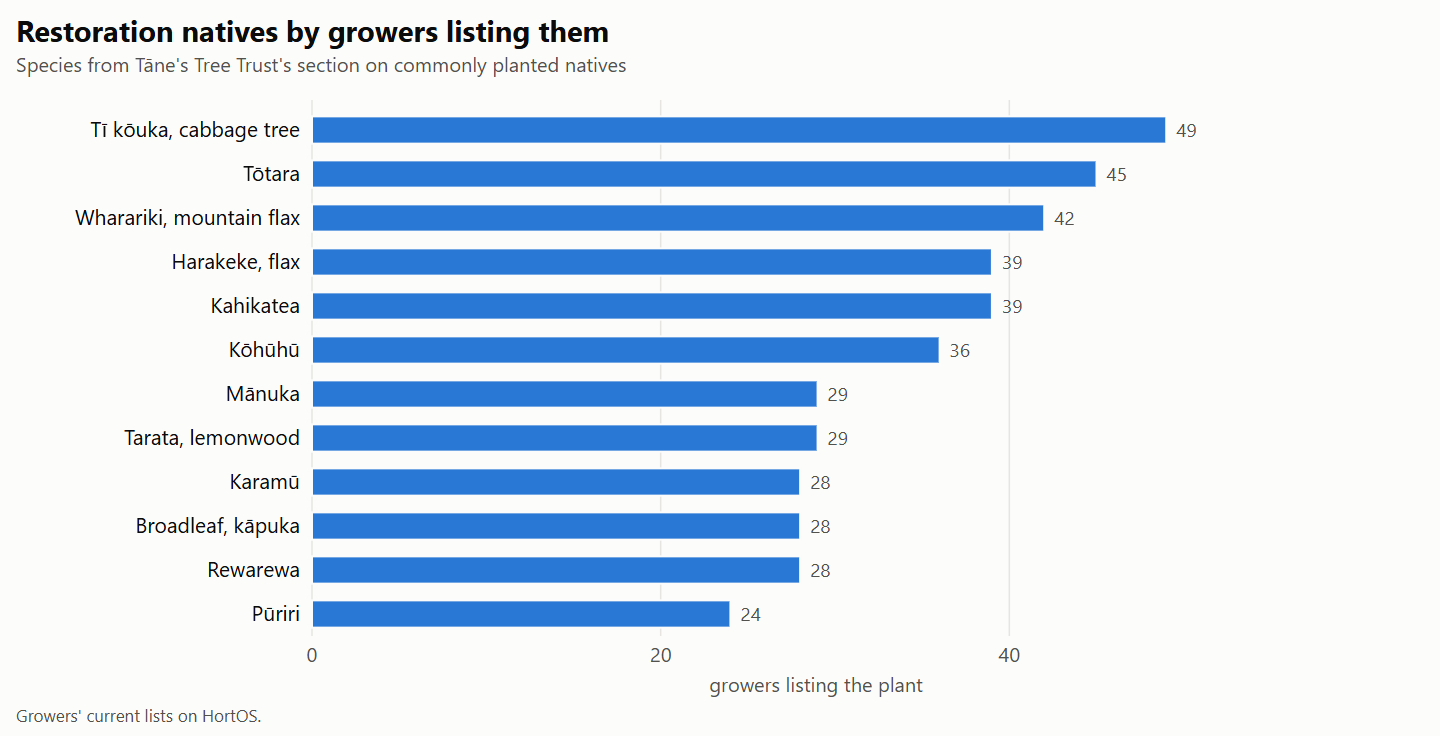
| Growers listing the species | On HortOS, in any size, 45 growers listed tōtara, 49 tī kōuka and 29 mānuka. No listing shows where the seed was collected. |
What the Department's guidelines ask
The Department of Conservation's guidelines (New Zealand, September 2025) define eco-sourcing as collecting seed or cuttings at the nearest workable places, from ecosystems like the one being restored, to raise plants for a restoration project. The sixth guideline sets the distance: the source is as close to the restoration site as it can be, and at the furthest it lies in the neighbouring ecological district. The seventh is for a buyer, who is asked to support a nursery that grows eco-sourced plants and specialises in them.
The collecting guideline (New Zealand, 2025) asks for material from as many plants as is practical, ideally more than 50, with few seeds from any one plant, generally under 10 per cent of the total.
The guidelines are for restoration planting. A footnote (New Zealand, 2025) says that term leaves out amenity gardens, work on threatened species away from their wild sites, and planting done for research, for cultural collection or for teaching. The guidelines add that, "for iwi, runaka and hapū", moving a species between places calls for attention to local protocols.
Finding the district, and why a region is not one
An ecological district is not a council region. The Department's guidelines (New Zealand, 2025) count 268 districts in 85 regions, and describe each as a distinct mix of climate, geology, soil and living things.
A council region can hold many districts. Auckland Council's restoration guide (Auckland, March 2024) groups the region into 12 ecological districts, and a Greater Wellington Regional Council officer report of February 2004 counted five in the Wellington Region. HortOS groups growers by region, not by ecological district: its hubs for Auckland and Wellington each cover a whole region.
The Department's eco-sourcing page (New Zealand, read 2026) points readers to its online map, where the Ecological Districts or Ecological Regions layer is ticked in the menu on the left. The New Zealand Plant Conservation Network publishes plant lists by ecological region and district (New Zealand, read October 2026), reached by picking a district on its map or from the listing under it.
Six documents on how close the seed should be
The table sets six documents side by side. Each was read on 5 October 2026, and each says both how close the seed source should be and something about the nursery or the order. The Department and Tāne's Tree Trust come first, then the councils from north to south. Auckland Council has two rows because its plan appendix and its restoration guide are separate documents. The cells are this page's summaries.
| Authority and date | How close the seed source should be | What it says about the nursery or the order |
|---|---|---|
| Department of Conservation, national guidelines, September 2025 | As near the planting site as possible, and no further than the neighbouring ecological district | Buyers are steered to a nursery that grows eco-sourced plants and specialises in them |
| Tāne's Tree Trust, Factsheet 2, 2022 | Wild populations as near as can be to the ground being planted | Ask the nursery about its ecosourcing policy; labelled lines or seed collection records are the evidence to expect |
| Auckland Council, Unitary Plan Appendix 16 (replanting behind a rural subdivision consent), text of July 2026 | Plants sourced in the site's own ecological district | The planting plan assessment covers the sourcing of the plants, with the species, sizes and density |
| Auckland Council, Te Haumanu Taiao restoration guide, March 2024 | As near the planting site as possible, which often means the same ecological district | A restoration nursery should be able to say where its seed was collected |
| Greater Wellington Regional Council, officer report to committee, February 2004 | The report recommended ecological district level for the council's own planting, wherever practicable | It said talks could be held with suppliers, looking to contracts for eco-sourced plants |
| Marlborough District Council, eco-sourcing page, read October 2026 | As near the original site as can be managed, and inside its ecological district at the least | Readers are told to ask local nurseries for eco-sourced plants, because asking leads nurseries to grow more |
The rows differ in standing. The Department's row is national guidance. The Department (New Zealand, 2025) says its staff also use the guidelines in regulatory work: as conditions on resource consents, in its permissions framework, and by helping make sure a nursery can identify the source of its plant material. Tāne's Tree Trust's row is a trust's factsheet, not a regulator's rule.
Appendix 16 of the Auckland Unitary Plan (Auckland, text of July 2026) speaks of an application for consent to subdivide that is based on replanting native vegetation. For that application, the appendix (Auckland, July 2026) says the council requires an assessment of the site before planting, an assessment of the planting plan and a monitoring programme each year. The same appendix (Auckland, July 2026) says it is important to use plants sourced in the specific ecological district, and lists the sourcing of plants among the matters the planting plan assessment covers.
Auckland Council's own page for Te Haumanu Taiao (Auckland, read 2026) says the guide "has no formal regulatory status" and gives best-practice guidance for restoration, and for planting that a resource consent may require.
The Greater Wellington row is an officer report to a council committee, dated 11 February 2004, which recommended eco-sourcing at ecological district level as council policy. It is reported here as a recommendation of that date and no more.
Marlborough District Council's page (Marlborough, read 2026) adds that collecting inside the district is not always possible. It says council ecologists agreed two broad zones for eco-sourcing with Department of Conservation and QEII staff, as a practical minimum guide.
Four documents read for this page give a lead time, each for its own case. Auckland Council's guide (Auckland, 2024) says a large order of several eco-sourced species often needs a contract order at least a year ahead. Tāne's Tree Trust's Factsheet 15 (New Zealand, 2024) says planting programmes need to allow one to three years for nurseries to get seed from suitable places and raise the seedlings. The Trust's Factsheet 2 (New Zealand, 2022), setting out principles it attributes to the Department of Conservation, speaks of a possible wait of two years or longer from the start of a programme until the plants go in. Marlborough District Council (Marlborough, read 2026) says a landowner who collects local seed for a local nursery to grow faces a delay of a couple of years.
Where the district line bends
The Department does not treat the district line as exact. Its guidelines (New Zealand, 2025) call the district boundaries a practical place to start, and say the habitat and local conditions inside a district count as well. Their example is the Port Hills district near Christchurch, which alone holds forest, wetlands, dunes, rocky bluffs and sub-alpine shrubland. Where a site sits near the edge of its district, they say, the nearest and best source may lie in the district next door.
The guidelines allow that some projects may need to depart from them, and say those cases call for technical and ecological advice. One case listed is a common, widespread native with a very wide natural range whose populations have kept mixing genetically.
The Department's eco-sourcing page (New Zealand, read 2026) says wind-pollinated plants, such as podocarps, beech and grasses, differ least from place to place. Plants pollinated or spread by birds or insects vary with climate, landform and soil, it says, and their seed is collected as near the planting site as possible.
Two documents single out particular plants. The Department's seed collecting guide (New Zealand, read 2026) says kānuka and mānuka each vary so much around the country that they are always to be eco-sourced with care. It says the common kōwhai, Sophora microphylla, varies too, so its seed is taken from trees known to be natural and not planted. Auckland Council's guide (Auckland, 2024) notes that Kunzea has several species in Auckland, and tells planters to take seed from the closest natural stands.
Tāne's Tree Trust's Factsheet 2 (New Zealand, 2022) says many practitioners work at the scale of the ecological region or district because it is practical, and adds that those boundaries were not mapped from plant genetics. Some natives, it says, vary little over large areas, while others have distinct populations suited to areas much smaller than a district. The Trust backs best-practice eco-sourcing but says it should not be enforced so rigidly that it puts people off planting native forest.
The Trust's Factsheet 15 (New Zealand, 2024) reports a continuing debate among planters, foresters and ecologists over the role of eco-sourcing and where the boundaries of a local provenance lie. It reports that a 2023 New Zealand Journal of Botany paper recommends nine broad eco-sourcing regions, with a plant's visible adaptation to its environment guiding the choice of seed inside each.
What a listing shows, and what it cannot
The second table counts growers for 25 native species. They head entries in the closing section of Tāne's Tree Trust's Factsheet 15 (New Zealand, 2024), which the Trust gives to the shrubs, monocots and trees most commonly planted. A further 6 plants that head entries there are not shown. Rows run from the most growers to the fewest. Grower counts are the growers listing each plant on HortOS, in any size. A count here is growers listing the plant, not how many plants exist or how well it suits a site. Median trade prices are not published for most New Zealand plants yet.
The third column gives the regions where the most growers list each plant, up to three. Where regions tie, the column does not put one ahead of another, so some rows show one region and some show only how many regions tie.
The last column names the regions with the most growers listing each plant, three at most, and stops where regions tie for the next place.
Each count is for one page: the species page under the botanical name the factsheet uses. Named selections and cultivars have pages of their own and are not counted. Some plants also have a page under another botanical name, among them koromiko under Veronica stricta, kohekohe under Dysoxylum spectabile, and red and silver beech under Nothofagus. Counts on two pages are never added together, so the low counts in those rows may not be all the growers listing those plants.
The last rows rest on very few growers: 5 for silver beech and 5 for mountain beech. A count that low moves when a single grower changes its list, and nothing regional can be read from those rows.
The regions column says which region a grower is in. It does not say where a plant's seed was collected or where a species grows naturally, and a region is not an ecological district.
For any one grower, the directory does not show the seed source of a line, its ecological district, or how many parent plants the seed came from. It does not show whether a plant listed under a species name was raised from seed of wild stands or is a selection. It does not show a grower's eco-sourcing policy, its seed records or whether it is accredited under Plant Pass. A listing is not proof of local provenance, and HortOS cannot vouch for it. Each of those is a question for the grower.
The first table gives what the documents say to ask a nursery. Tāne's Tree Trust's Factsheet 15 (New Zealand, 2024) adds that buyers of native seedlings should ask for evidence of record keeping. The first item it puts on a seed lot's label is the place of collection, with a GPS position if possible. For biosecurity, Auckland Council's guide (Auckland, 2024) says to buy, where possible, from nurseries accredited under Plant Pass.
The guide to buying from a wholesale grower covers how a group outside the trade places an order, and the guide to funding for native planting covers who pays. The guide to native plants for tūī, kererū and korimako counts growers for many of the same species.
What to watch for
- Reading a region as a district. Auckland Council's guide (Auckland, 2024) counts 12 ecological districts in one region, and a grower's region says nothing of where its seed was collected.
- Taking a species name as proof of local seed. A listing names the plant. Where the seed came from is the grower's to show.
- Treating the district line as exact. The Department of Conservation (New Zealand, 2025) calls the boundaries a practical starting point, and says the habitat inside a district counts too.
- Leaving the order to the planting season. Auckland Council's guide (Auckland, 2024) says a large order of several eco-sourced species often needs a contract a year or more ahead.
- Reading the Wellington row as a policy in force. It is the recommendation of an officer report of February 2004.
Getting it right
- Find the site's ecological district, and the districts beside it, on the map the Department of Conservation's eco-sourcing page points to.
- Ask the council whether a consent or a plan rule sets a sourcing condition for the planting. The council decides what a consent needs.
- Look up what grows in the district in the New Zealand Plant Conservation Network's plant lists by district.
- Open a plant's page from the second table to see the growers listing it and their regions.
- Ask each grower where the seed for the line was collected, whether it came from natural stands, and what record is kept. The grower answers, not HortOS.
- Settle the timing with the grower before the planting date is fixed.
A word of caution
The guidelines are the Department of Conservation's (New Zealand, September 2025), and the Department says a project that needs to depart from them calls for technical and ecological advice. What a consent requires is the council's to decide: Auckland's Appendix 16 is reported as it read in July 2026, and the Greater Wellington report is a recommendation of 2004. Seed source is the grower's to answer, and nothing on HortOS shows it.
Sources
- Department of Conservation, Eco-sourcing guidelines (September 2025): the national eco-sourcing guidelines. Source: Department of Conservation, CC BY 4.0.
- Department of Conservation, Eco-sourcing, collecting and propagating seeds and plant material: pollination, and the district map.
- Department of Conservation, Collect seeds and propagate native trees and shrubs: species that vary by place.
- New Zealand Plant Conservation Network, Plant lists by ecological region/district: plant lists for each district.
- Auckland Council, Auckland Unitary Plan, Appendix 16 Guideline for native revegetation plantings (text of July 2026): replanting behind a subdivision consent.
- Auckland Council, Te Haumanu Taiao: Restoring the natural environment in Tāmaki Makaurau (March 2024): Auckland's restoration guide.
- Auckland Council (Tiaki Tāmaki Makaurau), Te Haumanu Taiao: read the guide: the standing of that guide.
- Marlborough District Council, Eco-Sourcing Native Plants Seed Collection Project: Marlborough's zones and seed project.
- Greater Wellington Regional Council, Report 04.59, Eco-sourcing policy for native plants (11 February 2004): the officer report's recommendation.
- Tāne's Tree Trust, Factsheet 2: Ecosourcing of native species for planting (2022): boundaries, nurseries and exceptions.
- Tāne's Tree Trust, Factsheet 15: Collecting and handling seed of native trees and shrubs (2024): seed records and lead times.
More guides

Buying From a Wholesale Grower When You Are Not in the Trade
Catchment groups, schools, trusts and landowners can buy from New Zealand wholesale growers when they order like the trade: in quantity, a season ahead, on the grower's terms. This page explains who sells to whom, what an NZBN and GST change, grades from root trainers to PB bags, eco-sourcing and proof of it, lead times and Plant Pass.
Funding for native planting in New Zealand, scheme by scheme
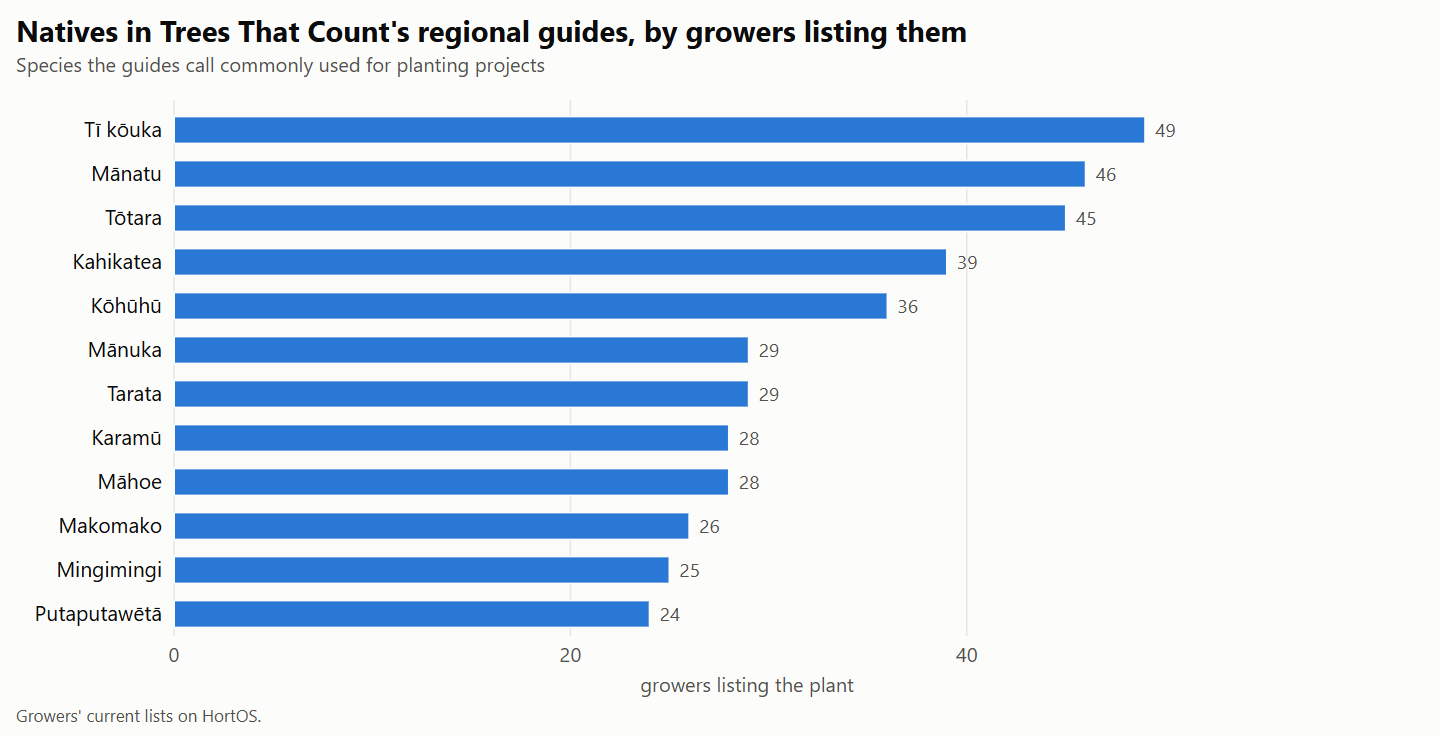
A dated map of who funds native planting in New Zealand, as read on 5 October 2026: Trees That Count's tree requests, regional council riparian and erosion grants, the Hill Country Erosion Programme and the forest land rules of the Emissions Trading Scheme, with how many growers list the species Trees That Count's regional guides call commonly used.
Native plants that feed tūī, kererū and korimako all year
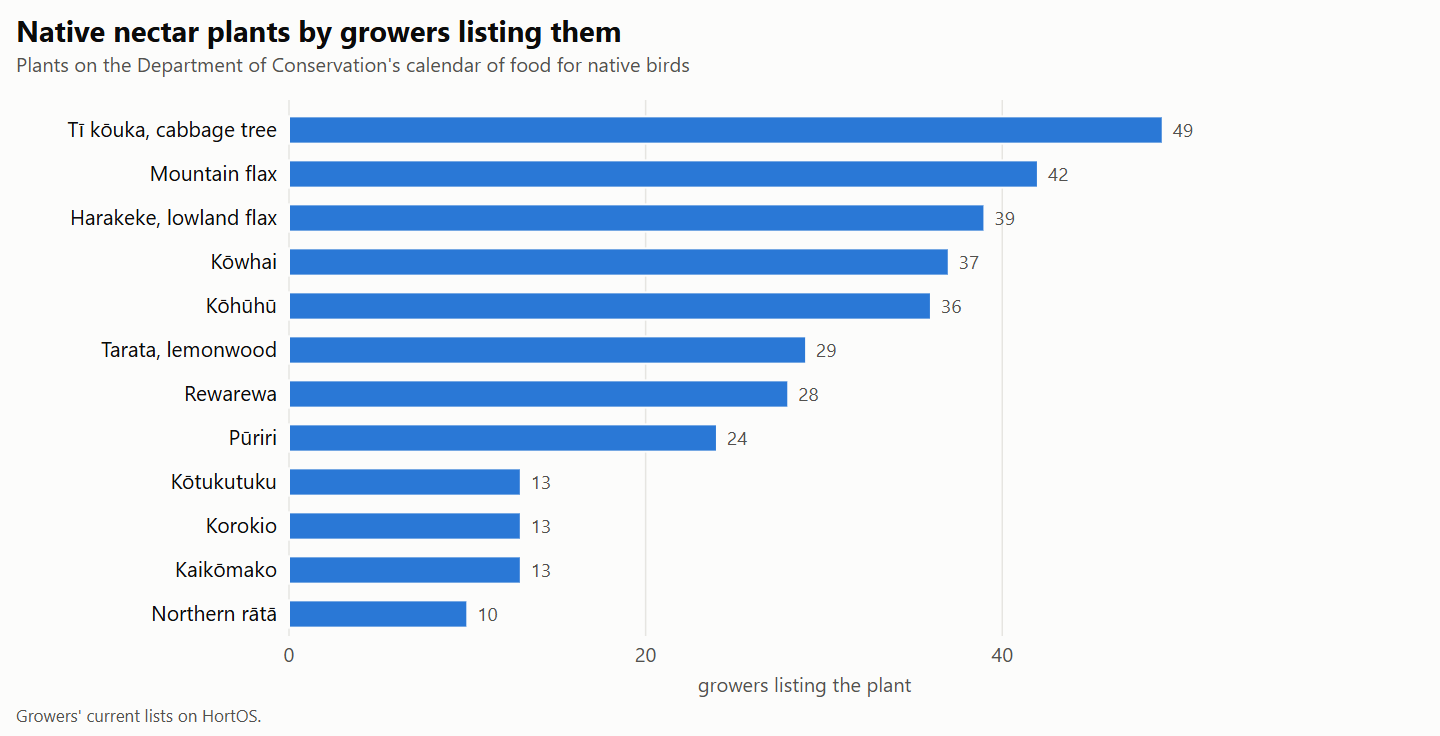
The Department of Conservation's month by month calendar of native food plants for birds, read for tūī, kererū and korimako and counted to show its full autumn and thin winter, set beside how many New Zealand wholesale growers list the plants shown and in which regions, with what the Department says about eco-sourced plants and cultivars near bush.