Funding for native planting in New Zealand, scheme by scheme
A dated map of who funds native planting in New Zealand, as read on 5 October 2026: Trees That Count's tree requests, regional council riparian and erosion grants, the Hill Country Erosion Programme and the forest land rules of the Emissions Trading Scheme, with how many growers list the species Trees That Count's regional guides call commonly used.
Updated 16 October 2026. Grower counts are what the live nz.hortosapp.com plant pages printed; medians are not published for most New Zealand plants yet.
On this page
- Quick facts
- Trees That Count pays the nursery, not the planter
- Council grants and the Hill Country Erosion Programme
- Why the Emissions Trading Scheme is not a grant
- Growers listing the species the regional guides name
- What the funding table and the grower counts leave out
- What to watch for
- Getting it right
- A word of caution
- Sources
A catchment group with a stream bank to plant, or a farmer retiring an eroding hillside, asks one thing first: who will help pay for the trees. In New Zealand the money for native planting sits with separate funders, and each sets its own terms and dates. One funder pays the nursery. Regional councils share the cost of work they have agreed. A government programme reaches the land through those councils. The Emissions Trading Scheme issues units and is not a grant.
This guide reports each scheme from the funder's own page, as read on 5 October 2026: Trees That Count, Te Uru Rākau's Canopy site, regional and district councils, the QEII National Trust and the Department of Conservation. Forest land is defined from the Climate Change Response Act 2002. HortOS, a free directory of New Zealand wholesale plant growers with their published availability and trade prices, adds how many growers list the species Trees That Count's regional guides call commonly used. It is not advice on eligibility: each funder decides.
Quick facts
| Smallest Trees That Count request | 500 trees for one planting season, inside a project planned to reach at least 10,000 trees over its life (Trees That Count, New Zealand, criteria page dated 4 July 2024). |
|---|---|
| Where that money goes | To the nursery, not to the planter as cash (Trees That Count, New Zealand, criteria page dated 4 July 2024). Its request page, as read on 5 October 2026, says it usually pays the planter's chosen nursery direct. |
| Requests for 2027 planting | Trees That Count's request page (New Zealand), as read on 5 October 2026, gave 15 September 2026 as the last day for requests for 2027 planting projects. |
| Hill Country Erosion Programme | A Ministry for Primary Industries programme that funds councils for regional projects on erosion-prone hill country; landowners are sent to their council's land management officers (Te Uru Rākau, Canopy, New Zealand, page updated 14 September 2026). |
| Two published cost shares | Kaipara Moana Remediation's Landowner Grants typically meet up to half of an eligible project's estimated cost (2026). Environment Southland's catchment improvement funding meets half, or 70% for a farmer with an active farm plan, capped at $10,000 a project (2026). |
| Emissions Trading Scheme | Not a grant. Section 4 of New Zealand's Climate Change Response Act 2002 (version as at 4 September 2026) defines forest land as at least 1 hectare with forest species crown cover, present or likely, above 30% on each hectare. |
Trees That Count pays the nursery, not the planter
Trees That Count takes requests for native trees through its website. Its criteria page (New Zealand, dated 4 July 2024) sets the smallest request at 500 trees for one planting season, inside a project planned to reach at least 10,000 trees over its life. The same 2024 page limits the scheme to permanent native forest, and rules out landscaping and private gardens.
Under those 2024 criteria the money goes to nurseries, not to the planter as cash. The request page, as read on 5 October 2026, says an accepted planter gets a quote from the local nursery it prefers. Trees That Count then approves the costs and usually pays that nursery direct. That page gave 15 September 2026 as the last day for requests for 2027 planting projects.
Eco-sourcing is a condition. The choice of nursery is the planter's. The 2024 criteria say funded trees have to be eco-sourced and endemic to the area being planted. Trees That Count says it has no exclusive agreements with nurseries (2024), and it describes its own regional list of nurseries as not a full one (2026). What eco-sourcing asks of a planter is the subject of the guide to ecosourcing by ecological district.
Council grants and the Hill Country Erosion Programme
The first table sets out 23 schemes, each described from the funder's own page with the year of that page. The funding table covers the councils whose pages were read for this guide. Where a row says a round or an order book was open or closed, that is its state as read on 5 October 2026.
| Scheme | Where | What it can pay for | Terms as published | Authority and year |
|---|---|---|---|---|
| Trees That Count tree requests | National | Native trees for permanent native forest projects; the money goes to the nursery and is not paid to the planter as cash | A request is for 500 trees or more in one planting season, within a project planned to reach at least 10,000 trees | Trees That Count, 2024 |
| Hill Country Erosion Programme | National, delivered through councils | Regional council projects on hill country that is prone to erosion | The money goes to councils; a landowner asks the council's land management officers what runs in the area | Te Uru Rākau (Ministry for Primary Industries), Canopy, 2026 |
| Sustainable Land Use Initiative (SLUI) | Manawatū-Whanganui | Erosion control works agreed with a council adviser once the property is mapped, at 30% to 50% of cost in the October 2023 handout | Rates and caps for most works are 20% higher for works approved between 1 March 2026 and 30 June 2027; space-planted poplar and willow are outside the increase | Horizons Regional Council, 2023 and 2026 |
| Environmental Grants (land) | Manawatū-Whanganui | Erosion control and water quality work anywhere in the region | Usually 30% of the cost, to a top limit of $10,000 a year for an applicant, as at October 2023 | Horizons Regional Council, 2023 |
| Freshwater grants | Manawatū-Whanganui | Fencing livestock out of a waterway, and native planting in the retired margin | Up to 50 per cent, depending on the catchment; the council can also help find plants and contractors | Horizons Regional Council, 2026 |
| Riparian Management Programme | Taranaki | A free riparian plan for the property, then native plants at cost from nurseries the council contracts | Advance plant orders for 2028 were open when the page was read on 5 October 2026 | Taranaki Regional Council, 2026 |
| South Taranaki and Regional Erosion Support Scheme (STRESS) | Taranaki hill country | Soil conservation works: exotic or indigenous forestry, fencing for forestry and for retirement, poplar and willow poles | A farmer needs a council farm plan on the property before applying | Taranaki Regional Council, 2026 |
| Environment Fund (open for 2026/27 when read) | Northland, outside the Kaipara Harbour catchment | Fencing that keeps livestock at least 3 metres back from a waterway or wetland, and water systems for the animals where that fencing goes in | Contestable and ranked on environmental benefit; work already finished is not funded | Northland Regional Council, 2026 |
| Grants for fencing on erosion-prone land | Northland | Retirement fencing so land can regenerate or be planted, fencing of grazed bush, and poplars and willows on pasture | A contestable fund for highly erodible grazed land | Northland Regional Council, 2026 |
| Kaipara Moana Remediation, Landowner Grants | Kaipara Moana catchment | Sediment reduction projects on private land: wetland restoration, waterway fencing, tree planting and forest regeneration | Typically up to half of the estimated cost of an eligible project | Kaipara Moana Remediation, 2026 |
| Kaipara Moana Remediation, Whenua Whānui Fund | Kaipara Moana catchment | Sediment reduction projects led by collectives such as iwi and hapū, marae, catchment groups and schools | Typically up to 70% of the estimated cost of an eligible project | Kaipara Moana Remediation, 2026 |
| Riparian Programme | Wellington region | Fencing to keep livestock out of waterways, native planting along their edges, and advice | Criteria steer the money to the catchments and sites with the most need; an enquiry form starts the eligibility check | Greater Wellington Regional Council, 2025 |
| Wetland restoration funding and support | Wellington region | Advice, fencing, pest plant control and native planting for a wetland | Expert advice, and funding help in some cases | Greater Wellington Regional Council, 2025 |
| Wellington Regional Erosion Control Initiative (WRECI) | Wellington region | Treatment of erosion-prone land, begun in 2009 with the ministry that is now the Ministry for Primary Industries | Since 1 July 2015 the programme has covered high priority Land Use Capability classes across the region; the council says which parts of a property qualify | Greater Wellington Regional Council, 2026 |
| Erosion support for farmers | Hawke's Bay | Financial support and trees for farmers managing land prone to erosion | The council's riparian planting page asks landowners to call its staff for advice and assistance | Hawke's Bay Regional Council, 2026 |
| Landowner funding assistance and focus catchments | Bay of Plenty | Funding help and practical support for landowners across the region, with extra effort in named focus catchments | The page sends landowners to their local Land Management Officer | Bay of Plenty Regional Council, read 2026 |
| Catchment improvement funding (applications open to 14 February 2027) | Southland | Building and planting a wetland, fencing waterways, restoring a wetland, and retiring and planting gullies and critical source areas | Half of the project cost, or 70% for a farmer with an active farm plan, to a top limit of $10,000 a project | Environment Southland, 2026 |
| Working for Nature, Habitat Marlborough grants | Marlborough | Buying native plants, with guards and stakes, for projects that restore native habitat | Up to $10,000 for one applicant in a year | Marlborough District Council, read 2026 |
| The Stephenson Fund (2026 round closed 31 August 2026) | National, land under a registered QEII covenant | Pest plant control, predator control and revegetation in a covenant; every planting must be eco-sourced | Grants from $1,000 to $15,000 including GST; the applicant puts in half of the project cost, in money or in kind | QEII National Trust, 2026 |
| DOC Community Fund (closed when read) | National | Conservation projects led by community groups, on public or private land | In the 2026 round $9.2 million went to 20 community groups | Department of Conservation, 2026 |
| Ngā Whenua Rāhui | National, Māori-owned land | A kawenata: a conservation agreement that protects native ecosystems while the owners keep ownership and management | Each kawenata comes up for review every 25 years | Department of Conservation, 2026 |
| Regional Environment and Natural Heritage Grant, and Waterway Protection Fund | Auckland | The grant: work that protects, restores or improves the environment in Auckland. The fund: the site says only that a project's eligibility can be checked | The council's conservation site lists both as the funds to start with | Auckland Council, Tiaki Tāmaki Makaurau, 2026 |
| Emissions Trading Scheme, post-1989 forest land | National | Not a grant: an owner who registers eligible forest land may earn New Zealand Units while the forest grows | Forest land is at least 1 hectare, with forest species that have or are likely to reach more than 30% crown cover on every hectare | Te Uru Rākau, Canopy, 2026; Climate Change Response Act 2002, section 4, version as at 4 September 2026 |
The Hill Country Erosion Programme reaches a landowner through a council. Te Uru Rākau's Canopy site (New Zealand, page updated 14 September 2026) says this Ministry for Primary Industries programme funds councils to run regional projects. Horizons Regional Council's handout (October 2023) says its Sustainable Land Use Initiative, SLUI, is paid for through the Hill Country Erosion Fund. Taranaki Regional Council (2026) says its STRESS scheme draws on the same fund, with $3.6 million for the four years ending June 2027.
Horizons' October 2023 handout puts SLUI grants at between 30% and 50% of what the agreed work costs. The council's land page (2026) says the caps and rates on most SLUI works are a further 20% higher for works it approves from 1 March 2026 to 30 June 2027. That 2026 page adds that the handout does not show those changes, and that a land management adviser gives the accurate estimate.
Some rows carry no rate or cap, because the page read states none. That is so for the Hill Country Erosion Programme, Greater Wellington's three programmes, Hawke's Bay Regional Council's erosion support, Bay of Plenty Regional Council's landowner funding, Ngā Whenua Rāhui and the two Auckland funds. In each case the council or agency named decides what it pays. For Hawke's Bay, the table's line about calling staff comes from the council's separate page on riparian planting (2026) and is not a condition of its erosion support.
Why the Emissions Trading Scheme is not a grant
Te Uru Rākau's Canopy guidance (New Zealand, 2026) says a person who registers eligible forest land may earn New Zealand Units while the forest grows.
Section 4 of New Zealand's Climate Change Response Act 2002, as at 4 September 2026, defines forest land as at least 1 hectare with forest species crown cover, present or likely, above 30% on each hectare. The same section of the Climate Change Response Act 2002 (New Zealand, as at 4 September 2026) defines a forest species as a tree species able to reach at least 5 metres at maturity where it grows. Under that New Zealand section, as at 4 September 2026, a tree species grown or managed mainly for fruit or nut crops is not a forest species. Section 4 of the Climate Change Response Act 2002 (New Zealand, as at 4 September 2026) excludes a shelter belt, and other land, where the crown cover averages or is likely to average under 30 metres in width. Under that New Zealand section, as at 4 September 2026, the other land is not excluded if it adjoins land meeting paragraph (a) or (b) of the definition.
Te Uru Rākau's Canopy guidance (New Zealand, 2026) says a person registering post-1989 forest land must own the land, or have a forestry right or a lease over it. The same 2026 guidance says regenerating native forest comes under the same rules as any other kind of forest in the scheme. It says, in 2026, that forest entered as permanent forestry has to stay in the scheme for at least 50 years. Te Uru Rākau's 2026 guidance also says that an owner who deforests registered post-1989 forest land must take that land out of the scheme and repay every unit earned on it.
Te Uru Rākau's Canopy guidance (New Zealand, 2026) gives both sides of the decision: some owners are issued enough units for registering to be worthwhile, and others, above all owners of small forests, are not. The Act and Te Uru Rākau set further rules for registration that this guide does not cover.
Growers listing the species the regional guides name
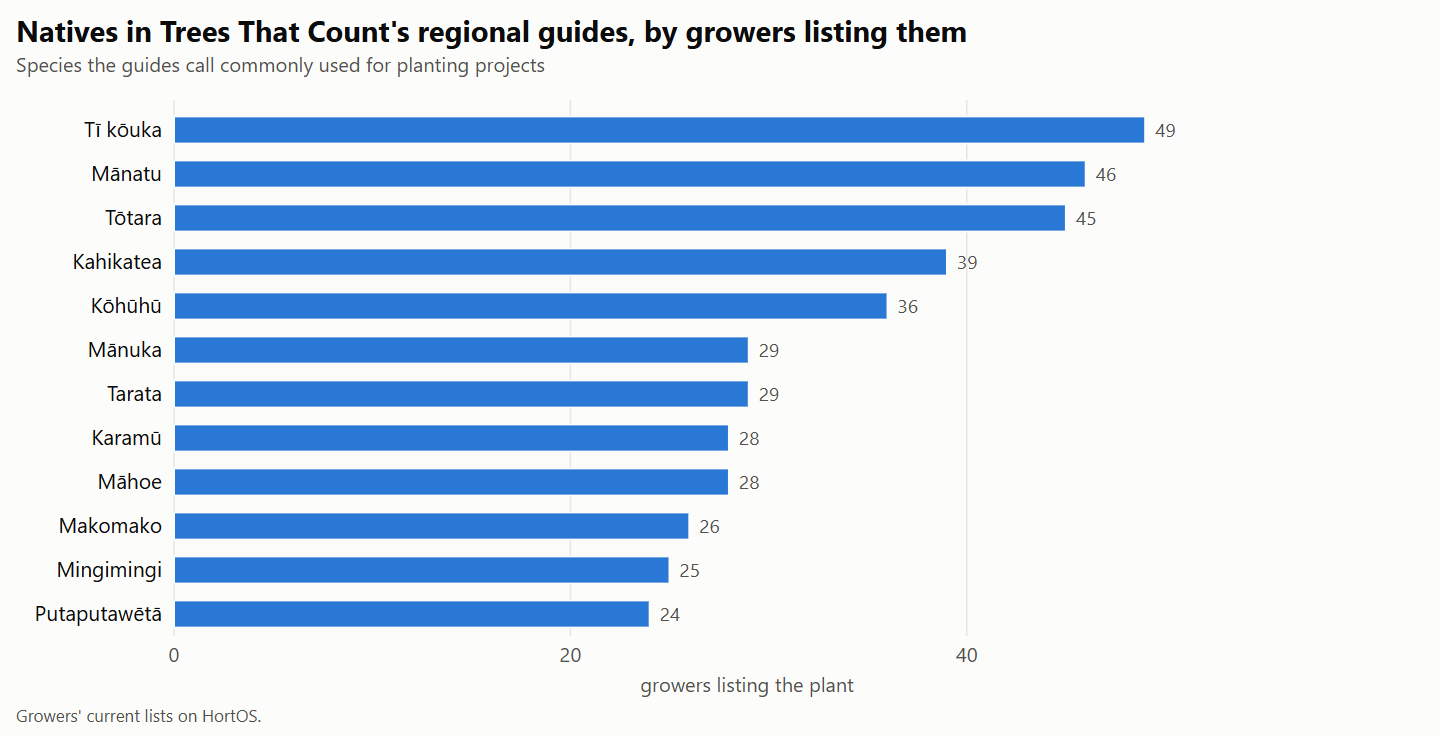
Trees That Count publishes regional guides for planters, and nine were read for this guide (2025 and 2026). The second table holds every species that any of the nine names as commonly used, 23 in all. They are the species Trees That Count's regional guides call commonly used, and the table does not say what any funder pays for.
Grower counts are the growers listing each plant on HortOS, in any size. Each count is for the botanical name in the row: koromiko is counted under Hebe stricta only and kānuka under Kunzea ericoides only, the names the guides use. A count here is growers listing the plant, not how many plants exist or how well it suits a site. Median trade prices are not published for most New Zealand plants yet.
| Plant | Growers listing it | Regions with most growers |
|---|---|---|
| Tī kōuka (Cordyline australis) | 49 | Waikato 7, Auckland 7, Northland 7 |
| Mānatu (Plagianthus regius) | 46 | Northland 7, Waikato 6 |
| Tōtara (Podocarpus totara) | 45 | Waikato 8, Auckland 6 |
| Kahikatea (Dacrycarpus dacrydioides) | 39 | Auckland 7, Northland 6, Waikato 5 |
| Kōhūhū (Pittosporum tenuifolium) | 36 | Auckland 5 |
| Mānuka (Leptospermum scoparium) | 29 | Auckland 6, Waikato 4 |
| Tarata (Pittosporum eugenioides) | 29 | Waikato 6, Auckland 5 |
| Karamū (Coprosma robusta) | 28 | Waikato 5, Northland 5 |
| Māhoe (Melicytus ramiflorus) | 28 | Northland 5, Auckland 5 |
| Makomako (Aristotelia serrata) | 26 | Northland 4 |
| Mingimingi (Coprosma propinqua) | 25 | Waikato 4, Auckland 3, Canterbury 3 |
| Putaputawētā (Carpodetus serratus) | 24 | Waikato 4, Northland 3, Wellington 3 |
| Akeake (Dodonaea viscosa) | 22 | Northland 4 |
| Kānuka (Kunzea ericoides) | 21 | Canterbury 5, Waikato 3, Northland 3 |
| Ngaio (Myoporum laetum) | 21 | Northland 5, Tasman 3, Auckland 3 |
| Taupata (Coprosma repens) | 20 | Tasman 4, Auckland 3 |
| Kōwhai (Sophora tetraptera) | 18 | Northland 3 |
| Māpou (Myrsine australis) | 17 | Northland 3, Auckland 3 |
| Koromiko (Hebe stricta) | 13 | Northland 4, Waikato 2, Auckland 2 |
| Coastal tree daisy (Olearia solandri) | 8 | Hawke's Bay 2, Northland 2 |
| Houhere (Hoheria sexstylosa) | 6 | Tasman 2 |
| Kanono (Coprosma grandifolia) | 4 | 4 regions with 1 each |
| Pōkākā (Elaeocarpus hookerianus) | 3 | Northland 1, Canterbury 1, Auckland 1 |
The last column names the regions with the most growers listing each plant, three at most, and stops where regions tie for the next place.
Tī kōuka is the one species named in all nine guides, and 49 growers listed it. Kānuka, karamū and kōhūhū are in eight guides, and ten species are each in one guide only.
Each region has a hub page of growers on HortOS, among them Northland, Taranaki, Manawatū-Whanganui, Wellington and Southland. For a group that is not in the trade, the guide to buying from a wholesale grower covers quotes, minimum orders and GST.
What the funding table and the grower counts leave out
The directory names more than 1,100 growers that sell plants to the trade, and it holds no field for seed source, eco-sourcing, ecological district or growing practice for any of them. A count in the second table shows who lists a species, not who grows it from local seed. Trees That Count's Manawatū-Whanganui guide (2026) describes eco-sourcing as growing plants from seed collected from naturally occurring vegetation near the planting site. It adds that a nursery on its regional list may also sell plants from outside the region, so the planter has to ask specifically for eco-sourced plants that suit the location.
The funding table does not show a round that opened after 5 October 2026, what remains in a funder's budget, or whether a given property qualifies. Nor does it say every scheme pays for plants: the pages read for the DOC Community Fund and Ngā Whenua Rāhui (Department of Conservation, 2026) do not say that planting is paid for.
What to watch for
- Reading a grant as cash in hand. Trees That Count's 2024 criteria send the money to the nursery, and Environment Southland (2026) reimburses the applicant after the work.
- Starting the work before asking. Northland Regional Council (2026) says its Environment Fund does not pay for work already completed, and Taranaki Regional Council (2026) says a farmer needs a council farm plan before applying to STRESS.
- Counting on units from a narrow strip. Section 4 of the Climate Change Response Act 2002 (New Zealand, as at 4 September 2026) excludes a shelter belt of forest species whose crown cover averages, or is likely to average, under 30 metres in width. Under that New Zealand section, as at 4 September 2026, other land that narrow is excluded too, unless it adjoins land meeting paragraph (a) or (b) of the definition.
- Taking a listed plant as eco-sourced. Trees That Count (2024) funds eco-sourced trees only, and a grower's listing on HortOS does not show where its seed was collected.
Getting it right
- Find the regional council for the land and ask its land management officers what runs in the area. Te Uru Rākau's Canopy site (New Zealand, 2026) names them as the people to ask.
- Read the funder's own page for the current round, and ask the funder what must be agreed before work starts and when the grant is paid. The funder decides who qualifies.
- For a Trees That Count request, approach local nurseries a year or more ahead, as its Manawatū-Whanganui guide (2026) says, and ask each to quote for eco-sourced plants that suit the site.
- Use each plant's page to find the growers listing it by region, then ask each grower where the seed was collected.
- Before counting on units, take the land's details to an ETS adviser, a qualified forestry expert or Te Uru Rākau, as Ag Matters (Ag Emissions Centre, New Zealand, 2026) tells farmers to do.
A word of caution
Every term in this guide was read from the funder's own page on 5 October 2026. A round, a rate or a cap can change after that date. Trees That Count, the council, Kaipara Moana Remediation, the QEII National Trust or the Department of Conservation decides what a project receives, and its staff are the ones to ask. Registration in the Emissions Trading Scheme is governed by the Climate Change Response Act 2002, and Te Uru Rākau is the agency to ask. On seed source and eco-sourcing, the grower's word is the one that counts.
Sources
- Trees That Count, Requesting native trees for my planting project: how a request works.
- Trees That Count, Requirements to be a planter with Trees That Count: criteria for planters.
- Trees That Count, Where to buy trees for my planting project: its regional nursery list.
- Trees That Count, Registering as a native tree provider: how nurseries join.
- Trees That Count, Regional guides for planting native trees: links to regional guides.
- Trees That Count, Northland regional information: species commonly used there.
- Trees That Count, Bay of Plenty regional information: species commonly used there.
- Trees That Count, Taranaki regional information: species commonly used there.
- Trees That Count, Tairāwhiti regional information: species commonly used there.
- Trees That Count, Hawke's Bay regional information: species commonly used there.
- Trees That Count, Manawatū-Whanganui regional information: species and eco-sourcing advice.
- Trees That Count, West Coast regional information: species commonly used there.
- Trees That Count, Canterbury regional information: species commonly used there.
- Trees That Count, Otago-Southland regional information: species commonly used there.
- Te Uru Rākau New Zealand Forest Service, Canopy, Get help with costs: government funds for tree planting.
- Te Uru Rākau New Zealand Forest Service, Canopy, Planning ETS forest land: joining the ETS with forest.
- Climate Change Response Act 2002, section 4 (Interpretation), version as at 4 September 2026: definitions of forest land.
- Ag Matters (Ag Emissions Centre), Trees and vegetation: farm forestry and the ETS.
- Horizons Regional Council, Land: SLUI and its 2026 rates.
- Horizons Regional Council, Land Management Environmental Grants (handout, as at October 2023): grant rates and criteria.
- Horizons Regional Council, Combined Environmental Grants: freshwater and land grants.
- Taranaki Regional Council, Riparian management: riparian plans and plants.
- Taranaki Regional Council, Hill Country Erosion Funding (STRESS): hill country erosion scheme.
- Taranaki Regional Council, Landowner funding assistance: the council's funding programmes.
- Northland Regional Council, Environment Fund: waterway fencing fund, 2026/27.
- Northland Regional Council, Grants for fencing on erosion-prone land: erosion fencing and pole grants.
- Kaipara Moana Remediation, Funding: the catchment's two grant schemes.
- Greater Wellington Regional Council, Protecting and restoring rivers and streams: the Riparian Programme (CC BY 4.0).
- Greater Wellington Regional Council, Wetland restoration funding and support: wetland funding and advice (CC BY 4.0).
- Greater Wellington Regional Council, Erosion control: regional erosion control initiative (CC BY 4.0).
- Hawke's Bay Regional Council, Managing erosion on my farm: erosion support for farmers.
- Hawke's Bay Regional Council, Riparian planting: riparian planting guidance.
- Bay of Plenty Regional Council, Focus catchments: landowner funding, focus catchments.
- Environment Southland, Catchment improvement funding: water quality fund, 2026 to 2027.
- Marlborough District Council, Working for Nature, Eligibility, assessment and guidelines: grant categories and limits.
- QEII National Trust, The Stephenson Fund: grants for work in covenants.
- Department of Conservation, DOC Community Fund: the fund's status. Source: Department of Conservation (CC BY 4.0).
- Department of Conservation, Ngā Whenua Rāhui: kawenata on Māori-owned land. Source: Department of Conservation (CC BY 4.0).
- Auckland Council, Tiaki Tāmaki Makaurau Conservation Auckland, Funding opportunities: Auckland conservation funds.
More guides
Eco-sourcing native plants by ecological district in New Zealand
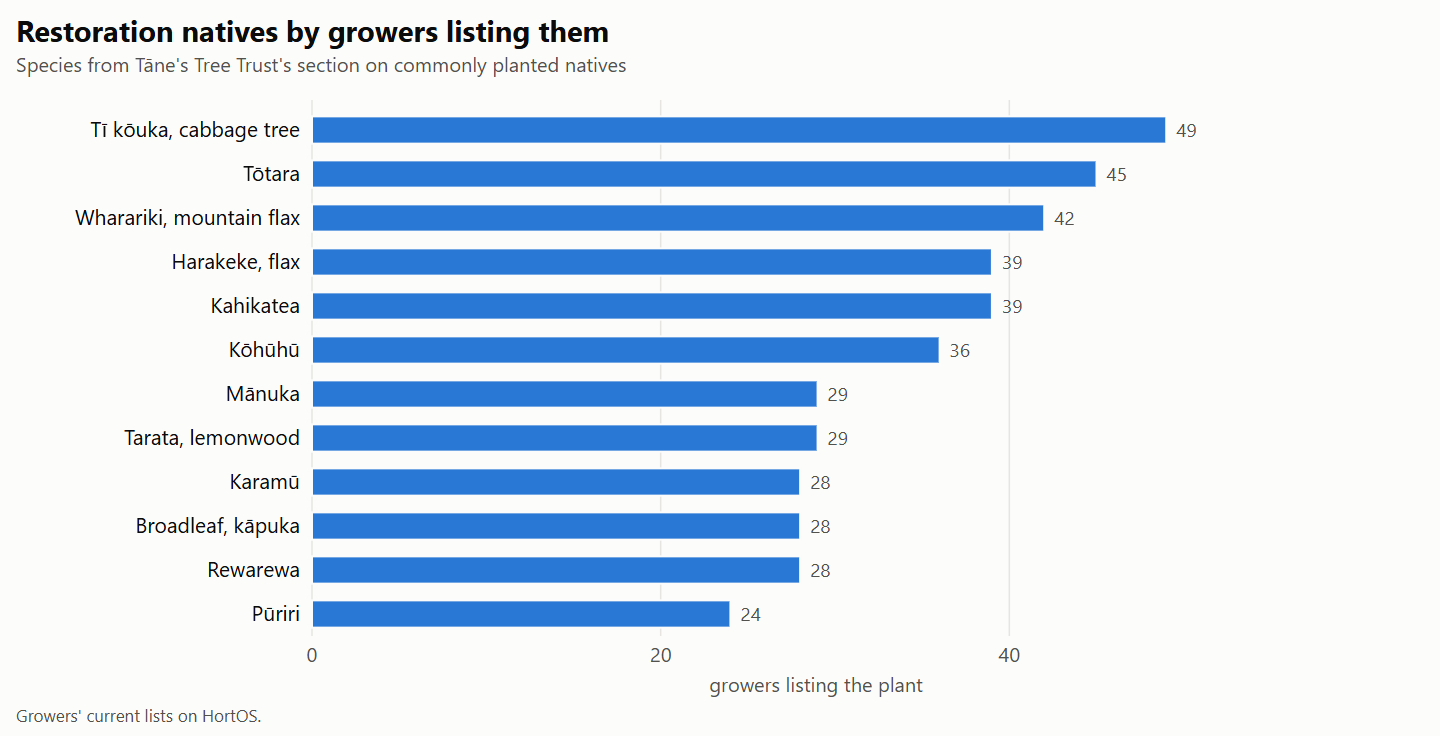
Sets out the Department of Conservation's eco-sourcing guidelines of September 2025, how an ecological district differs from a council region, and what six documents say about how close seed should be. A table counts the growers listing common restoration natives and names the regions with most growers for each, and the page says no listing shows a seed source.

Buying From a Wholesale Grower When You Are Not in the Trade
Catchment groups, schools, trusts and landowners can buy from New Zealand wholesale growers when they order like the trade: in quantity, a season ahead, on the grower's terms. This page explains who sells to whom, what an NZBN and GST change, grades from root trainers to PB bags, eco-sourcing and proof of it, lead times and Plant Pass.
Native plants that feed tūī, kererū and korimako all year
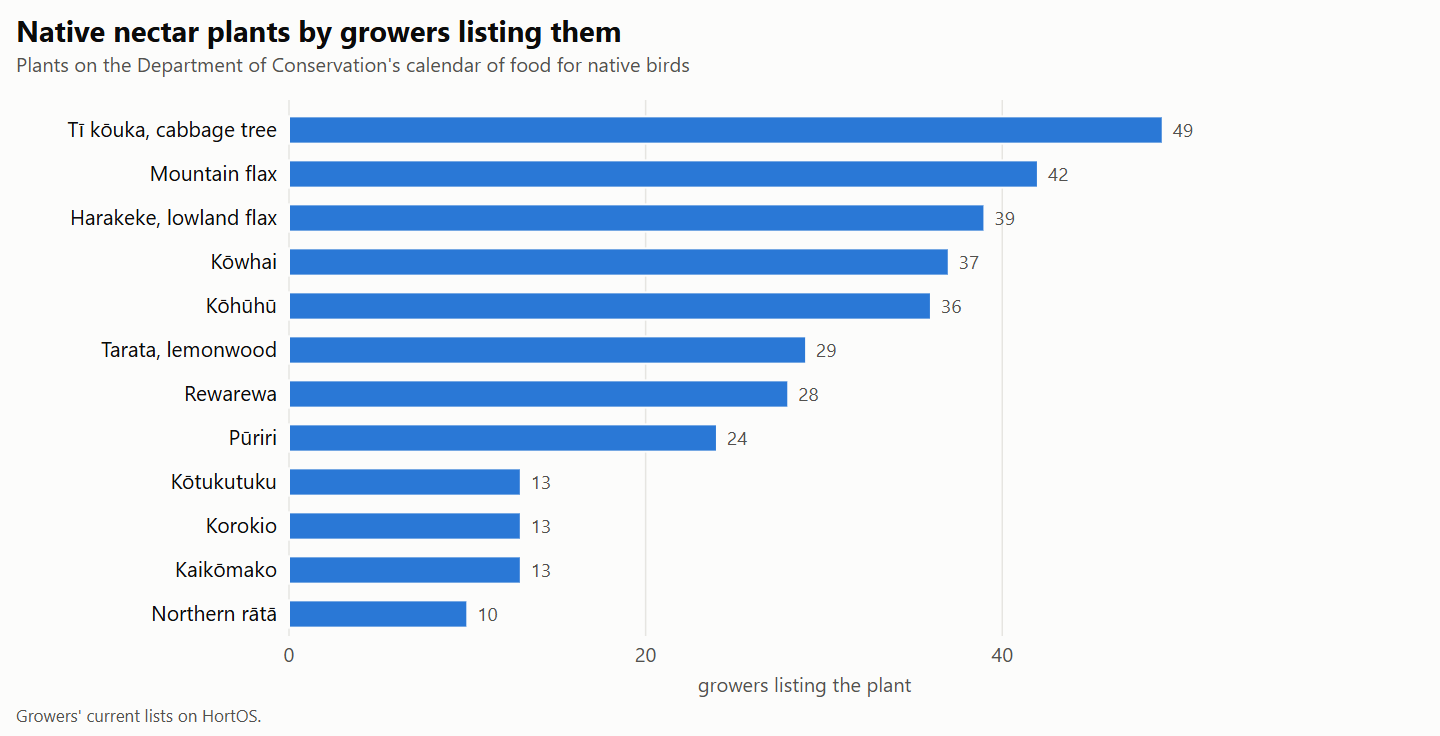
The Department of Conservation's month by month calendar of native food plants for birds, read for tūī, kererū and korimako and counted to show its full autumn and thin winter, set beside how many New Zealand wholesale growers list the plants shown and in which regions, with what the Department says about eco-sourced plants and cultivars near bush.