Native plants that feed tūī, kererū and korimako all year
The Department of Conservation's month by month calendar of native food plants for birds, read for tūī, kererū and korimako and counted to show its full autumn and thin winter, set beside how many New Zealand wholesale growers list the plants shown and in which regions, with what the Department says about eco-sourced plants and cultivars near bush.
Updated 24 October 2026. Grower counts are what the live nz.hortosapp.com plant pages printed; medians are not published for most New Zealand plants yet.
On this page
A catchment group planting a gully by the hundred asks which native plants will keep tūī, kererū and korimako fed in every month, and which growers list them. The year is uneven. Counted for this page from the calendar table on the Department of Conservation's web page, 32 of its 45 native plants carry fruit or seeds in March, but in July only three carry nectar and two carry fruit. On that calendar, a full year of food rests on a handful of winter plants.
This page reports the Department of Conservation's calendar, bird pages and eco-sourcing guidance. The Science Learning Hub, Greater Wellington Regional Council and the New Zealand Veterinary Association add diet, local choice and one caution. HortOS, a free directory of New Zealand wholesale plant growers with their published availability and trade prices, shows how many growers list the calendar plants in its tables, and in which regions. It is not a planting plan for any district.
Quick facts
| The calendar | The calendar table on the Department of Conservation's page Attract birds to your garden (New Zealand, read 2026) marks the months of nectar, fruit and seeds for 45 native plants. By this page's count of its marks, 20 give nectar in some month and 25 give fruit and seeds only. |
|---|---|
| Peak and trough | By this page's count of the calendar table on the Department of Conservation's web page (New Zealand, read 2026), fruit and seeds are marked on 32 plants in March and nectar on 14 in November. Nectar is marked on 3 plants in each month from April to July, and fruit on 2 in each of July, August and September. |
| The all-year plant | Pūriri is the only plant the Department of Conservation's calendar (New Zealand, read 2026) marks for nectar, fruit and seeds in all twelve months. The calendar also marks it frost tender. |
| Growers listing the June plants | Growers listing the five plants the Department of Conservation's calendar (New Zealand, read 2026) marks in June, counted on HortOS, in any size: pūriri 24, māpou 17, miro 12, kohekohe 7 and akatea 2. Each count covers only the page under the botanical name shown in this page's tables; pūriri, miro and kohekohe are among the plants that also have pages under other names or spellings, which are not counted. |
| Where the birds are | The Department of Conservation (New Zealand, read 2026) says tūī live on all three main islands and are scarce only in the drier, mostly open country to the east of the Southern Alps. It says korimako are all but missing from the mainland north of Hamilton. |
| Eco-sourcing | The Department of Conservation (New Zealand, read 2026) asks planters to try to use eco-sourced plants, meaning plants that occur naturally in the area. It says hybrids and cultivars bred for gardens should not be planted in natural bush or close to it. |
Three birds and what each one eats
The three birds do not eat alike. The diet table on the Department of Conservation's page (New Zealand, read 2026) marks tūī and korimako for fruit, nectar and insects. It marks kererū for fruit and foliage, with flowers noted beside them. The table sets the three birds side by side as that diet table marks them.
| Bird | Food groups on DOC's table (read 2026) |
|---|---|
| Tūī | Fruit, nectar and insects |
| Korimako (bellbird) | Fruit, nectar and insects |
| Kererū (New Zealand pigeon) | Fruit and foliage, and flowers |
The Department's tūī page (read 2026) says the birds will cover long distances for favoured food, most of all in winter. It names kōwhai, pūriri, rewarewa, rātā and flax among the native flowers they take nectar from.
The Department's bellbird page (New Zealand, read 2026) says korimako are all but missing from the mainland north of Hamilton, and remain rare in parts of Wellington and Wairarapa and through much of inland Otago and Canterbury.
The Department's kererū page (read 2026) says only kererū and parea are still large enough to swallow big fruit and so to carry the seed far. Its examples are karaka, miro, tawa and taraire. For the long term it names eleven food trees, among them tītoki, patē, porokaiwhiri, makomako, five-finger, kōwhai and pūriri. The Science Learning Hub (2022) reports that kōwhai is the tree on which people have most often seen kererū feeding.
A full autumn and a thin winter on the calendar
The Department of Conservation's calendar (New Zealand, read 2026) gives each plant a row and each month a column, and a mark shows nectar, fruit and seeds, or all three. It carries two further marks beside the plant names. One is for species where, in the Department's words, "several individuals may have to be planted to ensure fruiting". The other is for plants that are frost tender, especially when young. The Department also publishes the calendar as a one-page PDF. The PDF marks one plant differently, so its March count of fruit and seeds is one lower.
This page counted the marks in the web page's table, month by month, across all 45 plants. In that table fruit and seeds peak in March, on 32 plants, and nectar in November, on 14. The autumn peak is in fruit and seeds: nectar is already at its lowest from April, on three plants in each month to July. In June and July the three are akatea, kohekohe and pūriri. Fruit and seeds are marked on three plants in June, which are māpou, miro and pūriri, and on māpou and pūriri alone from July to September.
The Department wrote in 2023 that nectar eaters find plenty in spring and summer and go hungry in autumn and winter, and it named pūriri and kohekohe for the colder months.
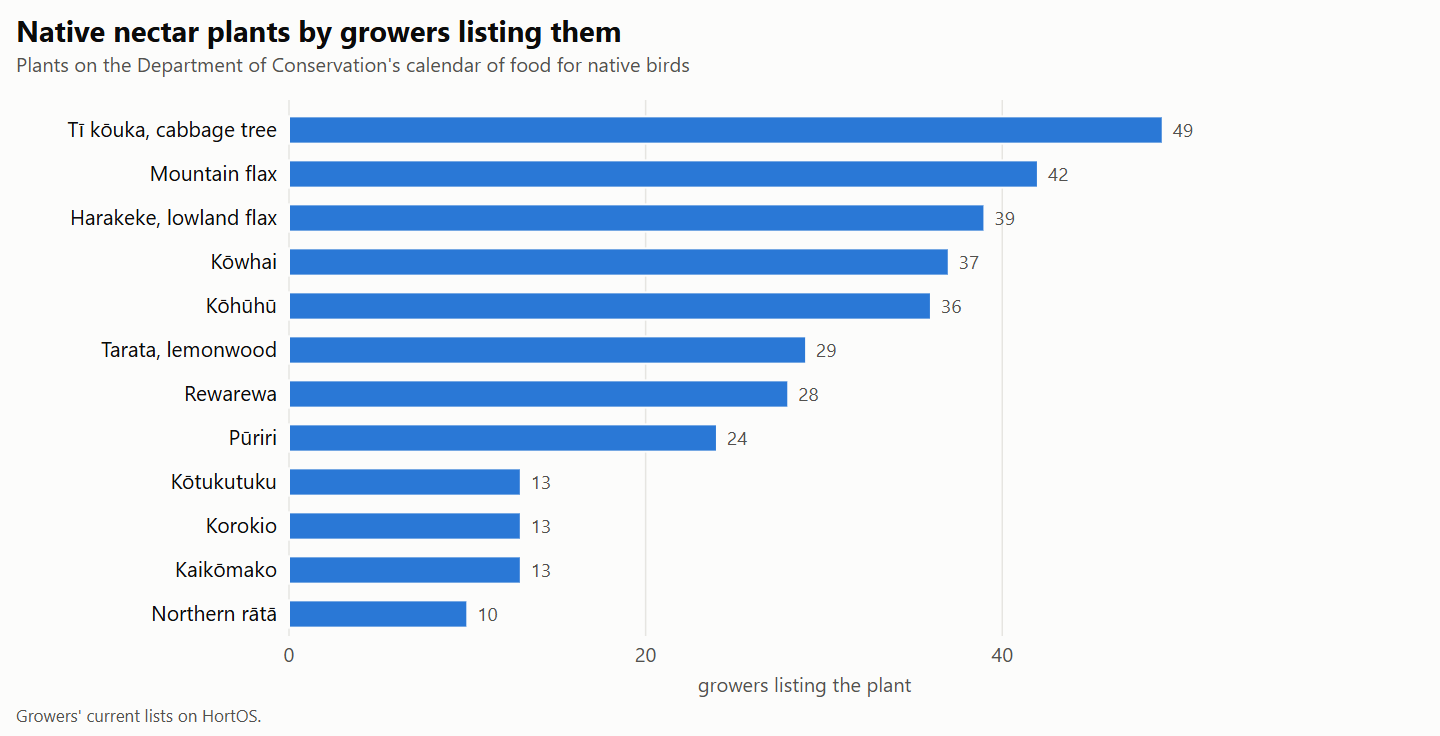
The first table holds the calendar's nectar plants: 17 of the 20 it marks with nectar in some month. They are set out by the first month of nectar from March, with pūriri first because it is marked all year. The other 3 are not shown; the Department's page, linked under Sources, carries the whole calendar. The last column names up to three regions where growers listing the plant are. They are the regions with the most growers listing it, and fewer than three are shown where a tie would put one region ahead of another with the same count; each plant's page shows every region. Grower counts are the growers listing each plant on HortOS, in any size. Each count covers only the page under the botanical name shown in the row. A count here is growers listing the plant, not how many plants exist or how well it suits a site. Median trade prices are not published for most New Zealand plants yet.
| Plant | Food by month, DOC calendar (read 2026) | DOC's note on the calendar | Growers listing it | Regions with most growers |
|---|---|---|---|---|
| Pūriri (Vitex lucens) | Nectar, fruit and seeds all year | Frost tender, especially when young | 24 | Northland 7, Tasman 5, Auckland 5 |
| Akatea (Metrosideros fulgens) | Nectar Mar to Jul | None | 2 | Wellington 1, Tasman 1 |
| Kohekohe (Dysoxylum spectabile) | Nectar May to Aug | Frost tender, especially when young | 7 | Northland 2 |
| Kōtukutuku (Fuchsia excorticata) | Nectar Aug to Dec; fruit Dec to Mar | May need several plants to fruit | 13 | 5 regions with 2 each |
| Korokio (Corokia cotoneaster) | Nectar Sep to Nov; fruit Feb to Apr | None | 13 | 5 regions with 2 each |
| Kōwhai (Sophora microphylla) | Nectar Sep to Nov | None | 37 | Tasman 6, Auckland 5, Waikato 5 |
| Rewarewa (Knightia excelsa) | Nectar Sep to Dec | None | 28 | Northland 5, Waikato 5, Tasman 4 |
| Mountain flax (Phormium cookianum) | Nectar Oct to Jan | None | 42 | Auckland 8, Northland 6, Waikato 5 |
| Kōhūhū (Pittosporum tenuifolium) | Nectar Oct to Jan; fruit Feb to May | None | 36 | Auckland 5 |
| Tarata, lemonwood (Pittosporum eugenioides) | Nectar Oct to Dec; fruit Mar to May | May need several plants to fruit | 29 | Waikato 6, Auckland 5 |
| Tī kōuka, cabbage tree (Cordyline australis) | Nectar Nov; fruit Jan to Apr | None | 49 | Waikato 7, Auckland 7, Northland 7 |
| Kaikōmako (Pennantia corymbosa) | Nectar Nov to Dec; fruit Jan to Apr | May need several plants to fruit | 13 | 5 regions with 2 each |
| Kākābeak (Clianthus puniceus) | Nectar Nov to Dec | None | 5 | Northland 2 |
| Harakeke, lowland flax (Phormium tenax) | Nectar Nov to Jan | None | 39 | Auckland 8, Waikato 7, Northland 5 |
| Northern rātā (Metrosideros robusta) | Nectar Dec to Apr | None | 10 | Wellington 4, Tasman 2 |
| Kakaha, astelia (Astelia nervosa) | Nectar Jan to Feb; fruit Feb to May | None | 4 | Otago 2, Canterbury 1, Wellington 1 |
| Maukoro, native broom (Carmichaelia williamsii) | Nectar Jan to Mar | None | 1 | Tasman 1 |
The last column names the regions with the most growers listing each plant, three at most, and stops where regions tie for the next place.
For the three plants marked for nectar in June and July, the count of growers was 24 for pūriri, 7 for kohekohe and 2 for akatea. For kōtukutuku, marked from August, it was 13. The rows with the most growers listing them flower in spring and summer: tī kōuka (49), mountain flax (42), harakeke (39) and kōwhai (37).
Fruit, seeds and the trees with large fruit
The second table holds the plants the calendar marks with fruit and seeds but no nectar. It shows 22 of the 25, set out by the first month of fruit from October, and 3 are not shown. Counts and regions are on the same basis as in the first table.
| Plant | Fruit and seed months, DOC calendar (read 2026) | DOC's note on the calendar | Growers listing it | Regions with most growers |
|---|---|---|---|---|
| Tītoki (Alectryon excelsus) | Oct to Feb | Frost tender, especially when young | 30 | Auckland 9, Northland 5, Waikato 4 |
| Porokaiwhiri, pigeonwood (Hedycarya arborea) | Nov to Apr | May need several plants to fruit; frost tender, especially when young | 14 | Northland 5, Auckland 2, Manawatū-Whanganui 2 |
| Hīnau (Elaeocarpus dentatus) | Dec to May | None | 3 | Wellington 1, Canterbury 1, Auckland 1 |
| Karamū (Coprosma lucida) | Jan to Apr | May need several plants to fruit | 9 | Canterbury 2, Wellington 2 |
| Kawakawa (Macropiper excelsum) | Jan to Feb | Frost tender, especially when young | 7 | Auckland 2, Northland 2 |
| Makomako, wineberry (Aristotelia serrata) | Jan to Mar | May need several plants to fruit | 26 | Northland 4 |
| Whauwhaupaku, five-finger (Pseudopanax arboreus) | Feb to May | May need several plants to fruit | 21 | Northland 4, Canterbury 4 |
| Whauwhaupaku, five-finger (Pseudopanax laetus) | Feb to May | May need several plants to fruit | 10 | Auckland 2, Northland 2, Taranaki 2 |
| Kanono (Coprosma grandifolia) | Feb to May | May need several plants to fruit | 4 | 4 regions with 1 each |
| Karamū (Coprosma rhamnoides) | Feb to Apr | May need several plants to fruit | 10 | Tasman 2, Taranaki 2 |
| Karamū (Coprosma robusta) | Feb to May | May need several plants to fruit | 28 | Waikato 5, Northland 5 |
| Māhoe (Melicytus ramiflorus) | Feb to Apr | May need several plants to fruit; frost tender, especially when young | 28 | Northland 5, Auckland 5 |
| Whārangi (Melicope ternata) | Feb to Mar | Frost tender, especially when young | 15 | Northland 4, Tasman 3, Auckland 3 |
| Kahikatea (Dacrycarpus dacrydioides) | Mar to May | None | 39 | Auckland 7, Northland 6, Waikato 5 |
| Māpou (Myrsine australis) | Mar to Oct | None | 17 | Northland 3, Auckland 3 |
| Miro (Prumnopitys ferruginea) | Mar to Jun | None | 12 | Northland 3, Bay of Plenty 2, Tasman 2 |
| Patē (Schefflera digitata) | Mar to Apr | Frost tender, especially when young | 9 | Tasman 2, Northland 2, Wellington 2 |
| Putaputawētā (Carpodetus serratus) | Mar to May | None | 24 | Waikato 4, Northland 3, Wellington 3 |
| Rimu (Dacrydium cupressinum) | Mar to May | May need several plants to fruit | 13 | Northland 4, Tasman 2, Waikato 2 |
| Tawa (Beilschmiedia tawa) | Mar to Apr | None | 5 | Tasman 2 |
| Tōtara (Podocarpus totara) | Mar to Apr | None | 45 | Waikato 8, Auckland 6 |
| Taraire (Beilschmiedia taraire) | Apr to May | None | 2 | Auckland 1, Northland 1 |
The last column names the regions with the most growers listing each plant, three at most, and stops where regions tie for the next place.
Late summer and autumn are crowded in the Department's marks: every row has fruit in some month from February to May. Māpou runs longest in this table, from March to October, and with pūriri it is the fruit the calendar shows through July, August and September. The mark for planting several individuals sits on many of the fruit plants: the three karamū, kanono, makomako, both five-fingers, māhoe, porokaiwhiri and rimu.
Miro, tawa and taraire, three of the large-fruit trees the Department's kererū page names, are in this table. The count of growers was 12 for miro, 5 for tawa and 2 for taraire. Tōtara and kahikatea, which the calendar marks for fruit in autumn, were listed by 45 and 39 growers.
One national calendar, read district by district
The Department of Conservation (New Zealand, read 2026) says of the plant list on the same page as its calendar that it is "a selection only, and not all will grow in every part of the country". Its Waikato Conservancy leaflet of 2007 said of its own chart of food plants that some do not grow in some parts of the country. The leaflet's general rule was to choose plants that occur naturally in the area.
The Department's own regional version shows how far a district list can differ. Its Wellington Conservancy published a calendar for the lower North Island in 2009 with 38 plants. That 2009 version has no pūriri, taraire, kākābeak, maukoro or Pseudopanax laetus, all of which are on the national calendar. It adds a second kōwhai, Sophora molloyi, and gives no reason for the differences.
A regional council's guide goes finer still. Greater Wellington Regional Council's native plant guide (Wellington region, 2010) recommends three kōwhai within one region: Sophora microphylla for most of it, Sophora molloyi for the south coast and Sophora chathamica for the Miramar Peninsula.
So this page names no plant for any district: a regional council's own planting guide, where the council publishes one, is the place to find what suits a district. Only two district documents were read here: the Department's 2009 calendar for the lower North Island and Greater Wellington's 2010 guide. Nothing on this page is a planting list for a South Island district.
What the counts leave unsaid about seed source and district
A count is the number of growers listing the species page under the botanical name shown in the table. Cultivar and selection pages are not counted, though growers list many, Phormium, Pittosporum and Corokia forms among them. The directory keeps a separate page for each botanical name, common name or spelling a plant is listed under, and a count covers one page only. Most plants in these tables have at least one more such page, pūriri, kohekohe, miro, tōtara and tītoki among them, so any row may undercount.
The regions column says where the growers listing a plant are. It does not say where the plant grows naturally. The column showed growers in Tasman listing pūriri, akatea and northern rātā, which says nothing about planting those in Tasman. The hubs for Northland, Auckland and Waikato show the growers of each region. The guide to nursery industry statistics names the natives listed by the most growers, on that guide's own counts.
Some rows rest on very few growers. The count was 3 for hīnau, 1 for maukoro and 5 for kākābeak. One grower's next list can change a count that small.
The directory shows no seed source for any grower. It does not show whether a line is eco-sourced, where its seed was collected, how it was grown, or whether a plant sold under a species name is the straight species. Those questions go to the grower. The guide to buying from a wholesale grower covers how a group outside the trade orders, and the provenance questions to put to a nursery.
The Department of Conservation (New Zealand, read 2026) defines eco-sourcing as gathering seed or cuttings from similar ecosystems close by, to raise native plants for restoration work, and says it is used mainly for restoration planting, not for gardens. The Department's eco-sourcing page (New Zealand, read 2026) says species pollinated or spread by birds vary with climate, landform and soil, so their seed should come from as near the site as possible. The Department's line for buyers on the same page (New Zealand, read 2026) is to choose nurseries that raise natives by eco-sourcing methods and to check that they follow the same sourcing guidelines.
Greater Wellington's guide (2010) describes eco-sourced plants as grown from the seed of local, wild populations, and suggests asking the nursery whether its plants are locally sourced.
What to watch for
- Reading the national calendar as a district list. The Department of Conservation's Waikato leaflet (New Zealand, 2007) said of its chart of food plants that some do not grow in some parts of the country.
- Judging a planting by its summer. By this page's count of the Department's calendar, November has nectar on 14 plants and July on three.
- Counting one plant where the calendar says several may be needed. The Department's mark for species that may need several individuals to fruit sits on many plants in the second table.
- Overlooking the frost mark. Pūriri and kohekohe, two of the three plants the Department's calendar (New Zealand, read 2026) marks for nectar in June and July, are both marked frost tender.
- Taking a garden cultivar to a bush edge. The Department of Conservation (New Zealand, read 2026) says hybrids and cultivars developed for gardens should stay out of natural bush and away from it, to avoid cross-pollination.
- Planting food and leaving the predators and the glass. The Department (read 2026) says controlling pests is a must if birds are to flourish, and that some kererū die each year flying into window glass.
Getting it right
- Find the regional council's native planting guide for the district, where one is published. It says which calendar plants suit the district; ask the council where there is no guide or the guide is silent.
- Set the chosen plants against the Department of Conservation's calendar and count the months covered, June to September first.
- Read the calendar's two marks for each plant: whether several individuals may be needed for fruit, and whether it is frost tender when young.
- Open a plant's page from its link on this page to see the growers listing it and their regions, then open the hub for the region.
- Ask each grower where the seed for the line was collected and whether the plant is the straight species. The grower answers, not HortOS.
A word of caution
The calendar, its months and its marks are the Department of Conservation's (New Zealand, read 2026); a regional council's planting guide, where one is published, says what suits a district, and a grower answers for seed source. The New Zealand Veterinary Association, in a media release that prints no date (New Zealand, read October 2026), says dogs are particularly sensitive to the toxin in karaka berries, and calls the tree a taonga for mana whenua. The Association's release (New Zealand, read October 2026) says the kernel holds the most toxin, that eating the berries can lead to respiratory failure and death in dogs, and that signs can be delayed by up to 48 hours. The Association (New Zealand, read October 2026) tells a concerned owner to seek emergency veterinary treatment, and the vet decides the treatment.
Sources
- Department of Conservation, Attract birds to your garden: bird diets, plant list, monthly calendar. Source: Department of Conservation, reused under the Creative Commons Attribution 4.0 International licence.
- Department of Conservation, Month by month calendar of plants for native birds (PDF): the calendar on one page.
- Department of Conservation, Wellington Conservancy, Plants for native birds: gardening suggestions for the lower North Island: the 2009 regional calendar.
- Department of Conservation, Waikato Conservancy, Attracting native wildlife to your garden: the 2007 leaflet.
- Department of Conservation, Conservation blog, 10 tips for attracting native birds to your garden: winter food for nectar eaters.
- Department of Conservation, Tūī: range and nectar plants.
- Department of Conservation, Bellbird/korimako: where korimako are found.
- Department of Conservation, New Zealand pigeon/kererū/kūkū/kūkupa: large fruit and food trees.
- Department of Conservation, Eco-sourcing, collecting and propagating seeds and plant material: what eco-sourcing means.
- Science Learning Hub, Kererū: our native pigeon: kererū feeding on kōwhai.
- Greater Wellington Regional Council, Wellington Regional Native Plant Guide, revised edition: eco-sourcing and Wellington kōwhai.
- New Zealand Veterinary Association, Warning to seek emergency veterinary care if dogs consume toxic karaka berries: karaka berries and dogs.
More guides

Nursery Industry Statistics 2026, and How to Cite HortOS
The two kinds of nursery industry number, the official count and the live supply picture, for New Zealand: the Stats NZ enterprise series, the industry body's members, growers listed on HortOS by region and town, the natives listed by the most growers, why no medians exist yet, and how to cite HortOS and the Index.
Buying From a Wholesale Grower When You Are Not in the Trade
Catchment groups, schools, trusts and landowners can buy from New Zealand wholesale growers when they order like the trade: in quantity, a season ahead, on the grower's terms. This page explains who sells to whom, what an NZBN and GST change, grades from root trainers to PB bags, eco-sourcing and proof of it, lead times and Plant Pass.
Funding for native planting in New Zealand, scheme by scheme
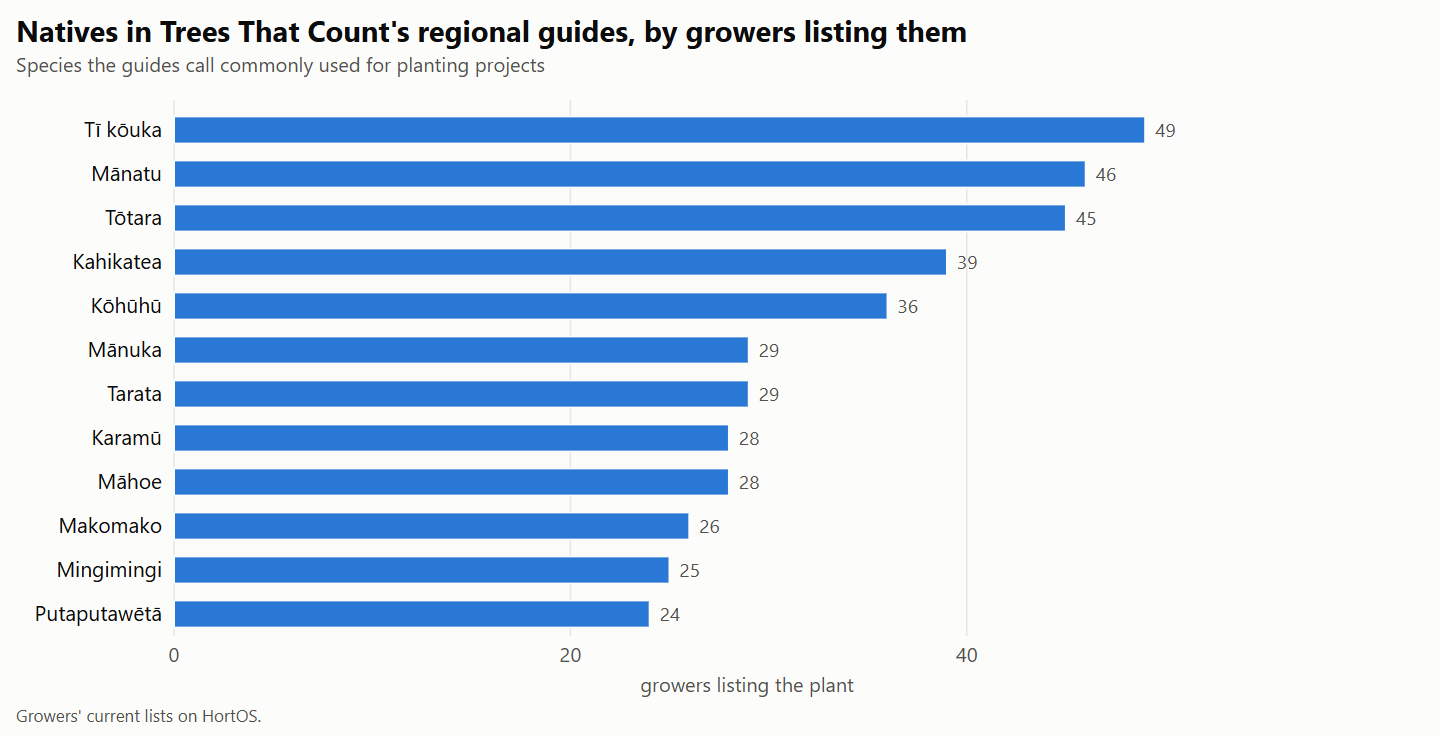
A dated map of who funds native planting in New Zealand, as read on 5 October 2026: Trees That Count's tree requests, regional council riparian and erosion grants, the Hill Country Erosion Programme and the forest land rules of the Emissions Trading Scheme, with how many growers list the species Trees That Count's regional guides call commonly used.