Native shelter belts for New Zealand farms and lifestyle blocks
A shelter belt works best when some wind passes through it. This page sets out what a 2011 New Zealand Farm Forestry Association article says about density, length, spacing and direction, which native species a 2009 farm account and a 2023 national guide name for shelter, and how many growers list each species on HortOS.
Updated 10 September 2026. Grower counts are what the live nz.hortosapp.com plant pages printed; medians are not published for most New Zealand plants yet.
On this page
A sheep farmer on an exposed terrace, or the owner of a lifestyle block whose back paddock catches every southerly, asks the same thing: which native trees make a working shelter belt, and who grows them nearby. A shelter belt works best when some of the wind passes through it, and a belt that cannot be seen through is too dense, according to a 2011 article published by the New Zealand Farm Forestry Association.
This page draws on that article, which Hawke's Bay Regional Council wrote, and on a Southland farmer's 2009 account of native shelter in the same association's journal. Its third source is The Right Tree for Your Place, a national shelter planting guide of 2023. Beside their words on layout and species it sets grower counts from HortOS, a free directory of New Zealand wholesale plant growers with their published availability and trade prices. It reports what those sources say and is not a planting plan for any one property.
Quick facts
| How dense | The best shelter comes from a belt with 40 to 60 per cent porosity, says the Hawke's Bay Regional Council article published by the New Zealand Farm Forestry Association in 2011. |
|---|---|
| How far it reaches | A medium density belt cuts wind speed by up to 50 per cent across the 8 to 10 tree heights behind it, and gives some shelter as far as 20 tree heights away (New Zealand Farm Forestry Association, 2011). |
| How long | A belt's length is 12 times the height of its trees at the least, and 24 times for preference (New Zealand Farm Forestry Association, 2011). |
| How close | Trees in a single row stand two to three metres apart, so that no draught gets through at ground level (New Zealand Farm Forestry Association, 2011). |
| How tall | The Right Tree for Your Place, a New Zealand shelter planting guide of 2023, sorts its species into shelter of 8 metres and over and shelter of 4 to 8 metres. |
| How soon | A Southland farmer writing in New Zealand Tree Grower in 2009 reports effective native shelter in five years where competing growth was kept down. |
How the sources lay out a belt
The New Zealand Farm Forestry Association's 2011 article starts from purpose: farm shelter is there mainly to keep wind off livestock, pasture and crops. A solid wall of foliage is not the aim. The article puts the best result at 40 to 60 per cent porosity, and its field test is the eye: if nothing can be seen through the belt, it is too dense.
Height decides how much ground is sheltered, the same 2011 article says, and a tall narrow belt does more than a wide one. Length matters too. The article asks for a belt at least 12 times as long as its trees are tall, and preferably 24 times. It also wants foliage kept right to the ground, so that wind does not funnel underneath.
On spacing, the 2011 article gives two to three metres between trees in a single row. A double row uses the same two to three metres between the rows and within them, with the rows offset. Triple rows are for very exposed sites. Low or slow growing evergreens keep their branches to the ground and give animals low shelter in winter, the article says.
Direction is the last choice. Where keeping shade to a minimum matters, the article says to run belts north to south. It also warns that a belt set more than 40 degrees off the prevailing wind can make the wind worse.
Native shelter species and the growers listing them
The Right Tree for Your Place, the national guide of 2023, says native plants shelter best when they go in as mixed species groups. It sorts its shelter species by the height they reach: 8 metres and over, and 4 to 8 metres. It describes kāpuka, or broadleaf, as first-rate shelter that can also be kept as a hedge. The guide adds that its species are for reference, and it points the reader to the regional council or to local nurseries.
The Southland account of 2009 is one farmer's record and not a recommendation by the association that printed it. He lists the natives in his belts by group: olearia, coprosma, hebe, pittosporum, broadleaf, toetoe, cabbage tree and red tussock. He names several olearias by species, among them akiraho, which his parents planted as a hedgerow, and he reports working shelter in five years where competing growth was kept down. He also reports a few problems in the 1996 freeze, by which time the farm had begun to use species new to its area.
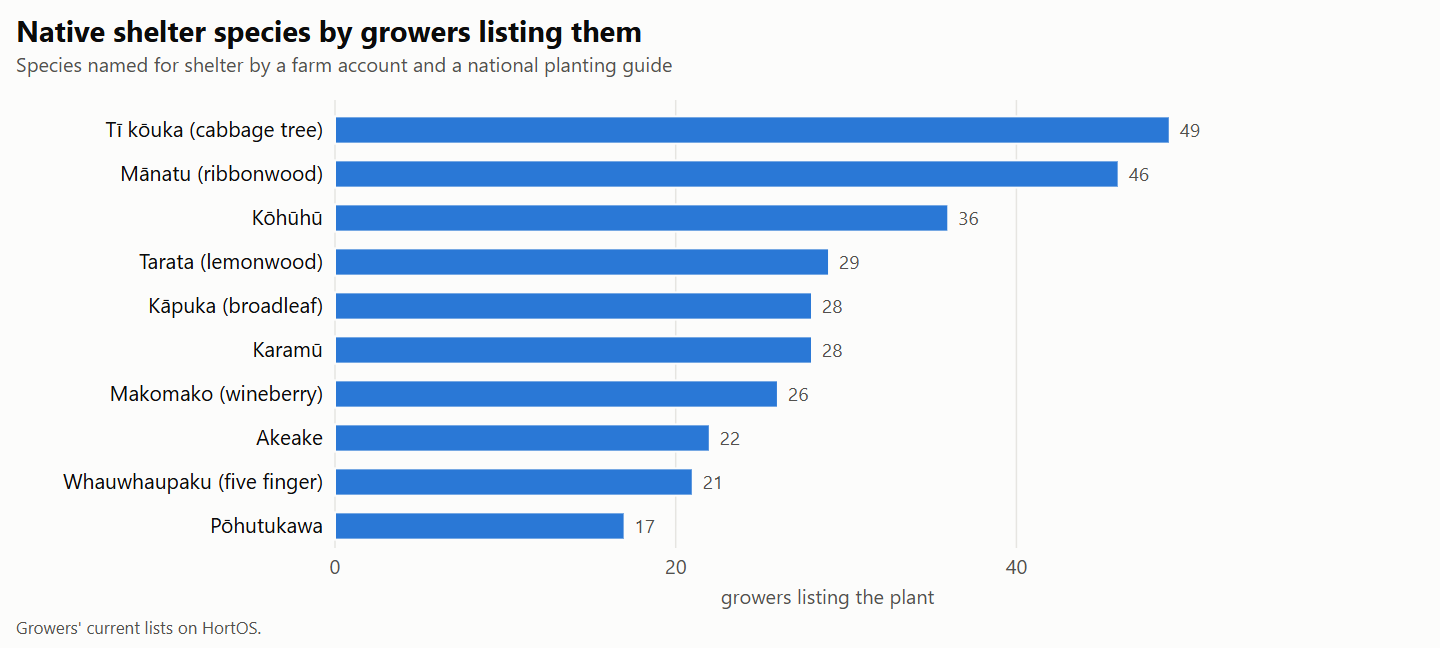
The table shows 16 of the native species that the 2009 account or the 2023 guide names for shelter and that have a plant page on HortOS, ordered by the growers listing them. Grower counts are the growers listing each plant on HortOS, in any size. A count here is growers listing the plant, not how many plants exist or how well it suits a site.
| Plant | Growers listing it | Regions with most growers |
|---|---|---|
| Tī kōuka (cabbage tree) (Cordyline australis) | 49 | Waikato 7, Auckland 7, Northland 7 |
| Mānatu (ribbonwood) (Plagianthus regius) | 46 | Northland 7, Waikato 6 |
| Kōhūhū (Pittosporum tenuifolium) | 36 | Auckland 5 |
| Tarata (lemonwood) (Pittosporum eugenioides) | 29 | Waikato 6, Auckland 5 |
| Kāpuka (broadleaf) (Griselinia littoralis) | 28 | Tasman 4, Canterbury 4 |
| Karamū (Coprosma robusta) | 28 | Waikato 5, Northland 5 |
| Makomako (wineberry) (Aristotelia serrata) | 26 | Northland 4 |
| Akeake (Dodonaea viscosa) | 22 | Northland 4 |
| Whauwhaupaku (five finger) (Pseudopanax arboreus) | 21 | Northland 4, Canterbury 4 |
| Pōhutukawa (Metrosideros excelsa) | 17 | 4 regions with 3 each |
| Māpou (red matipo) (Myrsine australis) | 17 | Northland 3, Auckland 3 |
| Akiraho (Olearia paniculata) | 12 | Canterbury 3, Northland 2, Manawatū-Whanganui 2 |
| Red beech (Fuscospora fusca) | 11 | Canterbury 3 |
| Coastal tree daisy (Olearia solandri) | 8 | Hawke's Bay 2, Northland 2 |
| Chatham Island akeake (Olearia traversii) | 6 | Tasman 3 |
| Twiggy tree daisy (Olearia dartonii) | 5 | Wellington 2 |
The last column names the regions with the most growers listing each plant, three at most, and stops where regions tie for the next place.
The spread is wide. Mānatu, or ribbonwood, is listed by 46 growers and tī kōuka by 49, while the Chatham Island akeake is listed by 6. Kōhūhū stands at 36 growers and tarata at 29. The growers of each region are on its hub page, among them Northland, Auckland, Waikato, Tasman, Canterbury and Otago. Across the country the directory lists more than 1,100 growers that sell plants to the trade.
What the counts leave unsaid
A count says that a grower lists a species. It does not say how many plants that grower has, in which grade, or whether they will be ready for a winter planting. Median trade prices are not published for most New Zealand plants yet. Each grower's own page and list carry the sizes and prices that grower has published.
The directory does not show where a grower collected seed. Whether a line was raised from local seed, and how it has fared in frost or coastal wind, is a question for the grower. The Southland farmer's 2009 account shows why a planter might ask: his few problems in the 1996 freeze came after the farm began to use species new to its area.
Nor does a count match a species to a site. The 2023 guide gives height classes for the whole country and suggests speaking with the regional council or local nurseries about which trees suit an area. The table does not say whether a species listed by many northern growers suits an inland southern farm.
A lifestyle block owner with no trade account can read how growers deal with smaller buyers in the guide to buying from a wholesale grower, since a long belt is an order in quantity. The guide to nursery industry statistics gives the wider picture of where New Zealand's growers are, which helps when a species has few growers close to home.
What to watch for
- Planting for a solid wall. The New Zealand Farm Forestry Association's 2011 article treats a belt that cannot be seen through as too dense.
- A belt that is too short. The same 2011 article sets length against height, at 12 times the height of the trees as the least, so a short row beside a yard falls outside its figures.
- Bare trunks at the base. The 2011 article wants shelter kept down to ground level, so that wind does not funnel under the trees.
- Species new to the district. The Southland farmer's 2009 account reports a few problems in the 1996 freeze, after the farm had begun to use species new to its area.
- Reading a count as a quantity. A species listed by many growers may still be short in the grade and number a long belt needs in one season.
Getting it right
- Walk the line and note the prevailing wind, then set the belt's direction against what the 2011 article says about angle and shade. The landowner decides this.
- Ask the district council and the regional council what they require for planting along boundaries and beside public roads. The 2011 article sends planters to both.
- Where the line runs near power lines or pylons, ask the network company what clearances it requires. The 2011 article sends planters to the company for them.
- Ask the regional council or a local nursery which of the listed species suit the site, as the 2023 guide suggests. The guide says natives shelter best in mixed species groups.
- Ask each grower where its seed came from, which grades it will have by planting time, and how far ahead it wants the order. The grower answers for its own list.
A word of caution
The layout figures here come from a Hawke's Bay Regional Council article that the New Zealand Farm Forestry Association published in 2011, and the Southland account of 2009 is one farm's experience in one climate. The Right Tree for Your Place says its species are for reference. The 2011 article sends planters to the district and regional councils for their requirements on boundary and roadside planting, and to the network company for the clearances required near power lines. A grower answers for its own plants.
Sources
- New Zealand Farm Forestry Association, Shelter design, what is best for your land (New Zealand Tree Grower, May 2011, by Hawke's Bay Regional Council): shelter belt layout and density.
- New Zealand Farm Forestry Association, Indigenous shelter planting (New Zealand Tree Grower, February 2009): native shelter on a Southland farm.
- The Right Tree for Your Place, a shelter planting guide (October 2023): native shelter species by height.
More guides

Buying From a Wholesale Grower When You Are Not in the Trade
Catchment groups, schools, trusts and landowners can buy from New Zealand wholesale growers when they order like the trade: in quantity, a season ahead, on the grower's terms. This page explains who sells to whom, what an NZBN and GST change, grades from root trainers to PB bags, eco-sourcing and proof of it, lead times and Plant Pass.
Nursery Industry Statistics 2026, and How to Cite HortOS
The two kinds of nursery industry number, the official count and the live supply picture, for New Zealand: the Stats NZ enterprise series, the industry body's members, growers listed on HortOS by region and town, the natives listed by the most growers, why no medians exist yet, and how to cite HortOS and the Index.
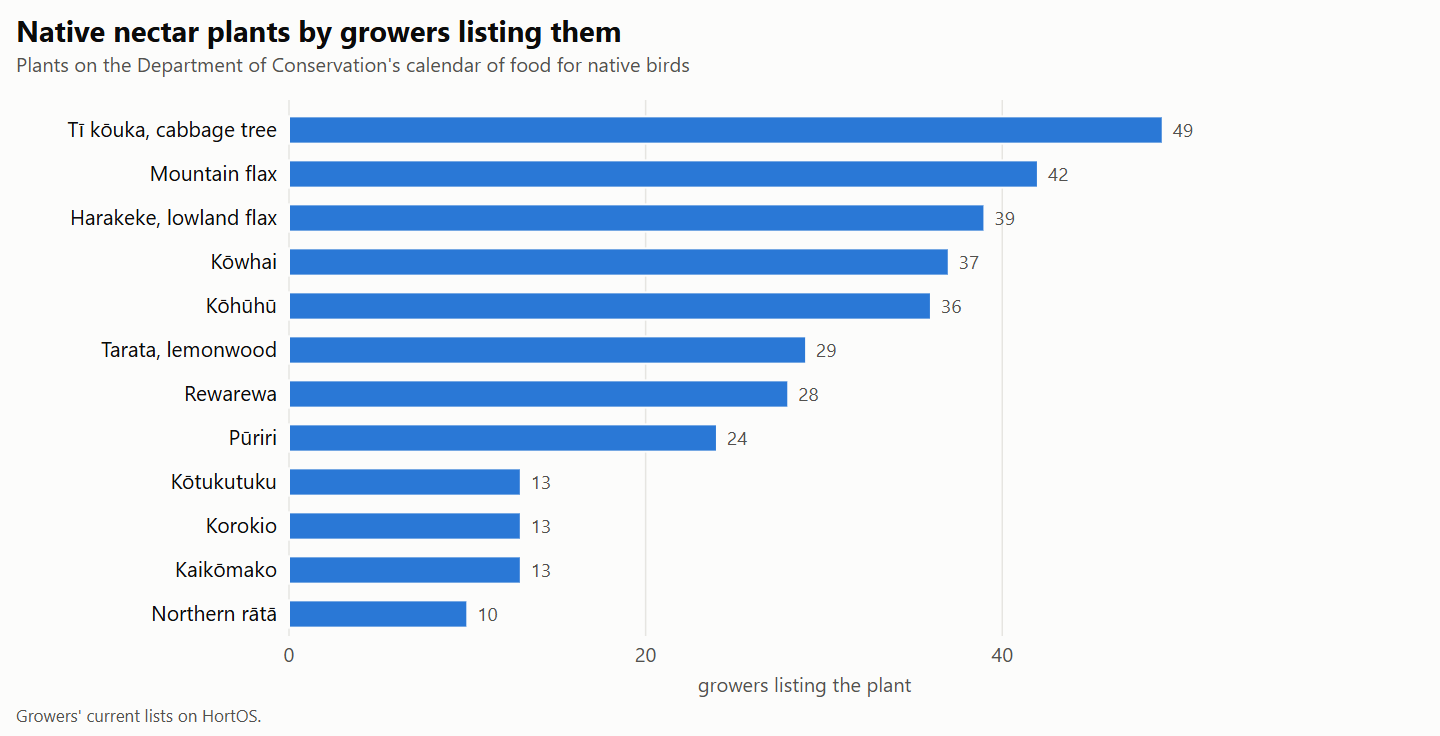
Native plants that feed tūī, kererū and korimako all year
The Department of Conservation's month by month calendar of native food plants for birds, read for tūī, kererū and korimako and counted to show its full autumn and thin winter, set beside how many New Zealand wholesale growers list the plants shown and in which regions, with what the Department says about eco-sourced plants and cultivars near bush.