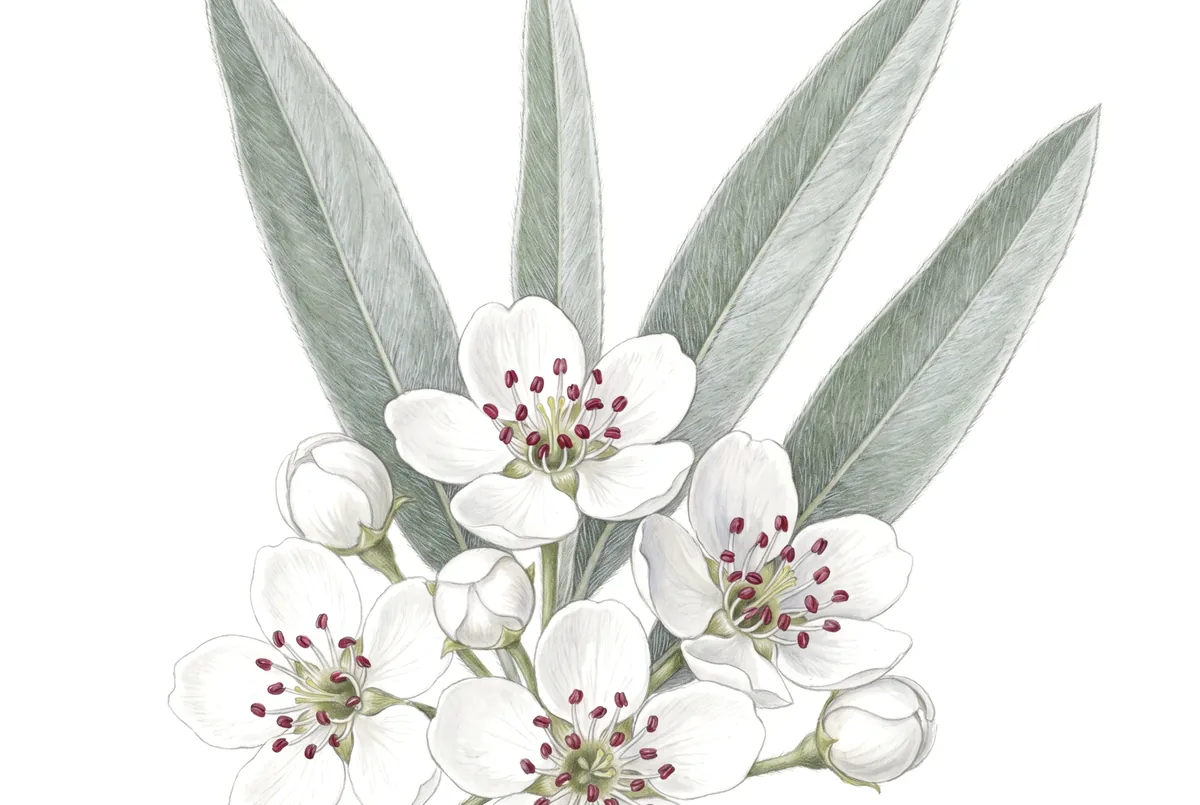
- Type
- Deciduous tree
- Height
- 4 m to 10 m
- Spread
- 3.7 m to 8 m
- Flowers
- White, spring
- Sun
- Full sun
- In New Zealand
- Not native
Growing silver pear
Climate. No New Zealand reference read gives its hardiness or says where in the country it does best. HortFlora, the horticultural flora of south-eastern Australia, says it grows best in cooler areas, and the Missouri Botanical Garden that it prefers cool summer climates. The RHS, a British reference, rates it H6, hardy in all of Britain and northern Europe.
Sun and soil. The RHS and Missouri give full sun, and Missouri adds that it tolerates some light shade; the RHS gives a sheltered spot. The RHS lists clay, loam or sand, acid, neutral or alkaline, well drained or moist but well drained. Missouri asks for an average, moderately fertile, well-drained soil of medium moisture, calls it adaptable to many soils including heavy clay, and says established trees tolerate some drought.
Pruning and propagation. HortFlora says it may be pruned to form a low clump, and the RHS puts it in pruning group 1. The RHS raises it from seed sown in autumn, by chip budding in late summer or by grafting in winter.
Pests and diseases. These are the overseas references' reports. The RHS lists aphids, caterpillars, codling moth and pear blister mite among its pests, and fireblight, blossom wilt, brown rot and pear scab among its diseases. Missouri calls fireblight a major problem where summers are warm and humid, and adds anthracnose, canker and powdery mildew.
Using silver pear
Trees and Shrubs Online (International Dendrology Society) calls it the most ornamental of all the pears, and the Missouri Botanical Garden suggests it for a group or as a specimen, for its early flowers, silvery foliage and form. South Australia's Plant Selector, writing of the weeping form 'Pendula', gives it a place as a feature in a garden or as a screen along a boundary, and lists it for shade; that form has its own page, silver weeping pear.
No reference read gives a planting distance for a row or a group. For a street or park order, the guide to specifying and procuring trees sets out what goes in the clause and how the trees are inspected.
What to check before you buy
Read the name on the line. Growers list the species and its weeping form 'Pendula' under several names, among them weeping silver pear and weeping silver flowering pear. HortFlora notes that the natural species also has weeping branches, so a weeping tree is not proof of the cultivar: check which form a grower lists before comparing prices. The table above shows the sizes growers list, and the guide to plant grades and container sizes sets out the New Zealand ladder from root trainers and PB bags to litre grades. What to check in the roots, the stem and the canopy before stock leaves the grower is in the guide to nursery plant quality.
Cautions
Thorns. HortFlora says the short shoots often end in a thorn, and the Missouri Botanical Garden that the twigs are often thorny. Under its potentially harmful heading, the RHS advises gloves and other protective equipment when handling it.
Used forspecimen
Prices are set by each grower and shown ex GST. Availability is confirmed by the grower at order.
Common questions
- What is the difference between silver pear and silver weeping pear?
- Silver weeping pear is the cultivar 'Pendula'. Trees and Shrubs Online says the species is mainly represented in cultivation by 'Pendula', a tree with its branches more drooping than ordinary, while noting that in the type they are more or less pendulous too. HortFlora calls 'Pendula' the form known to horticulture as weeping.
- How big does silver pear grow?
- HortFlora gives a tree 5 to 10 m tall, the RHS 4 to 8 m high and wide, and the Missouri Botanical Garden a height inside that range and a spread from 3.7 m. South Australia's Plant Selector gives the weeping form 'Pendula' 4 to 7 m high and 4 to 6 m wide. No New Zealand reference read gives a figure.
- Can you eat silver pear fruit?
- No. HortFlora calls the fruit small, hard, yellowish, sour and unpalatable, 2 to 3 cm long; Trees and Shrubs Online calls it harsh to the palate and of no value; and the RHS says the fruit are ornamental, not to be eaten.
- Why are the leaves silver?
- They open covered in silvery hairs. HortFlora says the sheen is gradually lost as the hairs are shed through the growing season, and Trees and Shrubs Online that after flowering the leaves stay silvery for some weeks before the upper surface turns a shining green.
- Is silver pear native to New Zealand?
- No. Biota of New Zealand, from Manaaki Whenua Landcare Research, gives its biostatus here as exotic and cultivated, and records the weeping form 'Pendula' in cultivation too, with one databased collection record of that form from the Nelson Land District.
Sources
- GBIF species match API: Pyrus salicifolia
- Plant Selector+ (Botanic Gardens and State Herbarium of South Australia): Pyrus salicifolia 'Pendula', the weeping form
- Flora of China (eFloras): the genus Pyrus
- Royal Horticultural Society plant profile: Pyrus salicifolia
- Missouri Botanical Garden Plant Finder: Pyrus salicifolia
- Biota of New Zealand (Manaaki Whenua Landcare Research): Pyrus salicifolia
- Biota of New Zealand (Manaaki Whenua Landcare Research): Pyrus salicifolia 'Pendula'
- Trees and Shrubs Online (International Dendrology Society): Pyrus salicifolia
- HortFlora, the Horticultural Flora of South-eastern Australia (Royal Botanic Gardens Victoria): Pyrus salicifolia, with its cultivar 'Pendula'
- The HortOS catalogue
- The HortOS guides (specifying and procuring trees; plant grades and container sizes by market; judging nursery plant quality)
The growers, sizes and prices above are live and change as lists arrive. Cite this page: HortOS, Silver pear (Pyrus salicifolia), https://nz.hortosapp.com/plants/pyrus-salicifolia.
Found a fact that is wrong? Tell us and it is checked against its source.